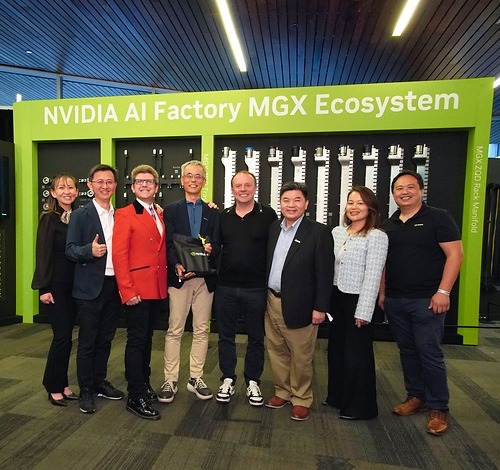
The race to build more powerful AI supercomputers is forcing a fundamental redesign of the electrical infrastructure that feeds them. At the Open Compute Project (OCP) Global Summit 2026, Delta Electronics is showcasing an increasingly comprehensive portfolio of high-voltage direct-current power delivery and liquid-cooling systems designed for the next generation of NVIDIA-based AI infrastructure.
The announcement highlights a problem that is becoming harder to ignore as accelerator systems scale toward megawatt-class racks: delivering electricity to the processors efficiently is no longer a peripheral data-center engineering task. It is becoming a central constraint on how much computing capacity operators can deploy within a given footprint, power envelope, and cooling budget.
Delta’s portfolio includes an 800 VDC in-row power rack rated for 660 kilowatts, a 90 kW DC/DC power shelf, a solid-state transformer designed to convert medium-voltage AC directly to 800 VDC, high-current power distribution hardware and a liquid-to-liquid coolant distribution unit rated for up to 2.5 megawatts of cooling capacity. The company says these systems are intended to support NVIDIA Vera Rubin NVL72 platforms and other systems built around NVIDIA’s MGX modular server architecture.
The engineering direction is significant. The commercial implications, however, remain less certain: Delta’s latest announcement is primarily a showcase of an existing product portfolio, not evidence of a new NVIDIA contract, a confirmed customer deployment, or independently verified data-center efficiency gains.
Why AI supercomputers are outgrowing conventional power delivery
The underlying challenge is electrical distribution at extreme power densities.
As AI infrastructure evolves from racks consuming tens of kilowatts toward configurations drawing hundreds of kilowatts and eventually approaching a megawatt, traditional power-delivery architectures become increasingly difficult to scale. More current must travel through conductors, more conversion equipment occupies valuable rack space, and electrical losses generate additional heat that cooling systems must remove.
At a given power level, increasing distribution voltage reduces the current required to deliver that power. For a simplified DC system, the relationship is:
[ P=VI ]
where (P) is electrical power, (V) is voltage, and (I) is current.
Delivering 1 megawatt at 54 volts requires approximately 18,519 amperes. At 800 volts, the same power requires approximately 1,250 amperes. These figures assume idealized DC delivery at the stated voltage and exclude conversion losses and differences in the electrical distribution topology.
That is a substantial reduction in current. Because resistive losses in a conductor scale with the square of current, increasing voltage can dramatically reduce distribution losses when conductor resistance and delivered power are held constant.
The benefits extend beyond electrical efficiency. Higher-voltage distribution can reduce conductor cross-sections, simplify buswork, and free space otherwise occupied by power equipment. In a densely packed AI rack, that space can be valuable for accelerators, memory, networking and cooling hardware.
But higher voltage does not eliminate engineering complexity. It shifts the challenge toward insulation, protection, conversion electronics, connectors, fault isolation, and safe maintenance. The practical benefits depend on the complete electrical design rather than voltage alone.
Delta’s grid-to-rack strategy
Delta is positioning itself to supply more than individual power components. Its portfolio spans several stages of the infrastructure between the incoming electrical supply and the computing hardware.
The company's 800 VDC in-row power rack is rated for 660 kW of output and incorporates 480 kW of battery backup capacity. Delta also lists a compact 800 kW variant without an integrated battery backup unit. The rack-level system is designed to consolidate power conversion and backup functions around high-density AI infrastructure.
A separate 90 kW DC/DC power shelf converts 800 VDC to a lower-voltage distribution rail. Delta’s announcement describes a 50 V output, while its broader product materials also discuss a 54 V implementation. Those output configurations should not be treated as interchangeable without confirming the specifications of the particular product and system design.
The distinction matters because the power architecture must accommodate the requirements of the rack, intermediate conversion stages, and the final voltage-regulation circuitry serving individual processors.
Delta is also presenting a solid-state transformer intended to convert medium-voltage AC directly to 800 VDC. Conventional architectures often involve multiple conversion stages between the utility supply and the computing load. Integrating conversion functions could reduce equipment footprint and losses, although actual performance will depend on operating conditions and the implementation.
The company's high-voltage DC power-distribution board and a 5,000-ampere liquid-cooled busbar extend the design into the distribution system itself. The busbar is intended for third-generation NVIDIA MGX racks, where high-current delivery and thermal management increasingly intersect.
Taken together, these components represent an attempt to engineer the power path as a coordinated system rather than a collection of independently optimized products.
That systems-level approach is increasingly important in AI infrastructure. Improving one power shelf's efficiency has limited value if losses elsewhere in the facility, inadequate protection, or cooling constraints prevent the entire installation from operating at its intended capacity.
Megawatt-class cooling becomes part of the electrical equation
Electrical distribution is only half the challenge. Nearly all the power consumed by computing hardware ultimately becomes heat that must be removed.
Delta's 800 VDC liquid-to-liquid coolant distribution unit is rated for up to 2.5 MW of cooling capacity, placing it in the same broad capacity class as competing systems being presented at the summit. The company is also highlighting cold-plate technology for NVIDIA Vera Rubin NVL72 systems.
Liquid cooling allows heat to be captured close to the processors and transferred into a circulating coolant loop. A coolant distribution unit manages the interface between the facility's cooling infrastructure and the equipment-side liquid circuit, helping control flow, pressure and heat transfer.
At these power levels, cooling is not simply a matter of installing larger pumps. Operators must account for flow distribution, coolant chemistry, filtration, pressure drop, leak detection, redundancy and the consequences of component failure. The facility's ability to reject heat also places demands on chillers, heat exchangers, water systems or other heat-rejection equipment.
Power and cooling must therefore be engineered together. A rack that can receive hundreds of kilowatts electrically is not useful if its thermal infrastructure cannot continuously remove the corresponding heat.
The same principle applies to energy efficiency. Higher electrical conversion efficiency can reduce wasted energy, but total facility performance depends on the entire system, including cooling power, pumps, fans, power distribution and the computing workload itself.
The 800 VDC transition is not yet a single settled standard
The industry's move toward higher-voltage DC distribution is gaining momentum, but describing 800 VDC as one universally established standard would be premature.
Delta's products use a two-wire 800 VDC architecture. The Open Compute Project's Diablo 400 specification, developed with participation from Google, Meta, and Microsoft, uses a three-wire arrangement with positive and negative 400-volt rails, producing 800 volts between the outer rails.
Both approaches address the challenge of distributing power to high-density computing systems, but their electrical arrangements are not identical. Compatibility depends on the relevant specifications, equipment interfaces, and system design.
Safety and protection also require attention. High-voltage DC systems present demanding arc-interruption and fault-management challenges. The industry must establish and implement suitable protection practices, equipment standards and installation requirements as deployments expand.
For data-center operators, the question is not simply whether 800 VDC can deliver power more efficiently. It is whether equipment from different vendors can work together reliably, whether operators can maintain it safely, and whether the architecture can be supported at commercial scale.
Those questions are especially important for facilities expected to operate continuously under variable AI workloads.
NVIDIA's projected gains need to be treated as targets
The broader NVIDIA 800 VDC architecture has been associated with projections of 45% less copper, up to 5% better end-to-end power efficiency, and up to 70% lower maintenance requirements.
These figures are projections for the planned architecture, not measured results from a production AI data center. They should not be interpreted as demonstrated savings from Delta's newly showcased hardware.
Delta's own component specifications also require context. Its power systems advertise peak conversion efficiencies reaching approximately 98% or more, depending on the component and configuration. Those figures are vendor specifications, with the relevant operating points and test conditions not fully disclosed in the announcement.
Peak efficiency is useful for comparing technology under defined conditions, but it does not describe performance across an entire facility. Power conversion equipment can behave differently at partial load, during rapid changes in demand, and under varying temperatures.
For AI systems, the operating profile matters. Training and inference workloads can create changing power demands, and infrastructure must maintain stability while responding to those variations.
A credible evaluation would require measured efficiency curves, thermal performance, reliability data, and end-to-end results under representative operating conditions. Ideally, those measurements would cover the complete path from incoming power to the computing load.
Without such evidence, the announced numbers remain engineering targets and product specifications rather than proof of operational savings.
Delta faces a crowded race to supply the next AI infrastructure generation
Delta is not the only company preparing hardware for the transition.
Lite-On is presenting competing high-voltage power-conversion and liquid-cooling products. Navitas is targeting power-conversion components for NVIDIA MGX systems, while Vertiv, Eaton and Schneider Electric are developing or promoting their own approaches to high-voltage distribution and next-generation AI infrastructure.
The competitive landscape reflects a broader change in the AI hardware market. As accelerator performance increases, differentiation increasingly depends on everything surrounding the processor: power conversion, thermal management, networking, mechanical design, and the ability to deploy complete systems at scale.
Delta's potential advantage is breadth. Its portfolio extends from solid-state transformers and power distribution to rack-level power systems, cooling equipment and microgrid solutions. That could simplify integration for customers seeking a coordinated infrastructure design.
Yet a broad product portfolio does not automatically establish market leadership. Customers will also evaluate delivery schedules, manufacturing capacity, field reliability, service support, interoperability, and total cost of ownership.
The critical milestone is not how many components a company can display at a conference. It is how many can be delivered, integrated, qualified, and operated successfully in production environments.
The real deadline is commercial deployment
The timing of the 800 VDC transition is closely linked to the next generation of high-density AI systems, including NVIDIA's planned Kyber-era infrastructure for 2027. The architecture is intended to support racks whose power demands exceed what conventional rack-level distribution can accommodate economically.
That creates a race for suppliers. Power systems, connectors, busbars, protection equipment and liquid-cooling infrastructure must mature alongside the computing platforms they are intended to support.
For operators planning new AI facilities, the decision will involve more than purchasing compatible racks. They must consider electrical distribution from the facility perimeter, backup power, cooling capacity, physical layout, maintenance procedures, and future expansion.
Retrofitting existing data centers introduces additional complications. An architecture that makes sense for a purpose-built AI factory may not be economically justified for a conventional enterprise facility with lower rack densities or a different workload mix.
The transition is therefore likely to be driven first by AI-dense deployments where the space and efficiency benefits are most valuable, rather than by a wholesale conversion of every data center.
Delta's announcement does not identify new customer deployments, contracted volumes or a confirmed production installation resulting from the latest showcase. Those omissions limit what can be concluded about commercial adoption.
A meaningful engineering shift, not yet a proven infrastructure breakthrough
Delta's presentation at the OCP Global Summit underscores how the escalating performance demands of the AI industry are necessitating a fundamental redesign of electrical and thermal infrastructure.
The industry's shift toward 800 VDC architectures offers the potential to reduce current requirements, minimize copper usage, and streamline conversion complexity, thereby optimizing space for high-density computing components. By integrating power delivery with megawatt-class liquid cooling, operators may be better positioned to design facilities tailored to the specific requirements of next-generation accelerators, moving beyond the limitations of conventional infrastructure.
However, the success of this transition relies on more than just promising technical specifications. It will require the maturation of competing electrical architectures, the standardization of safety and maintenance protocols, and rigorous, real-world validation of performance under diverse, high-load workloads.
While Delta has introduced a robust portfolio addressing critical infrastructure challenges, the industry has yet to reach a definitive consensus on a single implementation, nor have the projected efficiencies been fully realized in production environments. Moving forward, the true viability of these advancements will be determined by deployment milestones, customer adoption, interoperability benchmarks, and transparent, independently verified performance data. Ultimately, the next evolution of AI supercomputing hinges as much on the capacity to safely and efficiently manage massive power and thermal loads as it does on the speed of the processors themselves.