

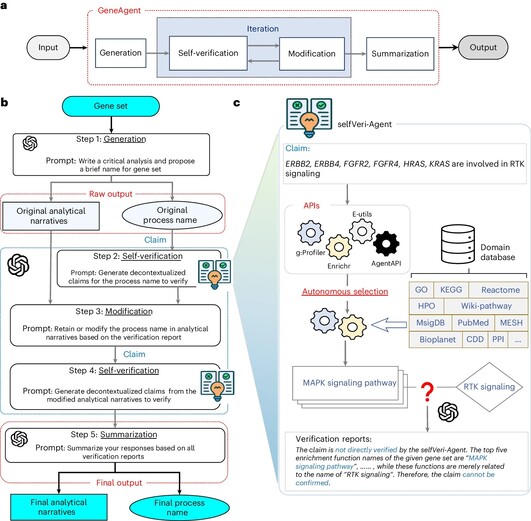
Researchers at the National Institutes of Health (NIH) have created an artificial intelligence (AI) agent called GeneAgent that enhances the accuracy and informativeness of gene set analysis. This AI is powered by a large language model (LLM) and improves upon existing systems by providing more accurate and detailed descriptions of biological processes and their functions.
GeneAgent cross-checks its initial predictions, also known as claims, for accuracy against information stored in established, expert-curated databases. It then generates a verification report that details its successes and failures. This AI agent aids researchers in interpreting high-throughput molecular data and identifying relevant biological pathways or functional modules, which can deepen our understanding of how various diseases and conditions impact groups of genes both individually and collectively.
While AI-generated content is produced by LLMs trained on vast amounts of text data from the internet, these models are not designed to verify facts. As a result, AI-generated content can sometimes be false, misleading, or fabricated—a phenomenon known as AI hallucination. LLMs can also exhibit circular reasoning, whereby they fact-check their outputs against their data, which can increase confidence in incorrect information.
Addressing AI hallucinations is crucial when using LLM tools for gene set analysis, which involves generating collective functional descriptions of grouped genes and their potential interactions. Previous studies utilizing LLMs to answer genomic questions or summarize biological processes did not adequately address the issue of hallucinations in generated content.
GeneAgent tackles this challenge by independently comparing its claims against established knowledge in external expert-curated databases. The research team initially tested GeneAgent on 1,106 gene sets sourced from existing databases that had known functions and process names. For each gene set, GeneAgent first generated an initial list of functional claims. It then used its self-verification module to cross-check these claims against the curated databases and produced a verification report indicating whether each claim was supported, partially supported, or refuted.
To evaluate the accuracy of its self-verification process, the researchers enlisted two human experts to manually review 10 randomly selected gene sets, comprising a total of 132 claims. The experts assessed whether GeneAgent's self-verification reports were correct, partially correct, or incorrect. Their analysis revealed that 92% of the decisions made by GeneAgent were accurate, demonstrating high performance in self-verification, particularly when compared to GPT-4. The experts confirmed the model's effectiveness in reducing hallucinations and producing more reliable analytical narratives.
The research team also explored real-world applications of GeneAgent using animal-model gene sets. When tested on seven novel gene sets derived from mouse melanoma cell lines, GeneAgent provided valuable insights into the functions of specific genes, potentially leading to the discovery of new drug targets for diseases such as cancer.
While LLMs like GeneAgent are still constrained by the information they can access and their inability to reason like humans, GeneAgent's self-driven fact-checking capability shows significant promise in addressing AI hallucinations.