

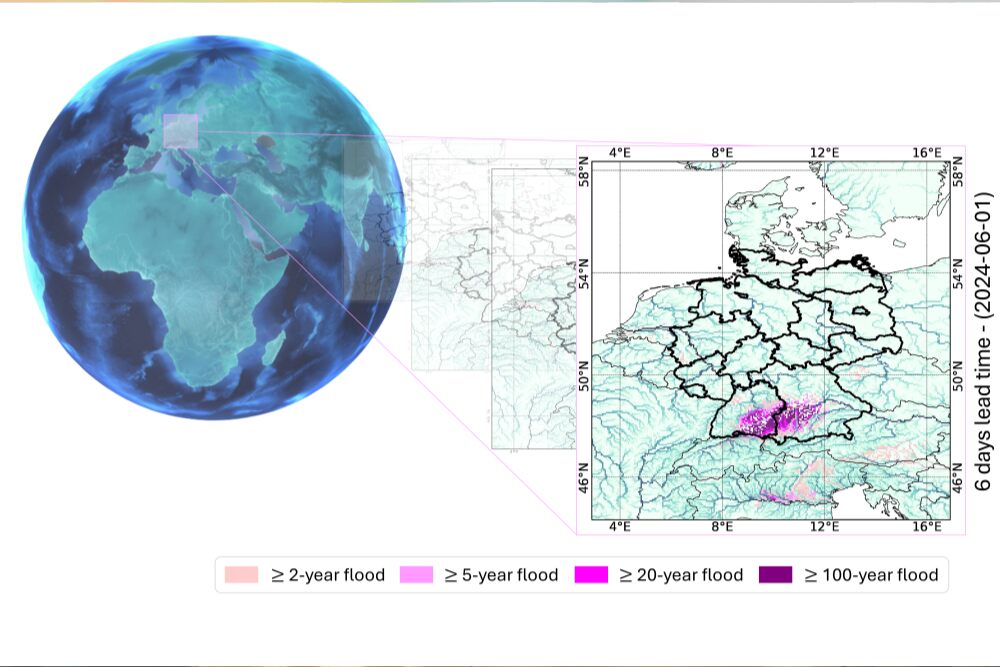
Key technical features include:
- The utilization of "Mamba blocks" (bidirectional state-space modules) to model the spatio-temporal routing of rivers and meteorological forcing.
- Integration of long-term reanalysis data (e.g., ERA5-Land), static river attributes, and meteorological forecasts (ECMWF HRES) to inform predictions.
- The developers assert that RiverMamba "surpasses both operational AI- and physics-based models" in forecasting accuracy for extreme events.
- Lead-time extension: Up to seven days provides emergency planners with increased preparedness time.
- Granular spatial resolution: The 0.05° grid enables finer discrimination of catchments.
- Extreme flood modeling: Enables the analysis of rare, high-impact events, rather than just "typical" flows.
- Scalability: A global model allows for potential application beyond major rivers to smaller basins, which are often less well-monitored.
Supercomputing's Advancement in River Flow Modeling
The underlying technology, supercomputing (i.e., large-scale clusters, high-performance computing, GPU farms), has transitioned from modeling galactic structures to modeling granular elements, such as water molecules in rivers. This shift is significant because: Data volume and velocity necessitate processing terabytes of meteorological, land-surface, and hydrological data to predict floods globally at approximately 5 km resolution with a seven-day lead time, an undertaking that posed challenges for traditional models.
Model complexity
The Mamba blocks in RiverMamba embed spatio-temporal routing, which is computationally intensive. Without supercomputing or GPU acceleration, the model would operate too slowly to be practical for real-time forecasting. Operational resilience: Flood-warning centers in regions like the Midwest require models that run quickly, reliably, and frequently to issue timely alerts, which is facilitated by supercomputing infrastructure.
Democratization risk
However, compute-heavy models necessitate resources (energy, hardware, expertise). If only a few institutions can operate them, the benefits may not reach underserved regions, raising equity concerns. In summary, supercomputing is not merely "big machines doing big math" but rather the new infrastructure supporting Earth-system resilience. For flood forecasting, this infrastructure is finally undergoing the necessary upgrades.