

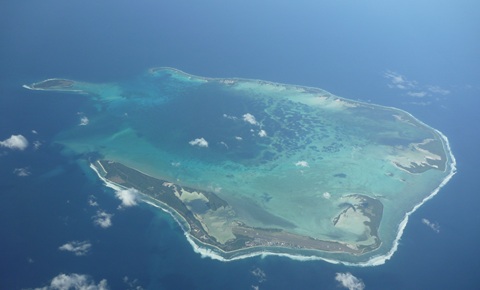
When continents undergo separation, the effects are not limited to the surface. A gradual revolution is occurring beneath our feet, detectable only through the utilization of the world's most advanced supercomputers. Researchers from the UK's University of Southampton and Germany's GFZ Helmholtz Centre for Geosciences have discovered that the Earth's continents are undergoing a "peeling" process from below, thereby triggering volcanic activity across the ocean floor. Their recent study suggests that this deep churning of the planet's mantle may be responsible for many of the volcanic islands scattered across our oceans, including the Indian Ocean's Christmas Island seamounts and the Atlantic's Walvis Ridges.
Peeling Continents, Boiling Oceans
The team's simulations, powered by high-performance computing models, demonstrate that as continents stretch and fracture, their thick roots of ancient rock (the subcontinental lithospheric mantle) are eroded by organized "chains" of convective currents. These instabilities act like conveyor belts, transporting chemically enriched material from deep beneath the continents into the oceanic mantle, where it can later erupt as seafloor volcanoes.
Over tens of millions of years, this subterranean process moves vast amounts of continental material outward, enriching the mantle in patterns that match the timing and chemistry of known oceanic volcanic provinces. “It’s as if the continents shed their skin into the sea,” said lead author Dr. Tom Gernon of Southampton. “We’ve uncovered a missing piece of Earth’s deep recycling system.”
Supercomputing the Deep Earth
To capture this invisible movement, the researchers relied on ASPECT, a powerful geodynamic modeling tool that simulates rock behavior under extreme pressures and temperatures. These thermomechanical simulations, run on supercomputers in the UK and Germany, tracked the flow of molten rock and heat through the mantle over spans exceeding 100 million years.
Such calculations require enormous computational power, similar to that used in climate modeling or astrophysical simulations, because they solve complex equations of energy, mass, and momentum at microscopic scales within a planet-sized domain. The models revealed that continental "peeling" begins within a few million years of tectonic breakup and peaks approximately 50 million years later, a finding that aligns with isotope data from Indian Ocean volcanoes.
These insights wouldn’t have been possible without advances in high-performance computing (HPC). This area has been prominently showcased at recent supercomputing gatherings, such as the COP30-linked climate and Earth system sessions in Brazil. As global attention turns toward planetary resilience, HPC has become a bridge between climate science, energy modeling, and now, deep-Earth geodynamics, allowing researchers to model entire planetary systems in silico.
Rethinking Oceanic Volcanism
Traditionally, scientists attributed oceanic volcanism to deep mantle plumes, columns of hot rock rising from near the Earth’s core. But this new study proposes a more surface-linked mechanism: the long-term “convective erosion” of continental roots. It explains why enriched volcanic rocks often appear along continental margins and even billions of years after the continents split apart.
This finding also has implications for the global carbon cycle, as the peeling and melting of carbon-rich rocks could regulate the release of greenhouse gases from deep within the Earth. It hints at a feedback loop between the planet’s tectonic heartbeat and its atmospheric chemistry, a process both ancient and ongoing.
The New Frontier Beneath Us
The Southampton team's discovery adds a fascinating layer to our understanding of planetary evolution. Beneath the seemingly stable crust, continents are quietly dissolving from below, feeding a slow planetary respiration that shapes the chemistry of oceans, the formation of islands, and perhaps even the stability of climate over eons.
It’s a humbling reminder that the ground beneath us is not still, merely patient. And with the help of supercomputers, we’re finally starting to hear its pulse.