

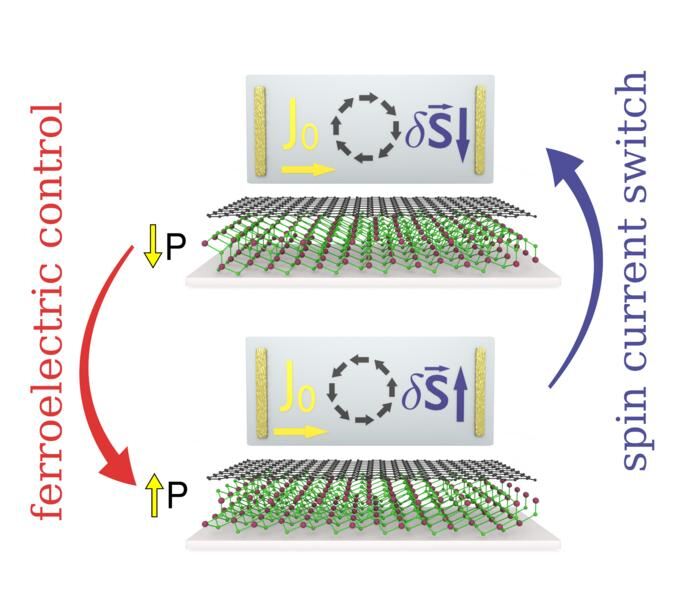
In an European collaboration blending quantum materials science and high-performance computing, researchers have discovered how ferroelectric switching can modulate spin currents in a graphene-based heterostructure, a revelation made possible by supercomputers.
From Charge to Spin: A New Spintronics Platform
The study, "Ferroelectric switching control of spin current in graphene proximitized by In₂Se₃," published in Materials Futures, explores a heterostructure of graphene, a two-dimensional conductor, stacked atop a ferroelectric monolayer of In₂Se₃. The team found that switching the polarization of the In₂Se₃ layer reverses the sign of the charge-to-spin conversion coefficient in the graphene layer, effectively flipping the chirality (spin orientation pattern) of the generated spin current. In one configuration (17.5° twist angle between layers), an unconventional "radial Rashba field" emerged for one polarization direction, a rare phenomenon in planar heterostructures.
Supercomputing: The Hidden Engine
This project would have been impossible without extensive computing power. The researchers combined first-principles calculations (density-functional theory) with tight-binding modelling to capture electronic structure, spin-orbit coupling, ferroelectric polarization effects, and interface proximity influences.
Such simulations involve large Hamiltonian matrices, fine k-space sampling, spin-texture mapping, and multiple twist-angle geometries, tasks that scale poorly without parallel, high-performance systems. By leveraging supercomputing clusters, the team was able to:
- Evaluate both polarization states of the ferroelectric layer.
- Model two twist angles (0° and 17.5°) to identify emergent fields;
- Extract charge-to-spin conversion coefficients and Rashba phase directly from computational data.
These capabilities underline how HPC is no longer just for weather and astrophysics; now it’s central to designing tomorrow’s spintronic devices.
Why It Matters
Modern electronics are approaching the limits of charge-based logic. Spintronics, using the electron’s spin rather than its charge, promises faster, lower-power, non-volatile devices. The challenge: controllably steering spin currents without bulky magnetic fields.
By showing that ferroelectric polarization can electrically flip spin current direction (and spin texture) in graphene, the study opens a pathway to magnet-free, ultra-efficient spin logic devices. In short, you apply a voltage, you flip a spin current, no magnetic coil needed.
A Timely Breakthrough for the HPC World
With the SC25 supercomputing conference opening next week in St. Louis, the research underscores a widening frontier: supercomputers aren’t just solving equations, they’re beginning to decode nature’s design language.
Although the study is not confirmed as an official SC25 presentation, its ideas are likely to circulate in hallway conversations, workshops, and poster sessions, where the fusion of physics, simulation, and computing continues to accelerate innovation.
Looking Ahead
While this work is theoretical (computational), the authors propose that the predicted effects "can be experimentally detected" under realistic conditions. The next step involves device fabrication, nanoscale spin current measurements, and benchmarking against conventional spintronic architectures.
The larger picture is HPC-driven material discovery. As supercomputers become more powerful and accessible, the timeline from concept to device may shorten, leading to a shift towards compute-to-create workflows, rather than the current synthesize-then-hope approach.