

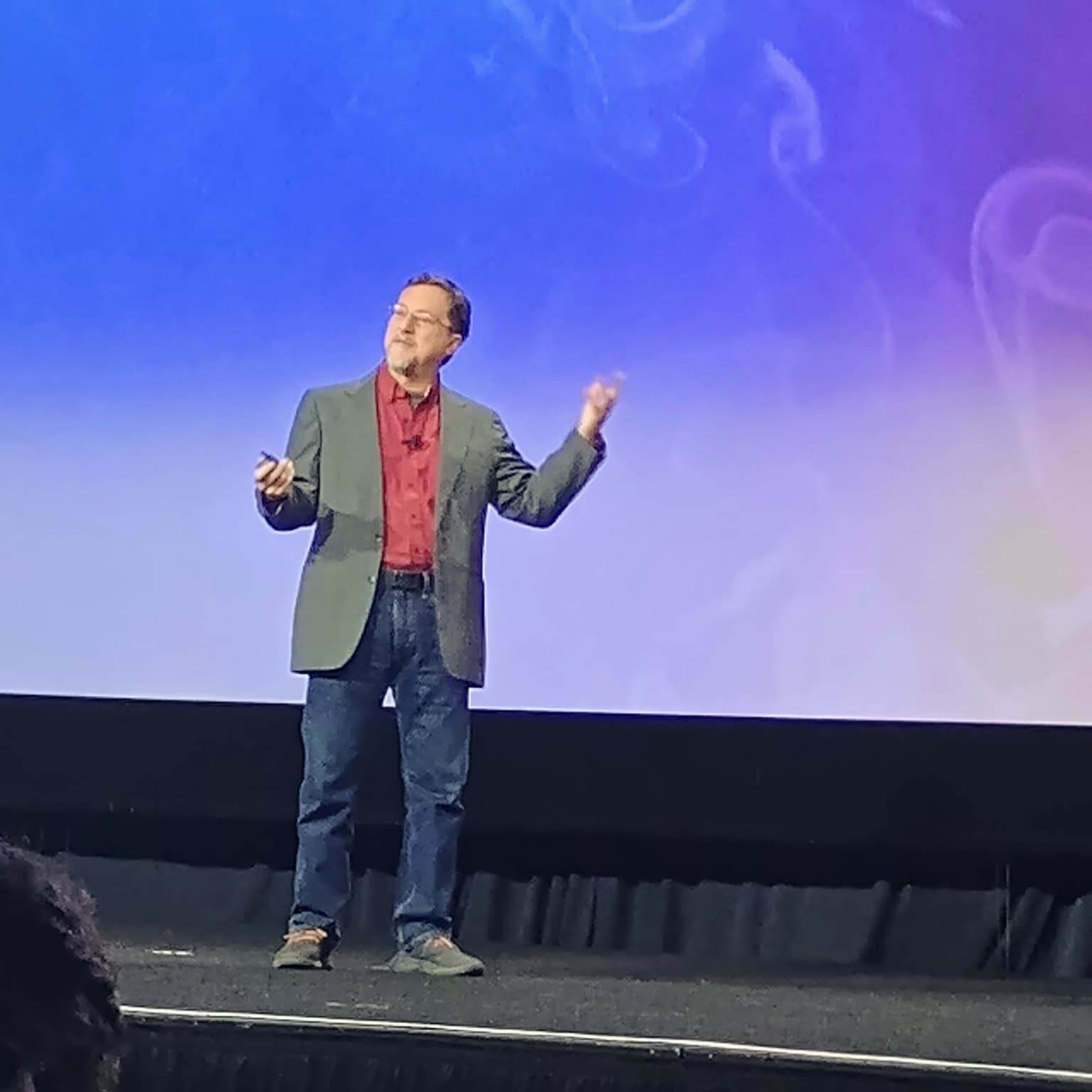
When John Shalf stepped onto the stage for his award presentation at SC25, the atmosphere was charged with the sense of a field at a pivotal moment. His talk, titled "A Retrospective on Science-Driven System Architecture and Grand Challenges for the New Century," traced his professional journey, which reflected the evolution and challenges of modern high-performance computing.
From Early Experiments to Scientific Breakthroughs
Shalf recounted his early days at Virginia Tech, where he was first introduced to reconfigurable computing and DNA sequence comparison, drawing him into the high-performance computing (HPC) ecosystem. This foundation led him to Oak Ridge, where he contributed to materials-prediction codes and experienced the renowned "frog memo." He later transitioned to the National Center for Supercomputing Applications (NCSA), where he worked on some of the most ambitious codes of that era.
He mentioned key projects such as Enzo for cosmology, Cactus for general relativity, and the SC95 initiative, which linked supercomputers across the continent to create a single distributed machine simulating colliding galaxies in real time.
These milestones were not mere footnotes; they represented significant advances leading to one of the greatest scientific achievements of the century: the detection of gravitational waves. Shalf emphasized that the 15-year gap between the prediction and confirmation of these waves was not a delay, but rather a testament to the kind of sustained, disciplined computation that truly defines scientific progress.
Designing for the Workload, Not the Hype
A key theme of Shalf's talk was clear and direct: future systems should be designed around real workloads rather than aspirational benchmarks. He pointed out the development of the Sustained System Performance (SSP) benchmark at Berkeley Lab, which aims to accurately represent system performance instead of flattering it.
This philosophy relies on workload analysis, the use of algorithm/application matrices, and collaboration with applied mathematicians. This transition from focusing on synthetic performance to emphasizing actionable intelligence signifies a significant evolution in high-performance computing (HPC) thinking.
Bandwidth, Wires, and the Growing Crisis Beneath the Surface
Shalf explored the fundamental technical challenge of the post-Dennard era: as transistors continue to shrink, the reliability of wires decreases. While bandwidth increases, so does congestion. Memory channel speeds may improve, but latency issues remain significant. The once-reliable engineering playbook is now under strain due to power constraints and interconnect limitations.
He reviewed earlier efforts involving heterogeneous architectures, Cell processors, multi-core AMD designs, and initial flexibly assignable switch topologies. This research culminated in the hybrid H-FAST network approach, which reduced packet switching by leveraging persistent communication patterns.
This wasn’t mere tinkering; it provided evidence that structural change is achievable.
The Green Flash Era and the Rebirth of Co-Design
Shalf revisited the Green Flash project, an early initiative aimed at implementing deep hardware/software co-design for climate modeling. Rather than forcing scientific codes to conform to standard architectures, Green Flash directly optimized kernels for the hardware, automatically tuning them across various architectures and prototyping custom accelerators well before the modern RISC-V renaissance.
The project's influence also reached into the industry. Shalf pointed out that Google's TPU lineage owes a conceptual debt to the early co-design culture that was established during this period.
A Historical Link: Berkeley Lab's Breakthrough in Data Transfer
At one point in his talk, Shalf paused to highlight a significant milestone in networking, which was documented in Steve Fisher's report from July 3, 2002, about Berkeley Lab's demonstration of 10-gigabit Ethernet. https://www.supercomputingonline.com/latest/924-berkeley-lab-proves-10-gigabit-ethernet-data-transfer-is-a-reality
Long before terms like "AI clusters" and "hyperscale fabrics" became common, Berkeley Lab demonstrated that multi-gigabit, wide-area data movement was not merely a concept of science fiction but a crucial component of scientific infrastructure. Their demonstration achieved data transfer at unprecedented speeds, validating 10GbE as a practical backbone for research networks and paving the way for the distributed science workflows we often take for granted today.
This achievement marked the beginning of an era where the bottleneck shifted decisively from computation to communication, an insight that resonates with Shalf's warnings even today.
Energy: The Defining Constraint of Our Time
Shalf's central thesis made a significant impact: energy is the real barrier.
He noted the end of Dennard scaling, emphasizing that wire delays are now surpassing transistor improvements. Additionally, hyperscale AI is driving consumption at the grid level.
Shalf argued that the next wave of innovation will not come from brute-force scaling but rather from specialization, advanced packaging, and chiplets. Most importantly, he highlighted the need for an expanded definition of co-design that integrates materials, circuits, architecture, and algorithms into a unified approach.
Reversible Logic and the Frontier Beyond Thermodynamics
In one of the most progressive sections of the talk, Shalf introduced reversible computing and topological materials as promising avenues for achieving ultra-low-energy computation. By eliminating the need for bit erasure, reversible logic avoids thermodynamic limits altogether, challenging the conventional belief that computation must always incur an energy cost. This serves as a reminder that future breakthroughs may look very different from the incremental improvements of the past decade.
Closing: A Field Ready for Reinvention
Shalf concluded on an optimistic note, albeit with a sense of urgency. He argued that the future of high-performance computing will not be dominated by massive machines or sheer scaling alone. Instead, it will belong to systems designed with humility, shaped by genuine scientific needs, and developed through collaboration rather than stagnation.
The applause that followed was not simply in recognition of a successful career. It was a response to a vision, a call for computing to reinvent itself, as it has done throughout history whenever science has demanded it.