

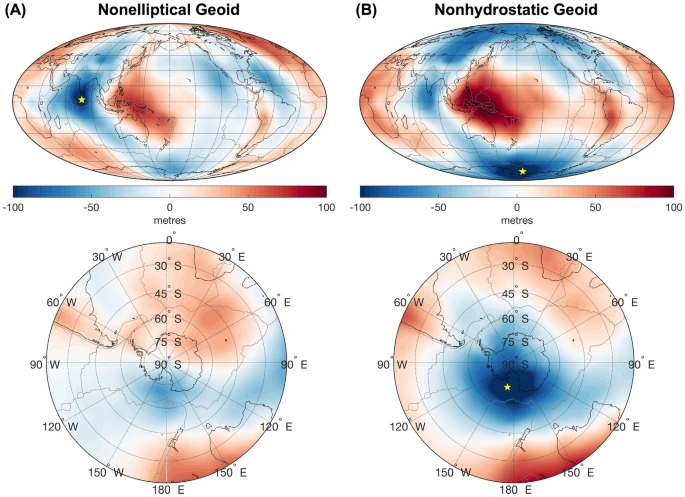
For years, geophysicists have been baffled by an unusual gravitational “hole” beneath Antarctica’s massive ice sheet. Recent advances in supercomputer modeling are now revealing what lies beneath the frozen landscape and how deep-Earth processes may be influencing the continent’s surface. Research led by the University of Florida demonstrates how sophisticated computational tools are bringing hidden aspects of our planet’s interior to light.
This anomaly, an area with unexpectedly low gravitational pull, about the size of a small country, was first identified using satellite gravity data. Usually, gravity readings over ice correspond to the total mass of rock and ice below. However, in this region of Antarctica, the gravitational pull was weaker than anticipated, hinting that something unusual lies within the deep crust or upper mantle. The anomaly is located inland from the Ross Ice Shelf, one of Antarctica’s largest floating ice extensions.
To investigate the anomaly, a team of geoscientists, led by the U.S. Antarctic Program and collaborating with researchers worldwide, turned to supercomputer-based geophysical models. Their goal was to test whether variations in rock composition, temperature, and structure could reproduce the gravity signal seen at the surface. These models combine a range of data, seismic imaging from prior surveys, satellite gravity measurements, and the physics governing how rocks deform under pressure, into a comprehensive simulation of Earth’s interior beneath Antarctica.
Running these simulations is a formidable computational challenge. Researchers must solve the complex equations of continuum mechanics and gravity simultaneously, accounting for thousands of variables that span many orders of magnitude in scale. The only tools capable of handling such a workload are high-performance computing (HPC) systems with extensive parallel processing capabilities. Without supercomputers, exploring thousands of potential configurations of rock density and structure beneath Antarctica would be all but impossible.
The results suggest that the gravity hole may be explained by a combination of lighter-than-expected rock compositions and localized thermal anomalies in the upper mantle. In particular, regions where rocks are warmer and thus less dense can create a measurable reduction in gravitational acceleration. These warmer zones may arise from ancient mantle processes, remnants of tectonic activity that predate Antarctica’s current icy quilt.
Lead author Dr. Matthew Schmidt describes the finding as “a fascinating clue to Antarctica’s deep past.” Rather than pointing to a void or missing mass beneath the ice, the gravity anomaly appears to reflect variations in the physical properties of deep rocks, information that can only be teased out through computational modeling anchored in robust physics and constrained by observational data.
For computational geoscientists, this work exemplifies the transformative role of supercomputing in Earth science. Supercomputers allow researchers to experiment with a wide range of theoretical models, fine-tuning parameters until the simulations align with real-world measurements. In the case of the Antarctic gravity hole, this meant iterating through many plausible combinations of rock types, temperature distributions, and structural configurations, an effort that would be impractical on conventional computing hardware.
The implications extend beyond one anomaly. Understanding gravitational variations beneath Antarctica has significance for models of ice sheet stability and long-term sea level change, because subtle differences in the Earth’s internal structure can influence how ice flows and how the land beneath it responds. As climate change accelerates ice loss in polar regions, accurate models of both ice dynamics and the solid Earth are essential for forecasting future impacts.
Supercomputing has become the bridge between observation and understanding in such contexts, enabling scientists to visualize what cannot be seen and test hypotheses that would otherwise remain speculative. By integrating diverse datasets and the laws of physics into unified simulations, researchers are now able to explore what lies beneath remote and inaccessible places like Antarctica.
In a broader sense, the Antarctic gravity hole reminds us that the Earth still holds deep mysteries, and that supercomputers are among the most powerful instruments available for unlocking them. As computational capabilities continue to grow, so too will our ability to decode the planet’s hidden signals and better understand the forces that shape the world beneath our feet.