

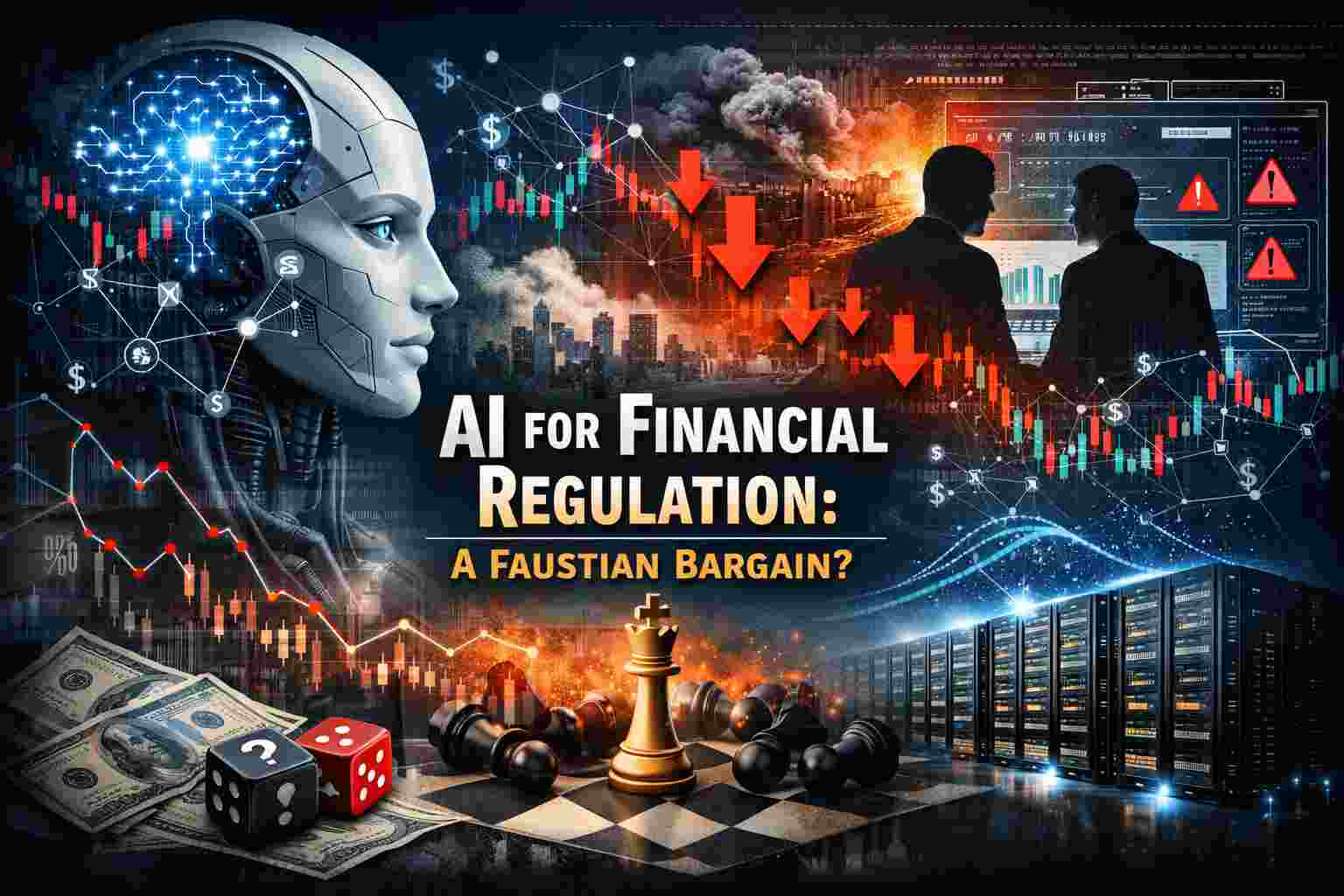
As supercomputing systems take on a increasing role in powering financial modeling, a new working paper from Stanford Graduate School of Business poses a challenging question: Should regulators rely on AI models that can forecast crises, yet fail to provide clear explanations for their predictions?
In “Financial Regulation and AI: A Faustian Bargain?”, the authors examine how advanced machine learning models, trained on detailed financial holdings, might transform macroprudential policy. For high-performance computing (HPC) professionals, the real issue is not finance per se, but the computational tradeoff: What are the risks when the ability to predict outstrips our ability to understand why?
From HPC Models to Financial Policy Engines
Modern financial systems generate enormous datasets: transaction flows, portfolio holdings, derivatives exposure, and cross-institutional dependencies. Processing these datasets requires supercomputing-scale infrastructure, where graph-based deep learning models can ingest and analyze relational data across millions of nodes and edges.
The Stanford study introduces a graph-based deep learning architecture designed specifically for this task. By learning embeddings for both assets and investors, the model captures the network structure of financial markets and achieves strong out-of-sample predictive performance in identifying stress points, such as forced liquidations or fire-sale cascades.
From an HPC standpoint, this is a familiar pattern:
- Massive graph datasets
- Distributed training across accelerators
- Nonlinear models extracting latent structure from high-dimensional inputs
In other words, financial regulation is beginning to resemble large-scale simulation and inference workflows already common in climate science or genomics.
The Core Tradeoff: Prediction vs. Causality
The paper’s central argument is deceptively simple: AI models can predict where financial stress will occur, but may provide little insight into how policy interventions will change those outcomes.
This creates what the authors describe as a “Faustian bargain.” Regulators gain predictive accuracy, but risk losing interpretability and causal grounding.
Technically, the issue stems from the nature of modern ML systems:
- Models are highly nonlinear and reduced-form.
- Predictions are derived from correlations in historical data.
- The underlying causal mechanisms remain opaque.
As the paper notes, there is “no guarantee” that these models capture structural relationships that remain stable when policy itself changes.
For HPC practitioners, this is analogous to running a highly accurate simulation that fails under perturbation, a model that fits the data, but not the system.
A Feedback Loop Hidden in the Compute
The study goes further by modeling how financial institutions might respond to AI-driven regulation.
If regulators use predictive models to anticipate crises and intervene earlier, market participants will adapt. Portfolios may shift toward assets perceived as “protected” or more likely to benefit from intervention.
This creates a feedback loop:
- AI predicts fragile assets.
- Regulators intervene.
- Markets adjust behavior based on expected intervention.
- The underlying system changes.
The result is a moving target, one where the model’s predictions may become less reliable precisely because they are being used.
From a supercomputing perspective, this resembles adaptive systems with endogenous responses, where the act of measurement or intervention alters the system being modeled.
When More Compute Doesn’t Mean More Certainty
The natural instinct in HPC is to scale:
- More data
- Larger models
- Higher-resolution predictions
But the Stanford paper suggests that scaling alone does not resolve the core issue.
Even a perfectly trained model, running on the most advanced GPU clusters, cannot guarantee useful policy guidance if it lacks causal interpretability. Predictive precision only improves outcomes when it aligns with areas where regulators already understand how interventions work.
In practical terms:
- Accuracy ≠ policy effectiveness
- Resolution ≠ robustness
- Compute ≠ understanding
This is a subtle but critical limitation for HPC-driven AI systems deployed in real-world decision-making environments.
Implications for Supercomputing Users
For the supercomputing community, the implications extend beyond finance.
The paper highlights a broader pattern emerging across domains:
- AI models trained on massive datasets outperform traditional methods.
- These models are deployed in decision loops, not just analysis pipelines.
- The systems they model begin to react to the models themselves.
In such settings, HPC becomes part of a closed-loop system, where computation influences behavior, and behavior feeds back into computation.
This raises uncomfortable questions:
- How do we validate models in systems that change in response to them?
- What does “ground truth” mean when interventions alter outcomes?
- Can we scale our way out of fundamentally epistemic uncertainty?
A Skeptical Outlook
The Stanford paper doesn’t suggest abandoning AI for financial regulation. Rather, it demonstrates that predictive models can enhance outcomes in specific scenarios.
However, the study pushes back against a prevailing belief in the HPC and AI worlds: the idea that increasing model power inevitably leads to better decisions.
Instead, it argues for caution. No matter how advanced, predictive systems are only as effective as their alignment with causal reasoning and policy limitations.
For supercomputing users, this may be the real takeaway.
The next frontier of HPC is not just scaling models, but understanding when those models should, and should not, be trusted.