

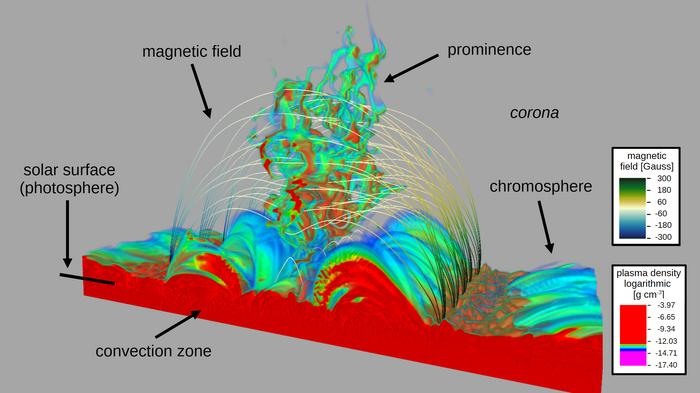
A recent study in Nature Astronomy (DOI: 10.1038/s41550-026-02840-7) represents a major leap forward in computational astrophysics, showcasing how state-of-the-art supercomputing is transforming our understanding of solar prominences, one of the Sun’s most mysterious features. By utilizing large-scale, high-resolution simulations, scientists at the Max Planck Institute for Solar System Research have, for the first time, recreated the Sun’s complex multi-layer dynamics from the convection zone up to the corona, uncovering a self-sustaining mechanism that supports these plasma formations.
A multiscale computational challenge
Solar prominences are massive, relatively cool plasma formations (~10,000 K) suspended within the Sun’s much hotter corona (~1 million K). Despite their apparent fragility, they can persist for weeks or months and may ultimately erupt, triggering space weather events that can disrupt Earth’s infrastructure.
Modeling such structures presents a formidable computational challenge. The physics spans multiple regimes: magnetohydrodynamics (MHD), radiative transfer, thermal instability, and turbulent plasma flows across spatial scales ranging from sub-surface convection to coronal loops extending tens of thousands of kilometers.
The research team addressed this complexity using advanced numerical simulations that integrate:
- Full-sphere stratified solar models, extending from the convection zone below the photosphere to the corona.
- Dynamic magnetic field evolution, driven by turbulent plasma flows.
- Thermal coupling across layers, capturing steep temperature gradients between the chromosphere and corona.
- Plasma injection and condensation processes, resolved in time-dependent MHD frameworks.
These simulations required high-performance computing (HPC) resources capable of resolving nonlinear interactions across scales while maintaining numerical stability over long simulation times.
Magnetic topology and plasma supply mechanisms
At the core of the study lies a specific magnetic configuration: a double-arched field structure forming a dip in the corona. Within this dip, prominence material accumulates and remains magnetically confined.
The simulations reveal a dual supply mechanism:
- Chromospheric Injection
Turbulent magnetic activity in the chromosphere ejects bursts of cool plasma upward. These injections are driven by small-scale magnetic reconnection and wave dynamics. - Coronal Condensation
Hot coronal plasma flows along magnetic field lines into the dip, where it cools radiatively and condenses into denser material.
Simultaneously, gravitational drainage causes some plasma to fall back toward lower layers. The prominence persists because these losses are continuously offset by the two supply channels, establishing a dynamic equilibrium.
This “supply–loss balance” represents a key breakthrough: earlier models typically captured only coronal condensation and neglected the deeper layers of the Sun. By coupling subsurface dynamics with atmospheric processes, the new simulations close a longstanding gap in solar physics.
Supercomputing as the enabling infrastructure
The study’s significance lies not only in its astrophysical findings but in its computational methodology. Achieving a self-consistent, multi-layer solar model required:
- Massively parallel MHD solvers to handle nonlinear plasma dynamics.
- Adaptive mesh refinement (AMR) or equivalent resolution strategies to capture fine-scale injection events.
- Long-duration time integration to observe prominence formation and stability cycles.
- High-throughput data handling, given the volumetric and temporal scale of simulation outputs.
Such requirements place the work squarely in the domain of modern supercomputing. Without HPC systems capable of petaflops (and increasingly exaflops) performance, resolving the coupled dynamics of magnetic fields and plasma across solar layers would be computationally prohibitive.
Implications for space weather forecasting
Understanding prominence formation is not merely an academic pursuit. Prominence eruptions are closely linked to coronal mass ejections (CMEs), which can trigger geomagnetic storms affecting satellites, power grids, and communications systems.
By identifying the underlying supply mechanisms and stability conditions of prominences, the study provides a pathway toward:
- Improved predictive models of solar eruptions.
- Better integration of subsurface solar dynamics into space weather simulations.
- Enhanced coupling between observational data and physics-based HPC models.
As noted by the researchers, a deeper understanding of prominences is “a crucial piece of the puzzle” in forecasting hazardous space weather events.
Toward exaflops solar physics
This study highlights a growing shift in astrophysics: moving away from inference based solely on observations toward data-intensive, physics-driven modeling. High-fidelity simulations of entire stellar subsystems are quickly becoming a hallmark of modern research in the field.
Future directions will likely include:
- Integration with real-time solar observation pipelines.
- Data assimilation frameworks combining HPC simulations with satellite measurements.
- Deployment on exaflops architectures to increase spatial resolution and physical realism.
In this context, solar prominences are no longer just spectacular features of our nearest star; they are a proving ground for the next generation of supercomputing-enabled science.