

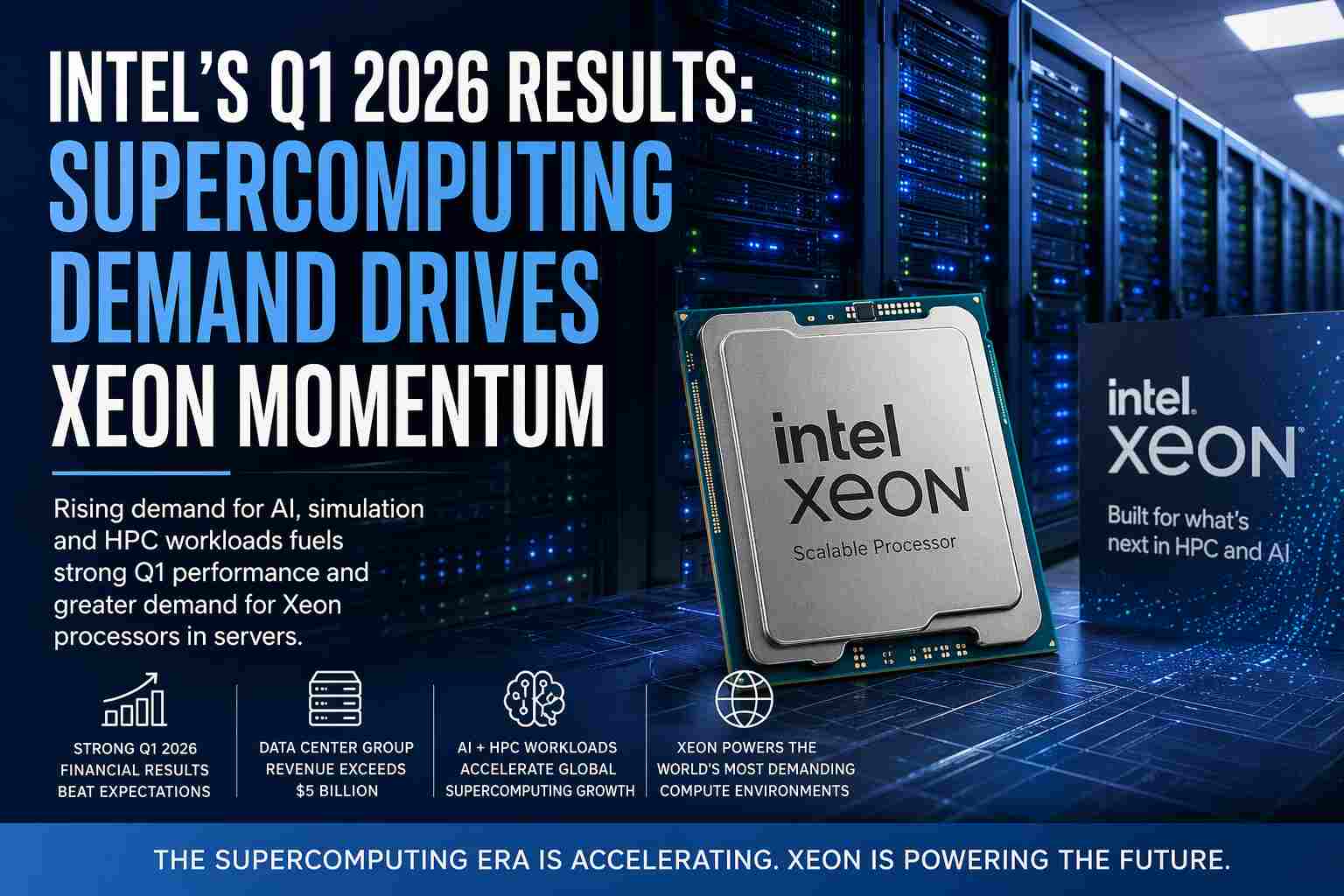
In a strong start to 2026, Intel has reported first-quarter financial results that underscore a growing reality across the high-performance computing (HPC) landscape: demand for supercomputing and AI-scale infrastructure is accelerating, and with it, the need for powerful server processors.
The company posted revenue of approximately $13.6 billion, exceeding expectations and marking a notable 7% year-over-year increase. Earnings also surpassed forecasts, reflecting renewed strength in Intel’s core data center business.
Shares of the U.S. chipmaker jumped 15% in after-hours trading.
Supercomputing demand lifts Xeon sales
At the center of this growth is Intel’s Xeon processor line, long a cornerstone of supercomputing systems and hyperscale data centers. As global investment in AI, simulation, and large-scale modeling intensifies, Xeon-based platforms are seeing renewed demand.
Intel’s data center segment delivered particularly strong performance, generating over $5 billion in revenue for the quarter and outperforming analyst expectations. This surge is closely tied to expanding workloads in AI training, scientific simulation, and cloud-scale analytics, domains traditionally dominated by supercomputing infrastructure.
Xeon processors remain deeply embedded in HPC ecosystems. Historically, they have powered a majority of the world’s top supercomputers, thanks to their high core counts, memory bandwidth, and compatibility with parallel workloads. As modern systems evolve toward hybrid CPU-GPU architectures, CPUs like Xeon continue to orchestrate workloads, manage data movement, and execute complex simulations.
AI and HPC converge
A key driver behind this momentum is the convergence of AI and traditional supercomputing. Workloads once confined to national labs, climate modeling, molecular dynamics, and astrophysics are now intersecting with enterprise AI applications such as large language models and digital twins.
Intel executives emphasized that CPUs remain essential even in GPU-heavy environments. Server processors are critical for feeding data to accelerators, running inference workloads, and maintaining system-level efficiency.
This architectural balance is fueling demand not just for accelerators, but for robust general-purpose compute, an area where Xeon continues to play a pivotal role.
Market tailwinds favor HPC growth
Broader industry trends reinforce Intel’s position. The global x86 server market remains dominant, accounting for the vast majority of server shipments and benefiting from the rapid expansion of hyperscale data centers.
At the same time, AI infrastructure investments are reaching unprecedented levels, with enterprises and governments alike racing to deploy supercomputing-class systems. These deployments increasingly require dense, scalable CPU architectures capable of handling both traditional HPC and emerging AI workloads.
Intel’s continued investment in next-generation Xeon platforms, including upcoming architectures designed for higher core counts and improved memory throughput, positions the company to capitalize on this shift.
Looking ahead: A supercomputing renaissance
While challenges remain, including competition and prior supply constraints, Intel’s latest results suggest a turning point. The company is benefiting from a broader resurgence in compute demand, driven by the same forces that are redefining supercomputing itself.
From national laboratories to cloud providers, the appetite for high-performance infrastructure is expanding rapidly. And as that demand grows, so too does the importance of the processors at its foundation.
For Intel, the message from Q1 2026 is clear: the supercomputing era is not just alive, it is accelerating, and Xeon is riding the wave.