

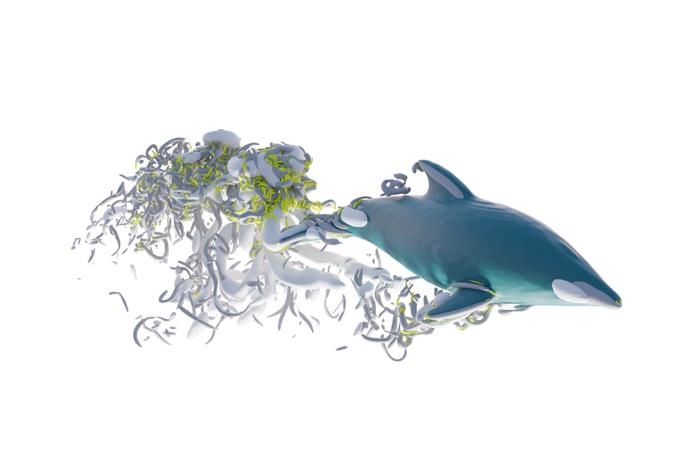
The exceptional swimming speed and efficiency of dolphins has long intrigued researchers. Recent advances in computational science have now enabled a novel approach to this question, utilizing high-performance supercomputing rather than relying solely on empirical observation.
Researchers at the University of Osaka employed large-scale numerical simulations to investigate the turbulent fluid dynamics associated with dolphin locomotion. Their analysis uncovers a hierarchical organization of vortices within the flow, structures that serve as the primary drivers of propulsion, thereby advancing the scientific understanding of efficient fluid motion.
Turbulence as a computational frontier
Fluid dynamics remains one of the most computationally demanding domains in physics. Governed by the nonlinear Navier–Stokes equations, turbulent flows exhibit multiscale behavior, where energy cascades from large coherent structures down to smaller, chaotic eddies.
Capturing this hierarchy requires direct numerical simulation (DNS) or similarly high-resolution computational approaches, techniques that are infeasible without supercomputing infrastructure. In this study, researchers used a supercomputer to resolve the full spatiotemporal evolution of flow fields generated by oscillating dolphin tails, enabling them to:
- Decompose turbulent flow into scale-dependent vortex structures.
- Track energy transfer across scales (the “energy cascade”).
- Quantify thrust contributions from different flow components.
- Perform parameter sweeps across multiple swimming regimes.
This computational framework effectively turns the supercomputer into a “fluid microscope,” revealing details inaccessible to experimental measurement alone.
The hierarchy of vortices
The simulations demonstrate that dolphin propulsion is dominated not by the total turbulence generated, but by a hierarchical structure of vortices.
At the top of this hierarchy are large-scale vortex rings, generated by the oscillatory motion of the dolphin’s tail. These structures:
- Carry the majority of the momentum transfer.
- Push water backward efficiently.
- Generate the bulk of forward thrust.
As these large vortices evolve, they break down into progressively smaller vortices through nonlinear interactions, a hallmark of turbulence known as the energy cascade. However, the simulations show that:
- Small-scale vortices contribute minimally to propulsion.
- Their role is largely dissipative, redistributing energy rather than generating thrust.
This distinction is critical. While classical turbulence theory emphasizes the complexity of small-scale structures, the Osaka team’s results indicate that biological propulsion exploits the largest coherent structures, effectively filtering useful motion from chaotic flow.
“Our goal is to understand which parts of the turbulent flow help dolphins swim so quickly,” noted lead researcher Yutaro Motoori, emphasizing the importance of isolating dominant flow components through computation.
Supercomputing enables flow decomposition
A key innovation in the study is the ability to computationally decompose turbulence into scale-specific contributions, a task nearly impossible in laboratory settings. By simulating the full velocity and vorticity fields, researchers could isolate:
- Coherent vortex rings (large-scale structures).
- Intermediate eddies contribute to energy transfer.
- Fine-scale turbulent dissipation.
This decomposition allows for a quantitative mapping between flow structure and propulsion efficiency. The results remained robust across varying swimming speeds, suggesting a universal mechanism underlying dolphin locomotion.
Such insights depend critically on high-resolution simulation grids and parallel computation, where millions, or more degrees of freedom, must be solved simultaneously over time.
From biological insight to engineering design
Beyond biology, the implications of this work extend into engineering and applied physics. Understanding how dolphins harness turbulence efficiently could inform:
- Next-generation underwater vehicles, optimized for thrust efficiency
- Bio-inspired propulsion systems, mimicking oscillatory tail dynamics
- Flow control strategies, reducing drag or enhancing lift in turbulent regimes
The study highlights a broader paradigm shift: rather than avoiding turbulence, advanced systems may learn to exploit its structure, guided by insights derived from supercomputing.
A curious glimpse into nature’s algorithms
Perhaps most intriguing is what this research suggests about nature itself. Dolphins, through evolution, appear to have “solved” a complex fluid dynamics problem, one that scientists are only now unraveling using some of the most powerful computational tools available.
By revealing that propulsion depends primarily on large-scale vortex organization rather than the full turbulent spectrum, the study offers a simpler, more elegant picture of motion in fluids.
It is a reminder that, in the age of supercomputing, curiosity driven science can uncover not only the mechanics of the natural world but the underlying principles that make it efficient.
And in this case, the answer to a deceptively simple question, why dolphins swim so fast, turns out to be written in the language of vortices, decoded by machines powerful enough to simulate the sea itself.