

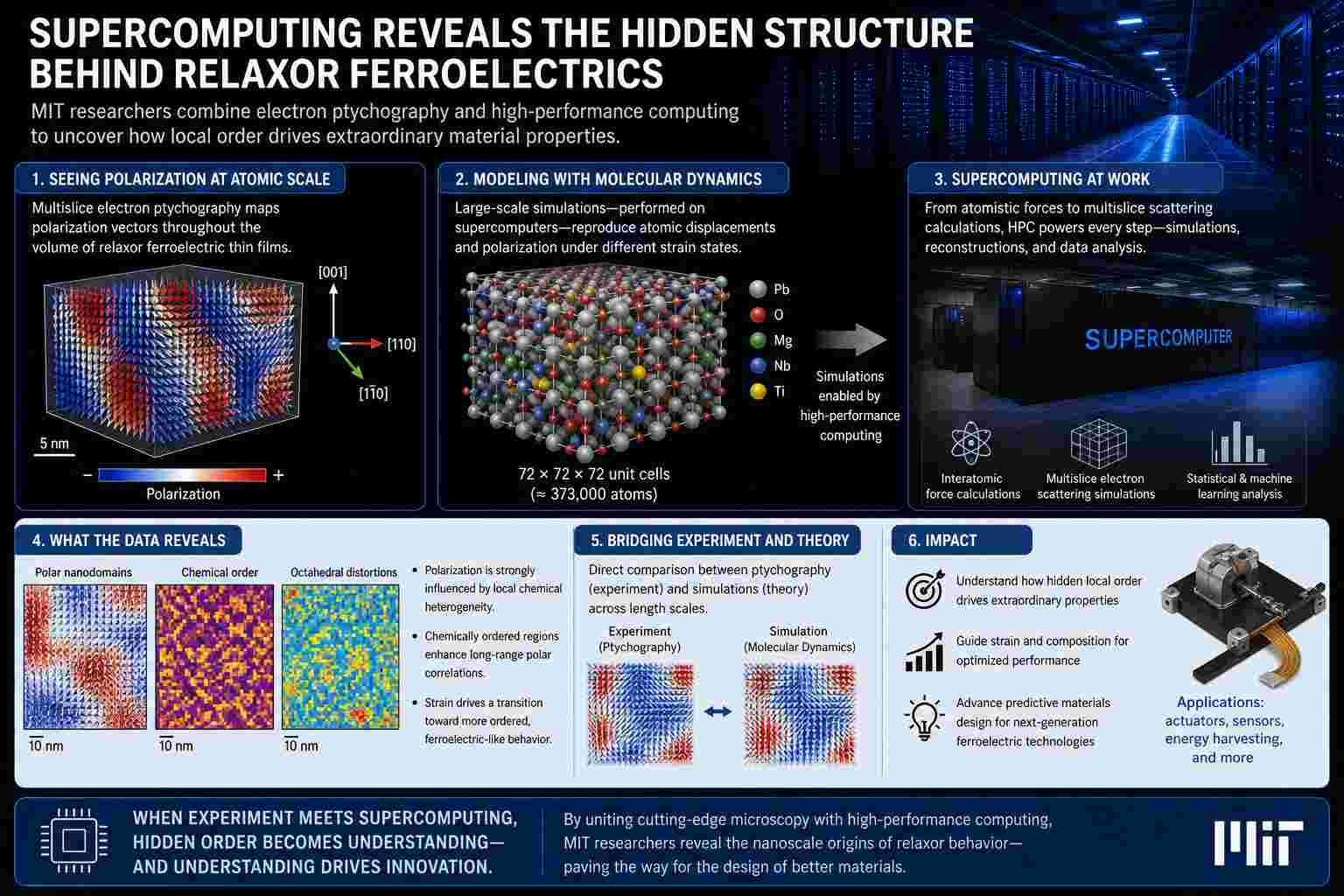
A recent study led by researchers at the Massachusetts Institute of Technology has shed new light on one of materials science’s most persistent puzzles: the elusive structural organization inside relaxor ferroelectrics. Although these materials are foundational to technologies such as precision actuators and advanced sensors, the atomic-level disorder inherent to relaxor ferroelectrics has, until now, masked the origins of their exceptional electromechanical behavior.
The breakthrough, highlighted in MIT News, goes beyond experimental advances; it is fundamentally computational. Central to this progress is the integration of high-resolution electron ptychography with large-scale simulation workflows powered by high-performance computing (HPC), bridging the gap between experiment and theory across various length scales.
A computational lens into atomic disorder
Relaxor ferroelectrics such as lead magnesium niobate–lead titanate (PMN-PT) exhibit what researchers describe as a “polar slush,” a complex, fluctuating arrangement of nanoscale polarization domains. Capturing this structure requires more than imaging; it demands reconstruction, simulation, and statistical interpretation of vast multidimensional datasets.
The MIT-led team employed multislice electron ptychography to generate 4D scanning transmission electron microscopy (4D-STEM) datasets. Each dataset consists of diffraction patterns collected across a real-space grid, yielding an immense volume of information that requires iterative reconstruction algorithms. These reconstructions rely on computational frameworks such as PtychoShelves and custom multislice solvers, tools that are computationally intensive and inherently suited to supercomputing environments.
Critically, the reconstruction process overcomes multiple scattering effects and retrieves depth-resolved structural information at near-atomic resolution. This allows researchers to visualize polarization variations through the thickness of the material, something unattainable with conventional microscopy techniques.
Supercomputing the physics of polarization
Beyond imaging, the study’s true computational depth emerges in its integration with molecular dynamics (MD) simulations. These simulations model supercells as large as 72 × 72 × 72 unit cells under varying strain conditions, tracking atomic displacements and polarization vectors over nanosecond timescales.
Such simulations are not trivial. They require:
- Parallelized computation of interatomic forces using bond-valence models
- Thermodynamic control via Nose–Hoover thermostats and Parrinello–Rahman barostats
- Statistical averaging across billions of atomic interactions
The resulting datasets enable direct comparison with experimental reconstructions, effectively validating observed polar structures and revealing their dependence on strain and chemical ordering.
Moreover, multislice simulations of electron scattering, used to replicate experimental conditions, incorporate frozen phonon approximations with dozens of configurations to ensure convergence.
These calculations, which simulate electron propagation through matter at atomic resolution, are computationally demanding and benefit significantly from HPC acceleration.
Data-driven discovery at the nanoscale
To interpret the immense data volumes, the researchers deployed advanced statistical and machine learning techniques. Principal component analysis (PCA) was applied to local polarization environments, reducing high-dimensional datasets into dominant “polar motifs” that describe recurring structural patterns.
Additionally, clustering algorithms were used to identify contiguous polarization domains, while pair-correlation functions quantified spatial relationships between dipoles. These analyses revealed that:
- Polarization is strongly influenced by local chemical heterogeneity, particularly the distribution of Nb⁵⁺ and Mg²⁺ ions.
- Short-range chemically ordered regions significantly enhance long-range polar correlations.
- Strain drives a transition toward more ordered, ferroelectric-like behavior without eliminating intrinsic disorder.
Such findings would be inaccessible without the combination of high-resolution experimental input and large-scale computational analysis.
Resolving the limits of measurement
One of the study’s notable achievements is quantifying the resolution limits of ptychographic reconstruction. Through simulation, the team demonstrated that polar domains as small as ~1 nm can be resolved under optimal conditions, despite a depth resolution of ~3.2 nm due to inherent blurring effects.
This calibration, achieved through synthetic datasets and reconstruction pipelines, underscores the importance of computational modeling in interpreting experimental data. It also highlights a broader trend in materials science: measurement is no longer purely observational but deeply intertwined with simulation.
Toward predictive materials design
By bridging atomistic simulations with experimental imaging, the MIT team has effectively created a multiscale framework for understanding relaxor ferroelectrics. The implications extend beyond academic curiosity.
With HPC-enabled workflows, researchers can now:
- Predict how nanoscale chemical ordering influences macroscopic properties.
- Optimize strain conditions for enhanced electromechanical performance.
- Design next-generation materials with tailored polarization behavior.
This convergence of supercomputing and microscopy signals a shift toward predictive materials engineering, where computation does not merely support experiments but guides them.
The supercomputing imperative
The study exemplifies how modern materials science is inseparable from high-performance computing. From reconstructing terabyte-scale microscopy datasets to simulating millions of atomic interactions, every stage of the workflow depends on computational power.
As datasets grow richer and models more sophisticated, the role of supercomputers will only expand, transforming hidden atomic disorder into actionable scientific insight.
In the case of relaxor ferroelectrics, what was once considered noise is now recognized as structure, and it is supercomputing that has made it visible.