

The explosive growth of supercomputing is no longer confined to national laboratories and elite research centers.
It is now directly reshaping the financial performance of one of the world’s largest infrastructure vendors.
In its first-quarter fiscal 2027 results, Dell Technologies delivered a dramatic revenue and earnings surge powered largely by accelerating demand for AI infrastructure, high-density servers, and hyperscale datacenter deployments. The company’s performance provides some of the clearest evidence yet that the global supercomputing boom is evolving into a foundational economic force.
Dell reported quarterly revenue of $43.84 billion, an 88% increase year over year, while its Infrastructure Solutions Group surged 181% as enterprises and hyperscalers raced to deploy AI-optimized compute systems.
More importantly for the HPC industry, Dell revealed that AI server revenue alone reached $16.1 billion during the quarter, with AI orders climbing to $24.4 billion and backlog expanding beyond $51 billion.
The implication is becoming impossible to ignore: supercomputing-scale infrastructure has become one of the primary engines of growth across the entire datacenter industry.
Shares of Dell Technologies surged following the company’s fiscal 2027 earnings report, as investors responded enthusiastically to booming AI and supercomputing infrastructure demand that is rapidly transforming Dell into one of the biggest beneficiaries of the global compute expansion cycle. Its stock shares are up 31% in after-hours trading.
AI factories are becoming the new supercomputers
The traditional distinction between supercomputers and enterprise infrastructure is rapidly disappearing.
Modern AI deployments increasingly require the same architectural characteristics that once defined elite HPC systems: massive parallelism, accelerator-dense clusters, ultra-fast networking fabrics, advanced cooling systems, and enormous memory bandwidth.
Dell’s financial results reflect that transition.
The company’s infrastructure growth is being fueled by organizations constructing what many vendors now describe as “AI factories,” enormous compute environments designed to train and deploy large-scale AI systems continuously. These deployments increasingly resemble exascale supercomputers more than traditional enterprise datacenters.
Customers, including hyperscalers, defense organizations, industrial firms, and cloud providers, are now purchasing infrastructure at scales previously associated only with national HPC initiatives.
The rise of generative AI has effectively industrialized supercomputing.
The Pentagon’s $10 Billion signal
One of the clearest indicators of this transformation is Dell’s expanding role in government-scale AI infrastructure initiatives.
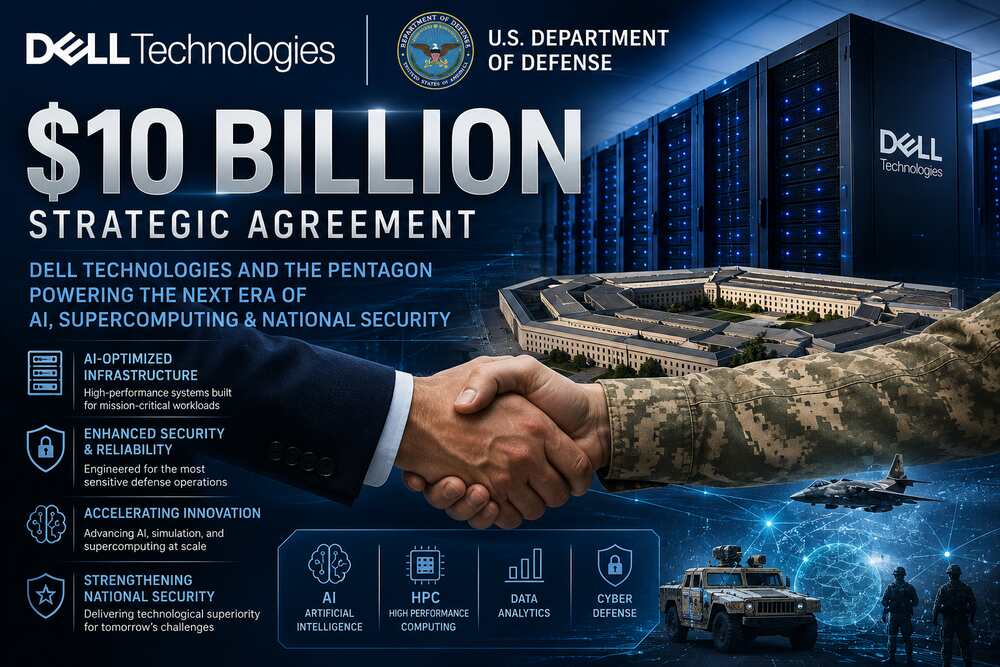
The company recently secured participation in a U.S. Department of Defense cloud and AI modernization contract ecosystem valued at up to $10 billion, reinforcing how national security agencies are rapidly scaling demand for supercomputing-class infrastructure. Defense organizations increasingly require accelerated systems capable of supporting battlefield analytics, autonomous systems, real-time intelligence processing, and large-scale simulation workloads.
The Pentagon’s growing investment in AI infrastructure is particularly significant because defense computing requirements often push the limits of HPC architecture years before commercial markets fully mature. That trend is now accelerating demand for dense compute clusters, GPU-heavy systems, high-performance storage, and secure networking environments, the same infrastructure categories driving Dell’s datacenter growth.
For the HPC sector, the Pentagon’s spending surge represents more than a government contract opportunity. It demonstrates that supercomputing is becoming a strategic national infrastructure on par with energy, telecommunications, and transportation systems.
Dell’s infrastructure business is becoming an HPC powerhouse
Historically, Dell was viewed primarily as a PC and enterprise server company.
That perception is changing rapidly.
The company’s Infrastructure Solutions Group has emerged as one of the largest beneficiaries of the global AI compute race. Dell’s server business now sits directly at the intersection of accelerated computing, hyperscale infrastructure, and HPC deployment.
Recent partnerships with NVIDIA have further strengthened Dell’s position in GPU-accelerated infrastructure. Dell AI Factory systems combine dense GPU clusters, high-speed networking, and integrated storage architectures specifically designed for AI and scientific computing workloads.
This matters because modern supercomputing increasingly depends on vertically integrated infrastructure stacks rather than standalone compute nodes.
As simulation, AI training, climate modeling, digital twins, and genomics workloads grow larger, organizations are prioritizing turnkey infrastructure ecosystems capable of scaling rapidly.
Dell appears to be positioning itself directly inside that demand wave.
The compute arms race is accelerating
Dell’s raised fiscal guidance may be the strongest indicator yet that the AI infrastructure boom remains in its early stages.
The company now expects fiscal 2027 AI server revenue to reach approximately $60 billion, substantially above prior projections.
That forecast aligns with broader industry expectations that hyperscalers and enterprises will spend hundreds of billions of dollars on accelerated infrastructure over the next several years.
This spending surge is being driven by an extraordinary range of compute-intensive applications:
Large language model training
Real-time inference systems
Computational fluid dynamics
Molecular simulation
Autonomous systems
Climate and weather modeling
Defense analytics
Industrial digital twins
Many of these workloads now require exascale-class infrastructure characteristics.
The growth of these workloads is directly increasing demand for the servers, networking systems, and storage platforms that Dell manufactures.
Supercomputing is becoming a commercial industry
For decades, the HPC market was comparatively specialized and limited in scale.
Today, AI has changed that equation completely.
What makes Dell’s quarter especially significant is that it demonstrates how supercomputing technologies are no longer niche infrastructure purchases. They are becoming mainstream commercial requirements.
The same architectures once reserved for advanced scientific research are now being deployed by banks, manufacturers, healthcare providers, logistics firms, retailers, and defense agencies seeking competitive advantages through AI.
This convergence is creating one of the largest infrastructure investment cycles in computing history.
Even concerns about power consumption and datacenter energy requirements are no longer slowing deployment. Instead, the industry is investing aggressively in liquid cooling, optimized accelerator utilization, and energy-aware HPC architectures to sustain growth.
Dell’s results confirm the HPC expansion cycle
For years, the supercomputing sector has predicted that the need for computational power would become a central driver of the digital economy.
Dell’s fiscal 2027 performance indicates that this inflection point has arrived.
The company’s remarkable infrastructure gains are not just a passing AI phenomenon; they signal a fundamental shift in how governments, businesses, hyperscalers, and defense organizations view and deploy computing resources.
Supercomputing has moved beyond the realm of specialized research.
It is now emerging as the backbone of modern industries and national infrastructure.
As Dell’s recent results and the Pentagon’s swelling AI investments show, demand for compute continues to accelerate.