

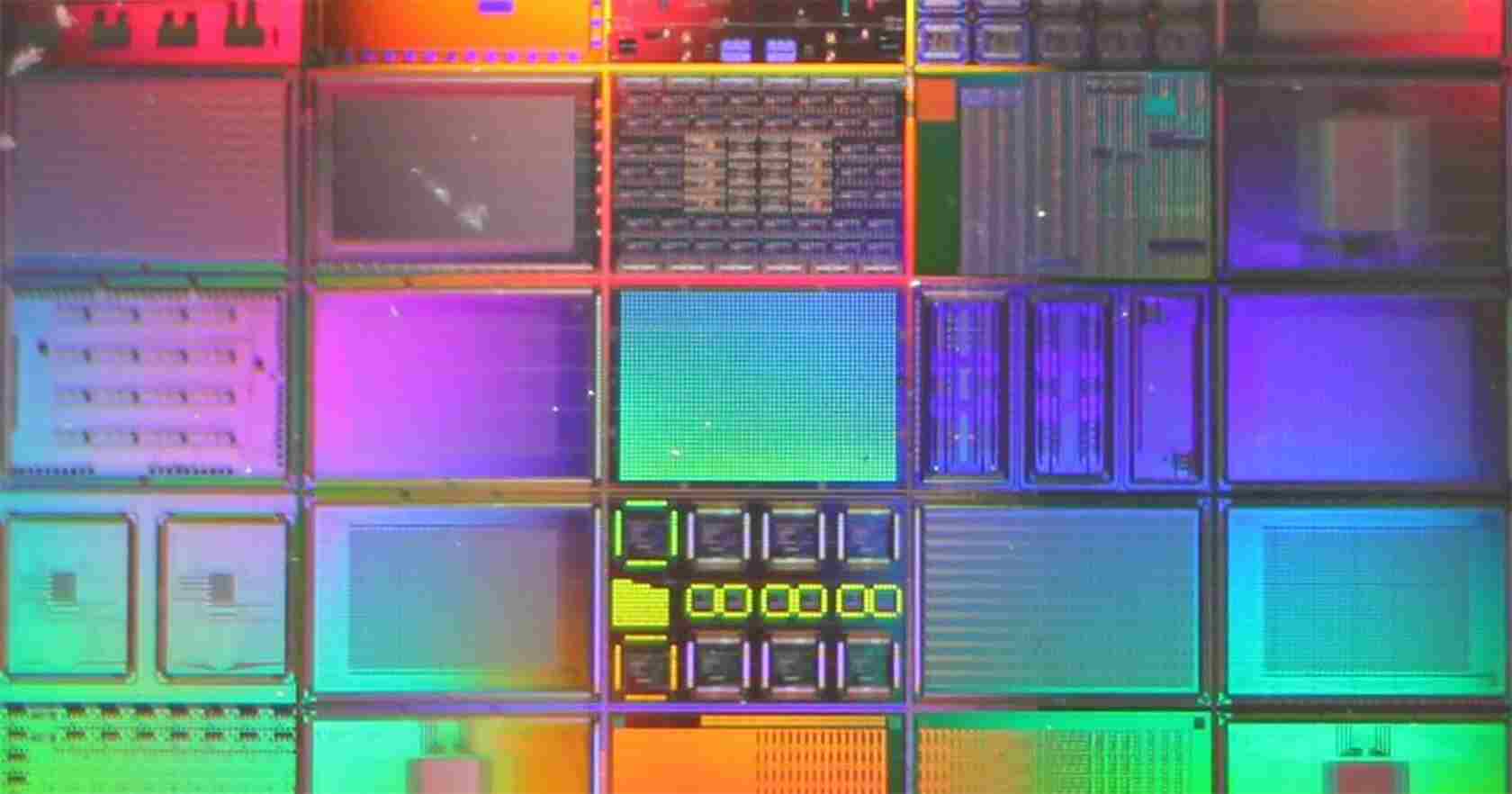
Tohoku University and NIST demonstrate the world’s first semiconductor-integrated spintronic p-bit, opening a path toward million-bit probabilistic computers for AI and optimization
Efforts to develop computing architectures that surpass conventional CMOS and modern AI accelerators have just advanced significantly. A team from Tohoku University and the National Institute of Standards and Technology (NIST) has created the world’s first semiconductor-integrated spintronic probabilistic bit (p-bit), fabricated directly on a silicon chip using standard semiconductor manufacturing methods. This breakthrough tackles one of the main challenges in probabilistic computing: scalability.
For the high-performance computing community, this result is especially compelling. It marks a shift from laboratory prototypes using discrete components to integrated architectures that could ultimately support large-scale AI and optimization workloads.
A different path beyond Moore’s Law
As AI models continue to grow, traditional processors increasingly struggle with the energy costs associated with searching enormous solution spaces. While quantum computing remains a promising long-term approach, researchers worldwide are also exploring alternative architectures that can handle probabilistic calculations more efficiently.
One such architecture is the probabilistic computer, or p-computer.
Unlike conventional bits that are fixed at either 0 or 1, p-bits fluctuate stochastically between the two states. Their probability distributions can be controlled and correlated with neighboring p-bits, allowing entire networks to explore many possible solutions simultaneously. This makes p-computers particularly attractive for combinatorial optimization, sampling, machine learning, and inference problems.
Previous demonstrations of spintronic p-computers relied on separate spin devices connected to external control electronics through cables. Those systems successfully validated the concept but were limited to roughly 100-bit-scale experiments and offered little opportunity for the kind of integration required for practical computing systems.
Integrating spintronics directly into silicon
The new work changes that equation.
The research team fabricated a p-bit circuit directly on a silicon substrate by combining advanced semiconductor manufacturing techniques in the United States with spintronic device fabrication performed at Tohoku University. The resulting device integrates CMOS circuitry with a superparamagnetic tunnel junction whose magnetic state fluctuates naturally due to thermal effects.
The prototype was fabricated using a 130-nanometer CMOS process and experimentally verified to exhibit the expected probabilistic input-output behavior required for p-bit operation. The work was reported in IEEE Electron Device Letters https://ieeexplore.ieee.org/document/11535457/.
While a single p-bit may appear modest compared with modern processors containing billions of transistors, the accomplishment is significant because it demonstrates a manufacturing pathway compatible with semiconductor-scale integration.
According to the researchers, this foundational technology could eventually enable systems containing on the order of one million p-bits, representing a dramatic leap beyond current demonstrations.
Why supercomputing researchers should pay attention
For the HPC community, probabilistic computing occupies an increasingly interesting niche between traditional computing and quantum computing.
Many computational science problems involve searching extremely large solution spaces:
- Protein folding and molecular sampling
- Logistics and routing optimization
- Bayesian inference
- Machine learning training and inference
- Statistical physics simulations
- Financial risk modeling
These workloads often consume enormous amounts of compute time on today’s GPU-powered supercomputers.
P-computers are not quantum computers and do not rely on fragile quantum coherence. Instead, they exploit naturally occurring randomness in physical devices, operate at room temperature, and use mature semiconductor manufacturing techniques.
If large-scale p-bit arrays become practical, they could emerge as specialized accelerators analogous to GPUs or AI tensor processors, targeting classes of problems where stochastic search and probabilistic inference dominate computational cost.
The spintronics connection
The work also highlights the growing importance of spintronics as a post-CMOS technology platform.
Spintronic devices use both the charge and the spin of electrons, enabling information processing mechanisms that differ fundamentally from traditional transistor logic. Technologies such as MRAM have already demonstrated that spintronic devices can be manufactured within semiconductor production flows.
The ability to combine CMOS circuitry and stochastic magnetic tunnel junctions on the same silicon substrate suggests that future p-computers could leverage existing semiconductor infrastructure rather than requiring entirely new fabrication ecosystems.
That compatibility may prove decisive in determining whether probabilistic computing remains a research curiosity or evolves into a deployable computing technology.
A new computing landscape
The history of computing is filled with architectures that appeared promising but never escaped the laboratory. What makes this announcement noteworthy is not merely the demonstration of another novel device, but the demonstration of a manufacturable pathway.
The researchers have effectively shown that spintronic p-bits can be integrated into semiconductor processes rather than attached as external experimental components. That shift transforms probabilistic computing from a proof-of-concept architecture into a technology with a plausible scaling roadmap.
For supercomputing researchers watching the search for post-Moore computing platforms, the question is no longer whether spintronic p-bits can operate on silicon. That has now been demonstrated.
The more interesting question is what happens when hundreds of thousands, or even millions, of them begin working together.