

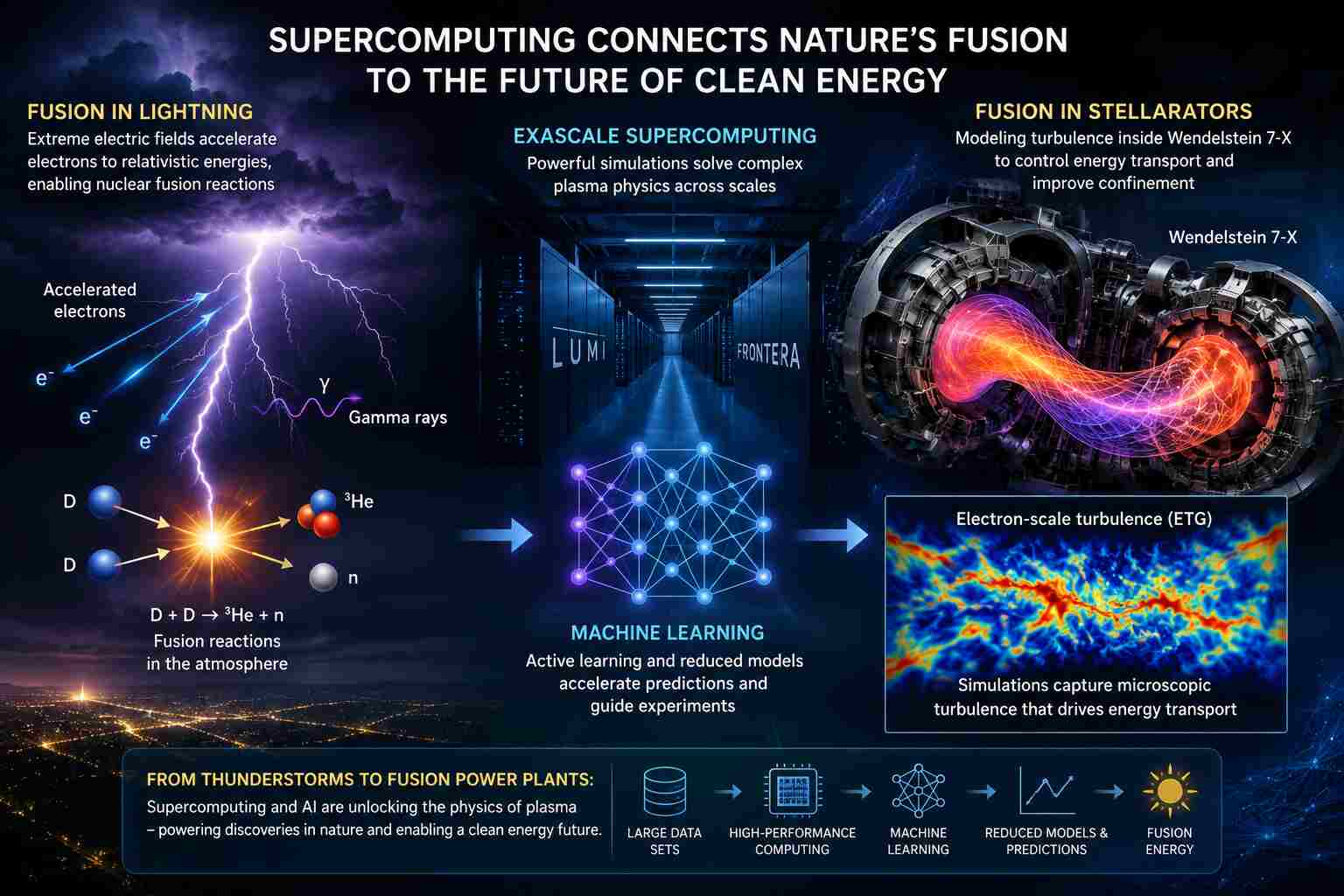
Virginia Tech researchers have advanced fusion energy modeling by developing machine-learning-assisted, reduced-order models of electron-temperature-gradient (ETG) turbulence within the Wendelstein 7-X stellarator. By integrating active learning, gyrokinetic simulations, and large-scale HPC resources, leveraging massive datasets from the GENE-KNOSOS-Tango framework, the team successfully analyzed plasma behavior across seven radial locations. Their models, built on three critical parameters (normalized electron temperature gradients, density-gradient relationships, and electron-to-ion temperature ratios) and refined through an active-learning framework using 10,000 bootstrap samples per iteration, achieved prediction errors below 18%. These findings demonstrate a robust capacity for generalization across multiple operating regimes, marking a significant step in accelerating the design of future fusion reactors.
Machine learning meets fusion physics
Perhaps the most remarkable aspect of the work is the efficiency gain. Traditional gyrokinetic simulations may consume thousands of CPU hours to evaluate a single plasma configuration. By training reduced-order models on carefully selected simulation data, researchers can reproduce key transport predictions at a fraction of the computational cost. The active-learning procedure required training sets containing only 104 to 190 carefully selected samples, despite validation datasets containing hundreds more points at each radial location.
This represents a growing trend throughout computational science. Rather than replacing physics-based simulations, artificial intelligence is increasingly being used to identify the most informative simulations, accelerate parameter exploration, and construct predictive surrogate models. For fusion research, this capability could dramatically shorten design cycles for future reactors.
A global supercomputing effort
The computational infrastructure supporting the stellarator research spans multiple continents. The simulation campaign utilized some of the world’s most powerful scientific computing systems, including the LUMI supercomputer in Finland, the Frontera system in the United States, the Leonardo and Marconi 100 in Italy, and the Raven in Germany. The use of multiple leadership-class systems underscores how fusion science increasingly depends upon international HPC collaborations. Modern fusion research is no longer confined to experimental facilities alone. It also occurs inside some of the world’s largest supercomputers.
From Nature’s fusion experiments to humanity’s energy future
The connection between lightning-induced fusion and stellarator turbulence may not be immediately obvious. One occurs naturally in thunderstorms. The other unfolds inside carefully engineered magnetic confinement systems. Yet both are governed by the same underlying laws of plasma physics. Both require sophisticated numerical methods to understand. And both increasingly rely upon machine learning and high-performance computing to transform theory into predictive science.
The lesson is inspirational. Nature has been conducting fusion experiments for billions of years, in stars, supernovae, and perhaps even thunderstorms. Today, through supercomputing, humanity is learning not merely to observe those processes but to understand them, simulate them, and ultimately harness them. The path to commercial fusion energy will not be built solely with magnets, lasers, or reactor vessels. It will also be built with algorithms, machine learning, and the extraordinary computational power of the world’s fastest supercomputers. Every simulation brings us one step closer to reproducing the power of the stars here on Earth.