

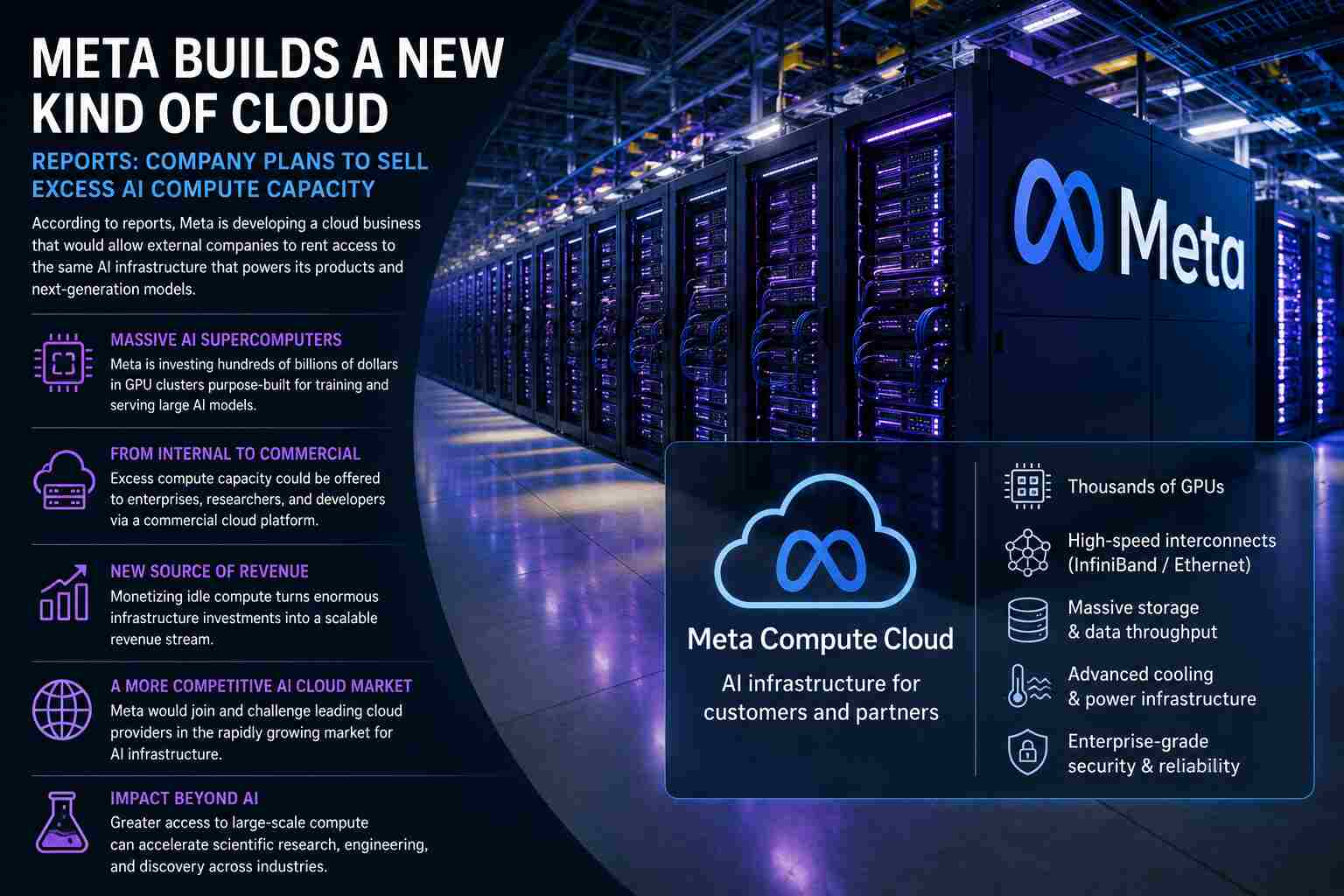
Reported plans to commercialize AI infrastructure could transform Meta from one of the world’s largest consumers of supercomputing into one of its largest providers.
This transition signifies a fundamental shift in the global technological landscape, where the primary barrier to entry for AI innovation is no longer just talent or algorithms, but the sheer availability of high-performance hardware. As Meta pivots toward potentially offering commercial cloud services, it underscores the realization that compute power has surpassed traditional software assets in strategic importance.
Key Implications of Meta’s Potential Infrastructure Commercialization:
- Commoditization of Compute: Access to high-density GPU clusters is evolving into a utility-like resource, placing it alongside electricity and bandwidth as a foundational requirement for enterprise growth.
- Capital Efficiency: By monetizing currently idle capacity, Meta can offset the staggering costs of its multi-billion dollar data center investments, turning depreciating capital expenditures into robust revenue streams.
- Expansion of the AI Ecosystem: Lowering the barrier to accessing world-class training environments democratizes the ability for smaller enterprises and research institutions to develop frontier-level AI models without the impossible cost of building their own physical infrastructure.
- Structural Market Shift: This move threatens to disrupt the existing cloud hierarchy, challenging incumbents like AWS and Azure while also putting pressure on specialized AI cloud startups that previously occupied this niche.
- Convergence with Scientific Computing: The blurring lines between large-scale AI training and traditional HPC workloads suggest that the future of scientific discovery, from medicine to climate science, will increasingly rely on the same infrastructure originally engineered for social media recommendation engines and LLMs.
The move marks a departure from the “walled garden” approach of previous tech eras. By inviting outside developers to run workloads on its proprietary systems, Meta is signaling that the competitive advantage in the next decade will belong to those who provide the foundational machinery upon which the rest of the industry is built. If this infrastructure becomes a public or semi-public utility, the company will have effectively positioned itself as the underlying engine of the broader artificial intelligence economy.
A different kind of supercomputer
Traditional supercomputers have historically been constructed for a single organization.
National laboratories build machines for scientific discovery.
Universities construct clusters for research.
Enterprises deploy HPC systems to solve engineering and manufacturing problems.
Meta’s infrastructure follows a different philosophy.
Rather than running tightly coupled scientific workloads using MPI-based parallelism, Meta’s AI clusters are optimized for enormous distributed training jobs involving trillions of model parameters. Tens of thousands of GPUs communicate simultaneously using ultra-high-bandwidth fabrics, while advanced storage systems stream petabytes of training data to accelerator nodes with minimal latency.
Although these systems differ architecturally from traditional capability-class supercomputers, they represent some of the largest computational installations ever assembled.
Their purpose is not climate modeling or astrophysics.
Their purpose is intelligence.
If Bloomberg’s reporting proves accurate, Meta may soon begin exposing that infrastructure to external users, allowing organizations to rent access to the same GPU clusters powering the company’s AI ambitions.
The economics of AI infrastructure
Modern AI data centers require investments measured not in millions but in tens of billions of dollars.
Each facility demands thousands of GPUs, advanced networking equipment, liquid cooling systems, substations, backup power generation, and increasingly dedicated energy sources capable of supporting hundreds of megawatts of continuous operation.
Meta has guided toward AI infrastructure spending as high as $145 billion in 2026, reflecting one of the largest capital investment programs in computing history. Industry-wide, major technology companies are expected to spend well over $700 billion on AI infrastructure this year.
Such investments fundamentally change the economics of computing.
Historically, cloud providers built infrastructure after customer demand materialized.
Today’s AI race reverses that model.
Companies are constructing enormous GPU capacity first, anticipating future demand for model training, inference, and agentic AI workloads.
The consequence is inevitable: At certain times, portions of these massive AI supercomputers will sit idle.
Commercializing unused capacity transforms what would otherwise be depreciating capital assets into revenue-generating infrastructure.
Compute becomes the product
The reported initiative reflects a broader industry trend.
Increasingly, the most valuable product is not necessarily the AI model itself.
It is the computational platform that can train and serve those models.
This distinction matters.
Training frontier AI models requires extraordinary computational density, often involving synchronized execution across thousands of accelerators connected through high-speed interconnects such as InfiniBand or custom Ethernet fabrics. These systems incorporate distributed storage, sophisticated scheduling software, fault-tolerant checkpointing, and optimized collective communication libraries that maximize GPU utilization.
Building such environments requires years of engineering experience.
For many enterprises, renting access to an existing AI supercomputer is significantly more practical than constructing one internally.
Should Meta commercialize its infrastructure, it would effectively be selling access not merely to GPUs, but to one of the world’s most sophisticated AI computing environments.
Challenging the AI cloud landscape
The reported strategy would position Meta alongside established hyperscale cloud providers while simultaneously challenging specialized AI infrastructure companies.
Unlike traditional cloud platforms that evolved from general-purpose virtual machines, AI infrastructure providers focus on delivering accelerator-rich environments optimized specifically for machine learning workloads.
This emerging “AI cloud” market emphasizes:
- Massive GPU clusters
- High-bandwidth networking
- Distributed AI training
- Inference optimization
- Foundation model hosting
- Large-scale storage architectures
- Advanced orchestration software
Bloomberg reported that Meta is evaluating both raw compute rentals and hosted AI model services, similar to existing offerings that allow developers to access foundation models without managing underlying infrastructure.
That combination would allow customers to choose between renting hardware directly or consuming AI models as managed services.
From internal infrastructure to public utility
Perhaps the most remarkable aspect of the reported strategy is philosophical rather than technical.
For much of its history, Meta’s infrastructure existed solely to support Facebook, Instagram, WhatsApp, and the company’s internal AI research.
Opening those systems to outside developers would fundamentally change their role.
Instead of operating as private computational assets, they would become shared digital infrastructure supporting thousands of organizations.
This transition mirrors an earlier evolution in computing.
Amazon Web Services originated from infrastructure Amazon built for its own retail operations before becoming the world’s largest cloud platform.
Many observers now wonder whether AI infrastructure is entering a similar phase.
The difference is scale.
Modern AI clusters rival traditional leadership-class supercomputers in computational capability while serving entirely different workloads.
Implications for scientific computing
Although the reported initiative targets enterprise AI, its implications extend into scientific computing.
Many HPC applications increasingly incorporate machine learning alongside traditional numerical simulation.
Drug discovery combines molecular dynamics with foundation models.
Climate science augments numerical weather prediction using neural networks.
Materials science integrates density functional theory with AI-guided search.
Access to large GPU clusters is becoming essential across nearly every computational discipline.
If additional commercial AI infrastructure becomes available, research institutions may benefit from expanded computational capacity without bearing the enormous capital costs associated with constructing comparable systems.
The distinction between AI infrastructure and scientific supercomputing continues to blur.
Increasingly, they are converging into a single computational ecosystem.
Infrastructure becomes the competitive advantage
Perhaps the most important lesson is that the AI race is evolving.
The first phase centered on developing larger language models.
The second emphasized acquiring the world’s best AI researchers.
The emerging third phase focuses on infrastructure itself.
Owning vast computational resources is becoming a strategic advantage comparable to owning intellectual property.
The companies capable of deploying gigawatts of power, networking hundreds of thousands of accelerators, and operating hyperscale AI clusters may ultimately possess the strongest competitive position, not simply because they build better models, but because they own the machines on which future models will be trained.
If Meta ultimately launches a commercial compute business, it would underscore a profound shift in the economics of artificial intelligence.
The world’s largest social networking company would also become one of the world’s largest supercomputing providers.
For the HPC community, that possibility reinforces an increasingly clear reality.
The future of artificial intelligence will not be determined solely by algorithms.
It will be determined by who owns, builds, and operates the supercomputers capable of bringing those algorithms to life.