

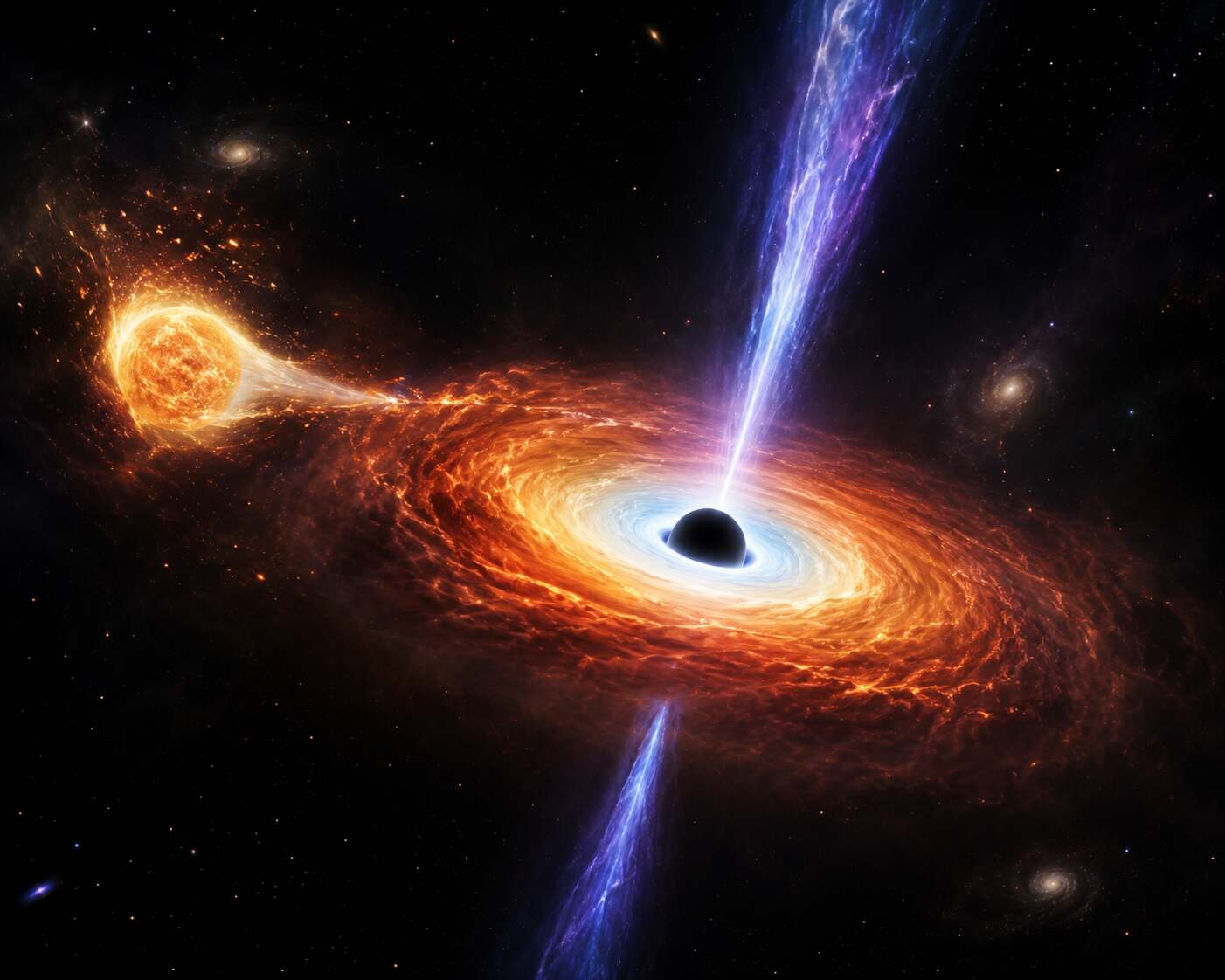
High-performance simulations reveal that the mysterious transient AT2019ijn may be powered by an off-axis relativistic jet from an intermediate-mass black hole, opening a new frontier in time-domain astrophysics.
Modern astronomy has entered an era where telescopes no longer make discoveries in isolation. Increasingly, the most profound scientific breakthroughs arise from a powerful synergy between observational surveys and high-performance computing. While modern instruments can detect extraordinary events billions of light-years away, deciphering their nature often relies on sophisticated numerical modeling to reconstruct the underlying physics.
A compelling example is the transient AT2019ijn, an unusual optical and radio outburst that defies conventional classification. Characterized by a rapid rise in brightness, a prolonged blue phase, and an exceptionally bright, long-lasting radio afterglow, the event fits poorly into established categories like supernovae or fast blue optical transients (LFBOTs), suggesting it represents an entirely new phenomenon.
This discovery is particularly significant for the high-performance computing community because it could not have been understood through observation alone. Successfully reconstructing one of the most energetic explosions ever observed in a dwarf galaxy required a complex suite of computational tools, including large-scale Bayesian inference, relativistic jet simulations, Markov chain Monte Carlo (MCMC) optimization, synchrotron emission modeling, and tidal disruption event (TDE) fitting.
An explosion that refused to fit the rules
AT2019ijn was discovered in the nucleus of a dwarf galaxy approximately 3.4 billion light-years away (redshift 0.2729). It reached an optical luminosity of about –21 magnitude in just over five days before fading over more than a month while maintaining a remarkably high blackbody temperature of roughly 15,000–16,000 K. These characteristics resemble fast blue optical transients, yet its slow decay is far more typical of tidal disruption events or superluminous supernovae. The real surprise came hundreds of days later.
Radio observations revealed emission that continued to rise long after the optical flash had faded, peaking 641 days after discovery at a luminosity of around 2 × 10³¹ erg s⁻¹ Hz⁻¹, more than an order of magnitude brighter than previously known radio-bright LFBOTs and comparable to relativistic jetted tidal disruption events. Such behavior immediately suggested that conventional explosion models were insufficient.
Turning observations into physics
Understanding the source required far more than comparing observations with previous events. The research team combined observational astronomy with advanced computational astrophysics to determine which physical scenario best reproduced every aspect of the transient.
Their first step involved fitting the optical spectral energy distribution using an MCMC framework with 64 walkers and 2,000 sampling steps to estimate the evolving temperature, luminosity, and emitting radius of the transient. These calculations established the unusually persistent thermal properties that distinguish AT2019ijn from known fast optical transients. The radio observations presented an even greater computational challenge.
Modeling a relativistic jet
To explain the delayed radio brightening, the researchers investigated whether AT2019ijn launched a relativistic jet pointed away from Earth. They employed VegasAfterglow, a high-performance numerical framework designed for multiwavelength afterglow simulations and Bayesian parameter estimation. The software models how relativistic jets propagate through the interstellar medium while accounting for synchrotron radiation, relativistic beaming, jet geometry, and energy transport.
The parameter space explored was enormous. The simulations considered initial Lorentz factors between 5 and 1,000, isotropic-equivalent jet energies spanning six orders of magnitude, interstellar medium densities covering five orders of magnitude, jet opening angles from 0° to 30°, and viewing angles ranging from directly on-axis to completely off-axis. Each candidate solution was evaluated through MCMC optimization using 16 walkers and one million sampling steps.
Such large Bayesian searches are precisely the kind of workload that benefits from leadership-class supercomputing systems, where thousands of parameter combinations can be evaluated simultaneously.
The best-fitting universe
The simulations converged on a remarkably energetic solution. The preferred model indicates that AT2019ijn produced a narrow relativistic jet with an opening angle of roughly 7°–10°, viewed from approximately 40° off-axis. The inferred isotropic-equivalent kinetic energy approaches 10⁵⁴ erg—comparable to the most energetic relativistic explosions known.
Because the jet was not pointed directly toward Earth, relativistic beaming initially suppressed the radio signal. As the jet slowed while interacting with surrounding gas, its emission gradually entered our line of sight, naturally producing the observed radio peak more than 600 days after the optical outburst. Without computational modeling, this delayed evolution would have remained difficult to interpret.
Testing competing physical models
The study did not stop with jet modeling. Researchers also examined whether the optical emission could originate from a newly born magnetar, a rapidly rotating neutron star with an extremely strong magnetic field. Bayesian fitting reproduced several optical properties, suggesting a millisecond spin period and magnetic field near 10¹⁴ gauss. However, the enormous radio energy proved difficult to reconcile with a magnetar unless highly specialized conditions were invoked.
The team then modeled the event using MOSFiT, a widely used computational framework for tidal disruption events. The best-fitting solution involved an intermediate-mass black hole of approximately 10⁵ solar masses disrupting a low-mass star. Bayesian model evaluation using the Widely Applicable Information Criterion (WAIC) indicated that this scenario is consistent with known tidal disruption events while naturally explaining the unusually rapid rise of the transient. Combining the optical fits, radio simulations, and host galaxy properties led the researchers to favor a jetted tidal disruption event involving an intermediate-mass black hole.
Supercomputing changes time-domain astronomy
The broader significance extends well beyond a single transient. Future observatories, including the Vera C. Rubin Observatory, the Square Kilometre Array, and the Nancy Grace Roman Space Telescope, will discover millions of transient events every year. Finding them will no longer be the limiting factor. Interpreting them will.
Each newly detected transient may require thousands or millions of numerical realizations spanning relativistic hydrodynamics, radiation transport, Bayesian inference, jet evolution, and statistical model comparison before astronomers can identify its physical origin. The bottleneck is rapidly shifting from telescope sensitivity to computational capability.
The next generation of discovery
AT2019ijn may ultimately represent the first recognized member of a previously unknown family of relativistic optical transients. The authors conclude that combining wide-field optical surveys with deep radio monitoring will be essential for discovering additional examples and determining how frequently intermediate-mass black holes launch relativistic jets. For the supercomputing community, the message is equally compelling.
The future of transient astronomy will not be defined solely by larger telescopes or more sensitive detectors. It will be shaped by the computational power needed to recreate extreme astrophysical environments, evaluate millions of possible universes, and identify the one that best matches reality. In that sense, every new supercomputer becomes more than a scientific instrument. It becomes a machine capable of revealing the hidden engines powering the most extraordinary explosions in the cosmos.