

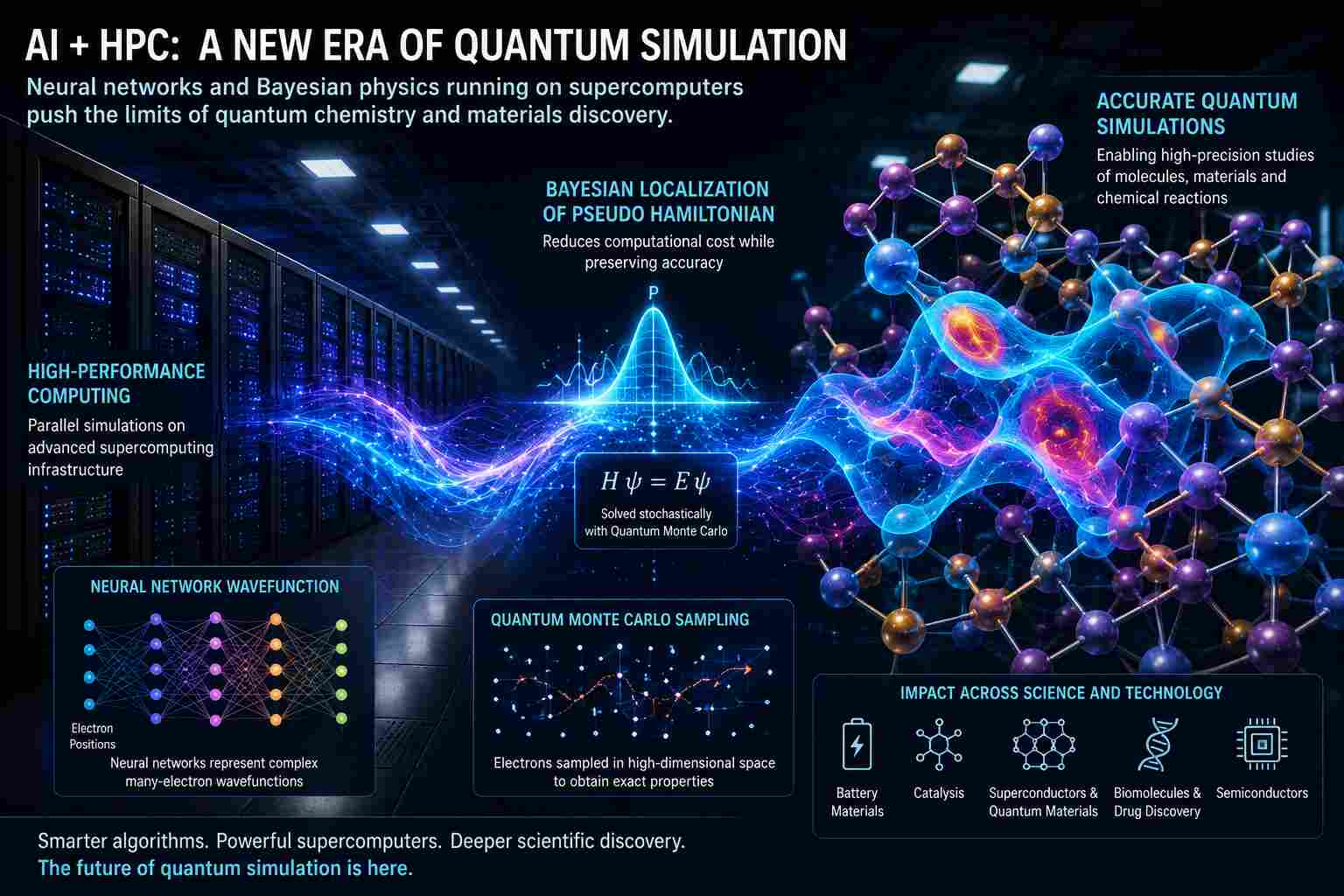
JAIST researchers combine artificial intelligence, Bayesian physics, and high-performance computing to make quantum Monte Carlo practical for larger molecular systems.
For decades, quantum chemists have grappled with a significant hurdle: the most precise methods for simulating molecular electronic behavior are also the most computationally demanding, limiting their use to small systems. Researchers from the Japan Advanced Institute of Science and Technology (JAIST), in collaboration with China’s ByteDance Seed and other institutions, have developed a solution.
As detailed in Nature Computational Science, their new framework integrates neural-network quantum Monte Carlo with a novel Bayesian localization technique. This innovation significantly lowers computational costs while maintaining the high accuracy required for first-principles simulations. Beyond the AI application, this work highlights the growing synergy between machine learning and high-performance computing, demonstrating how hybrid workflows can solve complex scientific problems that neither approach could effectively address in isolation.
Quantum Monte Carlo meets artificial intelligence
Quantum Monte Carlo (QMC) methods are widely regarded as among the most accurate computational techniques for solving the Schrödinger equation governing interacting electrons.
Unlike conventional density functional theory, QMC explicitly samples the quantum behavior of electrons using stochastic methods, often producing benchmark-quality predictions for molecular energies and material properties. The tradeoff has always been computational expense.
In recent years, neural-network wavefunctions have dramatically improved the expressive power of QMC calculations, allowing machine learning models to represent extremely complex electronic structures. However, training and evaluating these neural networks has introduced a new bottleneck: enormous computational requirements that restricted practical simulations to relatively modest molecular systems.
The JAIST-led team set out to remove that bottleneck.
A Bayesian shortcut for quantum physics
The researchers developed what they call Bayesian Localization of the Pseudo Hamiltonian, a mathematical framework that replaces computationally expensive nonlocal pseudopotential evaluations with localized approximations while maintaining high physical fidelity.
Rather than sacrificing accuracy for speed, the Bayesian framework intelligently estimates the localized interactions needed during quantum Monte Carlo sampling.
The result is a neural-network quantum simulation workflow that remains highly accurate while requiring substantially fewer computational resources. According to the researchers, the approach enables high-precision simulations of significantly larger molecular and materials systems than were previously practical.
For computational scientists, this represents the kind of algorithmic innovation that often produces larger performance gains than incremental hardware improvements alone.
Supercomputers still do the heavy lifting
Although artificial intelligence plays a central role, the research is fundamentally an HPC achievement.
The study relies on large-scale numerical simulation rather than replacing physics with machine learning. Neural networks become one component inside a much larger quantum computational pipeline that still demands substantial parallel computing resources.
The authors note that some of the calculations were performed using the facilities of the Center for Advanced Scientific Computing at JAIST, underscoring that state-of-the-art AI models continue to depend on advanced scientific computing infrastructure for both development and validation.
This reflects a growing trend across computational science: AI increasingly accelerates scientific simulation, but supercomputers remain the engines that make those simulations possible.
The rise of AI-augmented scientific computing
The new methodology belongs to a rapidly expanding class of hybrid computational techniques.
Rather than asking AI to replace traditional numerical simulation, researchers are embedding machine learning directly into established scientific algorithms.
In this study, neural networks improve the representation of electronic wavefunctions while Bayesian inference reduces the computational burden of evaluating pseudopotentials. The surrounding quantum Monte Carlo framework continues to enforce the underlying laws of quantum mechanics.
This philosophy differs fundamentally from purely data-driven AI.
Instead of learning chemistry from experimental databases alone, the algorithm performs physics-based simulations whose efficiency is enhanced by modern machine learning.
That distinction is increasingly defining next-generation scientific computing.
From molecules to materials
Reducing computational cost has implications far beyond faster benchmark calculations.
Many technologically important systems, including battery materials, heterogeneous catalysts, superconductors, semiconductor defects, and complex biomolecules, remain difficult to model accurately because of their electronic complexity.
The authors suggest their framework opens opportunities for investigating larger materials systems, more complicated chemical reactions, and biological phenomena that have previously remained beyond the practical reach of neural-network quantum Monte Carlo methods. Future extensions are expected to include broader elemental coverage, solid-state physics, and excited-state calculations.
For materials discovery, each increase in computational efficiency translates directly into larger searchable design spaces and more realistic simulations.
Algorithmic innovation as a performance multiplier
The history of supercomputing has often been told through faster processors and larger machines.
Yet many of the greatest advances have come from mathematics rather than hardware.
Multigrid solvers transformed computational fluid dynamics.
Fast Fourier Transforms revolutionized signal processing.
Sparse linear algebra enabled simulations that once seemed impossible.
The Bayesian localization strategy introduced in this work belongs to that same tradition.
Instead of waiting for future hardware generations, the researchers redesigned part of the quantum simulation itself, allowing existing HPC systems to solve substantially larger scientific problems.
Curiosity at the intersection of AI and HPC
As exaflops supercomputing continues to mature, researchers increasingly recognize that scientific progress will depend on both larger machines and smarter algorithms. The JAIST collaboration offers a compelling example of that convergence. Artificial intelligence contributes expressive neural representations. Bayesian statistics streamline quantum calculations. High-performance computing provides the computational foundation on which both operate. Together, they form a workflow capable of pushing neural-network quantum computation into scientific regimes that were previously impractical. For the HPC community, that may be the study’s most important lesson.
The next breakthroughs in computational chemistry are unlikely to come from AI alone or from faster supercomputers alone; they will emerge from carefully engineered collaborations between advanced algorithms and advanced computing infrastructure, where every improvement in mathematics unlocks more science from every available processor.