

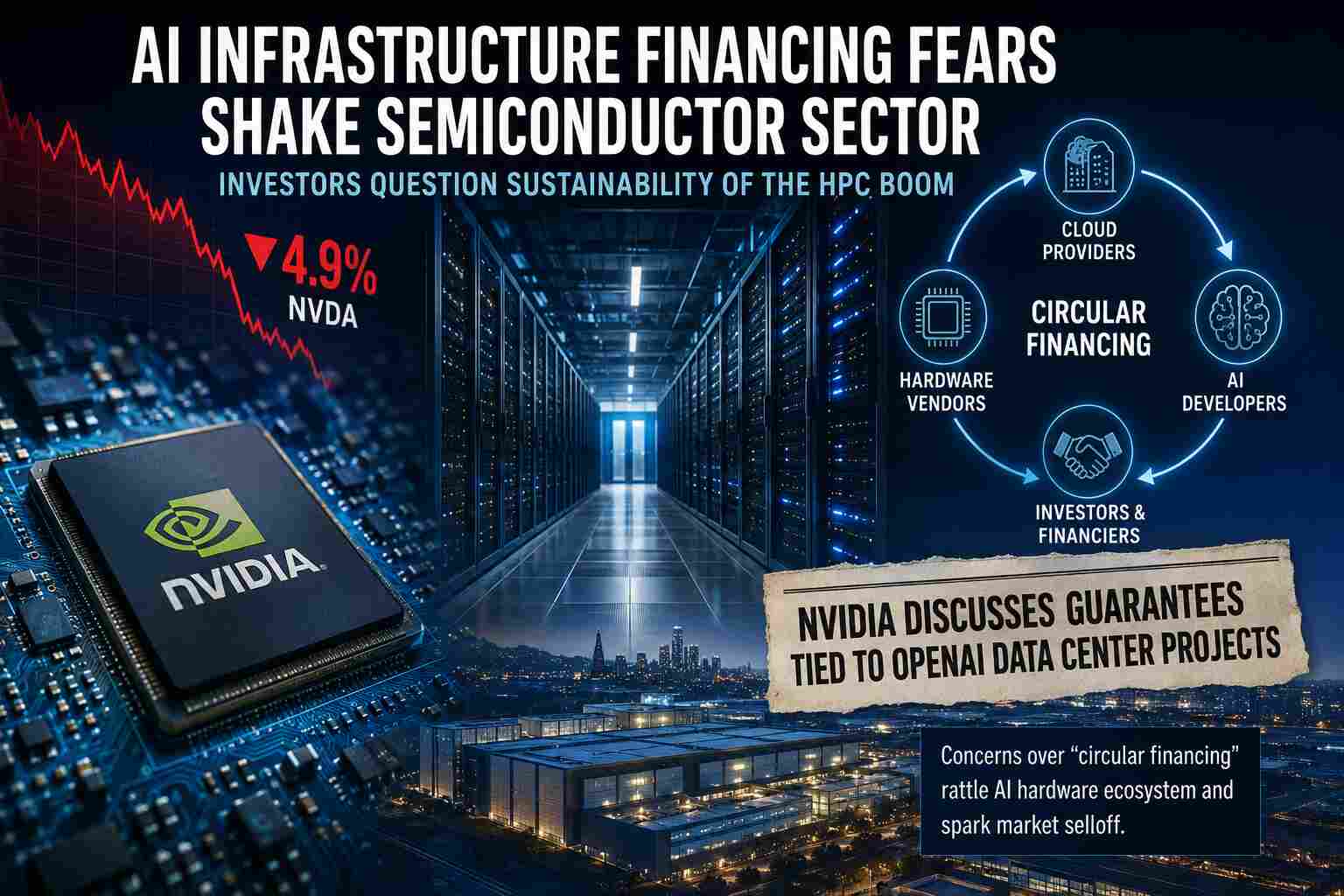
The semiconductor industry faced a significant selloff this week as investors questioned whether the rapid expansion of AI infrastructure is driven by sustainable end-user demand or a self-reinforcing cycle of investment. This uncertainty pushed Nvidia shares down nearly 5%, triggering a broader decline across the AI hardware sector and intensifying debates regarding the economic viability of massive supercomputing projects. Central to these concerns are reports that Nvidia may be providing financial guarantees for large-scale data-center initiatives involving OpenAI. While these arrangements reportedly stop short of Nvidia directly purchasing its own chips, investors fear the company is becoming excessively entangled in financing the very infrastructure that sustains its hardware sales.
The rise of "circular financing"
The term "circular financing" refers to a situation in which hardware vendors, investors, cloud providers, and AI developers become financially dependent on one another to sustain rapid expansion. Rather than infrastructure growth being driven solely by customer demand, critics fear that financing mechanisms could create a feedback loop where continued investment depends on ever-larger future investments.
Although these arrangements are not uncommon in large infrastructure industries, the AI boom has accelerated at an unprecedented pace. Multi-billion-dollar GPU clusters are now being planned across North America, Europe, and Asia, requiring financing packages that rival those used for airports, power plants, and telecommunications networks.
For investors, the concern is straightforward: if AI revenue growth slows, the financial obligations supporting these massive facilities could become increasingly difficult to justify.
Supercomputing's new economics
From the perspective of high-performance computing, the developments illustrate just how dramatically the industry has evolved.
Traditional supercomputers were typically funded through governments, universities, or national laboratories with long-term scientific objectives. Today's largest AI systems are often privately financed hyperscale computing facilities whose primary mission is training foundation models containing trillions of parameters.
These facilities require:
- Hundreds of thousands of GPUs
- Exabytes of high-speed storage
- Massive InfiniBand and Ethernet fabrics
- Gigawatts of electrical capacity
- Advanced liquid cooling systems
Each new AI supercomputer represents an investment measured not in millions, but often tens or even hundreds of billions of dollars.
Nvidia's position in the ecosystem
Nvidia remains the dominant supplier of accelerators powering modern AI supercomputers. Its GPUs underpin many of the world's fastest AI clusters, making the company's financial health closely tied to the pace of AI infrastructure deployment.
However, investors are now asking whether Nvidia is transitioning from being primarily a hardware supplier to becoming an active participant in financing AI expansion itself. Reports indicate discussions for guarantees associated with a major OpenAI data-center initiative, adding another layer of financial exposure beyond chip sales.
While such agreements could help accelerate deployment of next-generation AI systems, they also introduce additional financial risk if anticipated demand fails to materialize.
Ripple effects across the semiconductor industry
The market reaction extended well beyond Nvidia.
The semiconductor sector experienced a broad market retreat as investors scrutinized the sustainability of current AI infrastructure spending. Beyond Nvidia, the decline impacted a wide range of companies, including memory manufacturers and semiconductor equipment suppliers, as market sentiment shifted toward reevaluating future demand for AI hardware. South Korean memory producers faced particularly significant pressure, struggling with the dual concerns of cooling AI capital expenditure and rising competitive threats from the Chinese semiconductor industry.
The selloff highlights the growing interconnectedness of the AI hardware supply chain. GPU manufacturers, memory vendors, networking companies, cooling providers, and data-center builders now depend on sustained investment in AI infrastructure.
Implications for high-performance computing
For the HPC community, the situation represents both a challenge and an opportunity.
The enormous investments flowing into AI infrastructure continue to accelerate innovation in:
- GPU architectures
- High-bandwidth memory
- High-speed interconnects
- Power-efficient computing
- Advanced cooling technologies
These technologies frequently migrate into traditional scientific computing environments, benefiting researchers running climate simulations, molecular dynamics, astrophysics, computational fluid dynamics, and digital twin applications.
However, if financing concerns slow private-sector AI investment, the pace of hardware innovation could moderate, affecting the broader supercomputing ecosystem.
Looking ahead
The current debate centers less on the necessity of enormous computational resources for AI and more on the long-term sustainability of the financing models supporting them. For the supercomputing industry, this shift highlights that building exaFLOPS infrastructure is no longer solely a technological challenge; financial engineering has become as critical as processor design, network performance, and software optimization. As AI supercomputers continue to scale, the industry's success will depend on establishing robust economic frameworks supporting the next generation of computational infrastructure.