

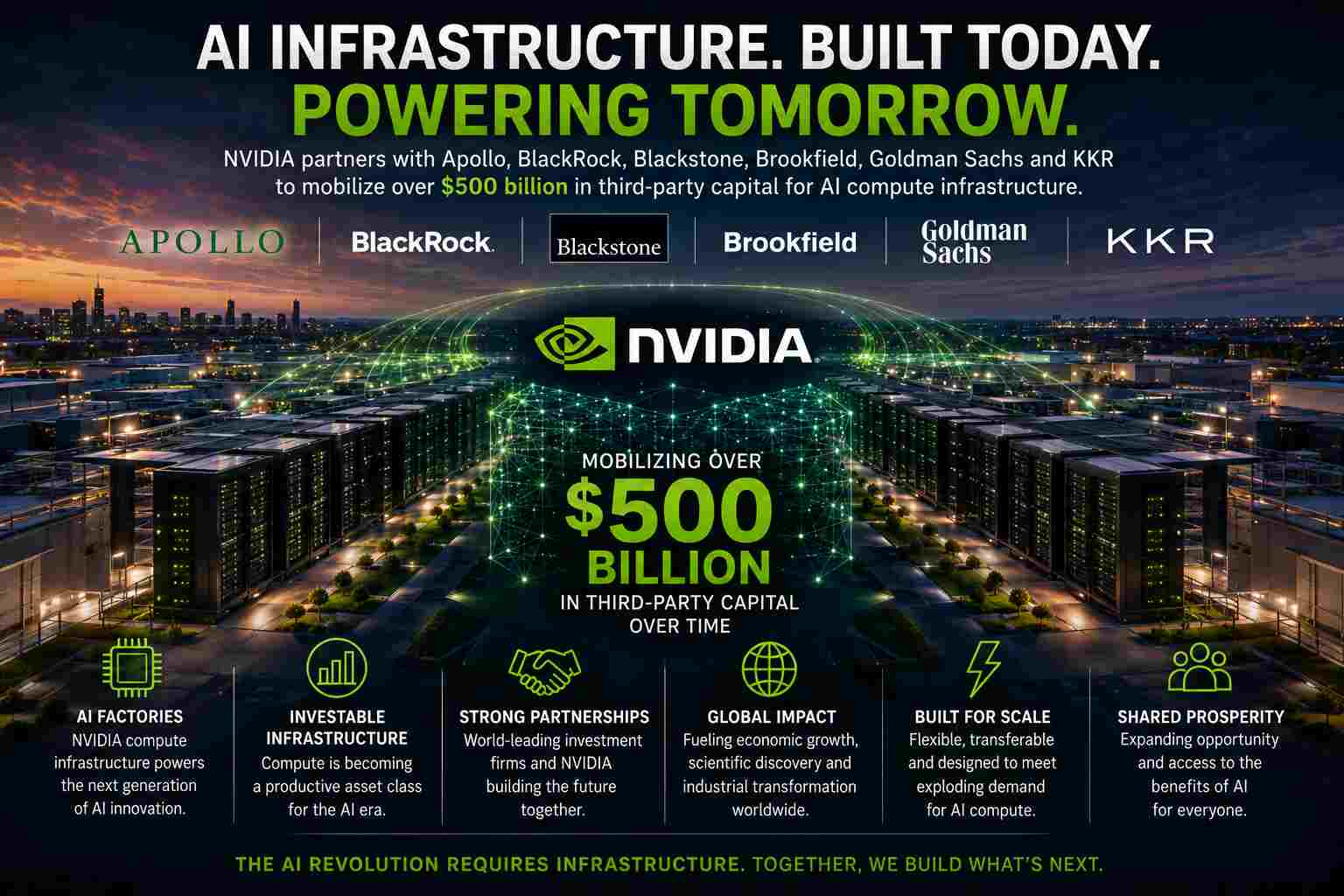
A landmark financing push with Apollo, BlackRock, Blackstone, Brookfield, Goldman Sachs and KKR signals that computing power is becoming infrastructure, and infrastructure is becoming an investment.
NVIDIA’s recent strategic shift, underscored by major partnerships with financial giants such as BlackRock, Apollo, and Blackstone, marks a fundamental transition in how the global economy views computing power. Traditionally, hardware like servers and supercomputers were treated as depreciating corporate expenses, requiring significant capital outlays that served as a cost of doing business. By mobilizing $500 billion in third-party capital, NVIDIA is repositioning "AI factories" as durable, revenue-generating infrastructure; a move that aligns AI compute with the investment profiles of traditional power grids or telecommunications networks.
This financial framework transforms the supercomputer into an income-producing asset class rather than a standalone piece of equipment. By connecting institutional investors with AI infrastructure developers, NVIDIA is effectively outsourcing the capital burden of the AI buildout while creating a powerful, self-reinforcing feedback loop. As more capital is directed toward the construction of NVIDIA-powered AI factories, the reach of the company's hardware and CUDA software ecosystem expands, making its infrastructure increasingly essential and harder to displace. Ultimately, this paradigm shift suggests that the future of computing is less about one-off equipment sales and more about sustaining an ongoing, multi-year "super cycle" of infrastructure investment, where computational capacity serves as the primary engine for long-term economic growth.
Compute is no longer just a cost
The central idea behind the announcement is remarkably straightforward.
AI systems require enormous quantities of computing power. Companies need accelerators, servers, networking, storage, data centers, and the electricity required to operate them. As demand for AI services grows, organizations increasingly need guaranteed access to large amounts of computational capacity.
That makes compute increasingly resemble traditional infrastructure.
A power plant produces electricity.
A telecommunications network delivers connectivity.
A data center delivers computing.
An AI factory delivers something even more economically interesting: computational capacity that can generate revenue.
NVIDIA CEO Jensen Huang put the concept bluntly, describing the company’s transition from building chips to helping create a new class of productive, investable infrastructure called “AI factories.” NVIDIA argues that its compute is broadly adopted, flexible across models and workloads, transferable among customers and supported by the company’s CUDA software ecosystem.
That combination is precisely what makes infrastructure attractive to long-term investors.
Wall Street has entered the supercomputing business
The list of financial partners is itself a signal.
Apollo, BlackRock, Blackstone, Brookfield, Goldman Sachs and KKR collectively represent enormous pools of institutional and alternative capital.
Rather than asking technology companies to finance the entire AI buildout from their own balance sheets, the new platforms are designed to connect NVIDIA-based computing infrastructure with investors seeking long-duration opportunities.
The proposed financing platforms would create dedicated pools of capital for NVIDIA customers, including frontier AI laboratories, enterprises, and AI cloud providers.
In other words, the financial system is beginning to treat computational infrastructure more like a conventional infrastructure investment.
That is a major milestone for the computing industry.
The $500 billion number matters, but so does what it represents.
NVIDIA says the partnerships are intended to mobilize more than $500 billion in third-party capital over time.
That figure should not be interpreted as $500 billion already committed to construction.
The company says the partnerships are subject to final agreements, and the announcement does not disclose individual investment commitments or a deployment timetable.
But the scale of the target is still extraordinary.
It demonstrates the size of the financial opportunity that institutional investors increasingly see in AI infrastructure.
Reuters reported that NVIDIA CEO Jensen Huang said NVIDIA has the option to backstop up to $125 billion, or 25%, of potential deals, although the final terms have not been disclosed.
The important point is not simply the headline number.
It is the emergence of a financing mechanism designed specifically around computational capacity as an economic asset.
Why NVIDIA is in such a powerful position
The announcement is also exceptionally good news for NVIDIA.
The company is no longer positioning itself simply as the manufacturer of the accelerators powering AI.
It is increasingly positioning itself at the center of an entire infrastructure ecosystem.
Every new AI factory potentially creates demand for NVIDIA GPUs and accelerated computing platforms.
But the relationship does not necessarily end when the hardware is sold.
NVIDIA emphasizes that its compute is supported by CUDA, its broad software ecosystem, and a large developer and customer base. The company argues that these characteristics can extend the useful economic life of its computing infrastructure and make capacity more flexible and transferable among customers and operators.
That creates a powerful feedback loop.
More capital → more AI infrastructure → more NVIDIA compute → more software adoption → more demand for AI capacity → more capital.
The financing announcement could therefore help NVIDIA accelerate the expansion of the very ecosystem that reinforces its competitive position.
The AI factory becomes the new industrial unit
The term AI factory deserves attention.
For much of the industrial age, factories transformed physical inputs into physical products.
Modern data centers transformed information.
AI factories are beginning to transform enormous quantities of data and computing cycles into intelligence.
They train models.
They run inference.
They generate software.
They analyze scientific data.
They design products.
They optimize industrial processes.
They support autonomous systems.
And increasingly, they produce the computational services that businesses themselves sell to customers.
The AI factory is therefore becoming an industrial asset in its own right.
NVIDIA’s financing strategy recognizes that shift.
If an AI factory can produce revenue over many years, it becomes possible to evaluate its economics in ways that resemble other infrastructure investments.
A new way to finance supercomputing
Traditional supercomputing has frequently depended on government budgets, research grants and institutional capital.
That model remains essential for scientific research.
But commercial AI is introducing another path.
Instead of a government agency building a supercomputer primarily for scientific research, an infrastructure investor can finance a computing facility because organizations are willing to pay for the computational capacity it produces.
This changes the economic model.
The question becomes less:
How much does this computer cost?
and more:
How much revenue can this computational infrastructure generate over its useful life?
That is a fundamental shift.
It also explains why the language of “asset class” is so important.
Compute has become scarce infrastructure
NVIDIA’s announcement arrives at a moment when computational capacity has become one of the biggest constraints facing the AI industry.
The world’s leading AI developers are competing for access to GPUs, networking, data centers and electricity.
The bottleneck is no longer simply whether someone can write a sufficiently sophisticated algorithm.
They need somewhere to run it.
NVIDIA describes modern compute as a scarce, mission-critical asset class with characteristics that can support long-term investment. Apollo similarly described modern compute as a scarce asset positioned to drive economic growth and productivity gains.
Brookfield called compute an increasingly essential layer of infrastructure and a core part of its AI infrastructure strategy, while KKR described compute as a critical infrastructure asset.
When multiple major infrastructure investors independently begin using that language, something important is happening.
The market is changing how it thinks about computing.
The supercomputer becomes a financial product
This may be the most consequential development hidden inside the announcement.
A supercomputer used to be something an organization purchased.
The emerging model is different.
An investor can finance the facility.
A technology company supplies the computing platform.
A data center operator builds and runs the infrastructure.
An AI company leases or consumes the capacity.
Customers pay for computational services.
Investors receive returns generated by that infrastructure.
The physical machine remains a piece of hardware.
But economically, the entire system becomes an income-producing computational asset.
That is a very different way of thinking about supercomputing.
NVIDIA’s opportunity extends beyond hardware
For NVIDIA, this financial architecture could be especially powerful.
The company has already built one of the world’s most influential accelerated-computing ecosystems.
Now capital markets can potentially help expand the physical footprint supporting that ecosystem.
The result could be a much larger installed base of NVIDIA-powered AI infrastructure without NVIDIA itself having to finance every dollar of the global buildout.
That is strategically significant.
The more infrastructure built around NVIDIA’s platform, the more opportunities exist for developers, enterprises, governments and cloud providers to adopt its hardware and software.
And as those customers become increasingly dependent on accelerated computing, the ecosystem becomes harder to displace.
Wall Street’s AI infrastructure super cycle
The announcement also reflects a broader transformation taking place across financial markets.
Reuters reported in July that Wall Street banks were seeing an AI-driven capital expenditure “super cycle,” with investment banks increasingly involved in equity issuance, debt financing, mergers and acquisitions and data-center financing. Morgan Stanley had raised its estimates for data-center capital expenditure substantially, while Goldman Sachs described the AI infrastructure buildout as a multi-year investment cycle.
The NVIDIA announcement takes that trend to another level.
Instead of financing individual companies alone, capital is increasingly being organized around the physical infrastructure required to run AI.
That potentially creates a much broader investment universe.
AI is no longer simply a software story.
It is becoming an infrastructure story.
The economic multiplier
The implications extend well beyond NVIDIA and its financial partners.
Building AI infrastructure requires construction workers, electrical engineers, equipment manufacturers, networking specialists, cooling technologies, power generation, utilities, fiber networks and data-center operators.
Every new AI factory can therefore create demand throughout an extensive industrial ecosystem.
BlackRock CEO Larry Fink said the partnership is intended to connect long-term capital with essential infrastructure and help deliver the computing capacity companies need to grow.
That is why the economic significance of AI infrastructure may ultimately be much larger than the value of the chips themselves.
The chips are the computational engines.
The surrounding infrastructure is the industrial system.
There are real constraints
The optimism should not obscure the challenges.
Building hundreds of billions of dollars of AI infrastructure requires more than money.
It requires electricity.
It requires land.
It requires permits.
It requires transmission capacity.
It requires water and cooling solutions.
It requires construction at unprecedented speed.
And it requires customers willing to commit to using the resulting capacity.
Recent reporting shows that data-center financing is already becoming more complicated in some U.S. communities as residents and governments debate electricity consumption, water use, noise, and land use. Lenders are increasingly examining permitting and community support when evaluating projects.
Capital can solve some problems.
It cannot manufacture electricity overnight or eliminate local permitting requirements.
The next phase of the AI infrastructure boom will therefore require coordination among technology companies, investors, utilities, governments and communities.
A vote of confidence in the future of compute
Nevertheless, the NVIDIA announcement represents a powerful vote of confidence.
Some of the world’s largest financial institutions are preparing to deploy capital around the proposition that demand for computational infrastructure will remain substantial for years.
That is significant.
Investors are not simply betting on another generation of software.
They are investing in the physical infrastructure required to run an increasingly computational economy.
And NVIDIA sits remarkably close to the center of that transformation.
From chip company to infrastructure platform
NVIDIA’s evolution is becoming increasingly fascinating.
The company began as a semiconductor designer focused on graphics processors.
Its technology then became foundational to accelerated computing.
Accelerated computing became central to modern AI.
AI created unprecedented demand for data-center compute.
And now that compute is being packaged into an infrastructure investment thesis capable of attracting some of the world’s largest pools of private capital.
That is an extraordinary progression.
NVIDIA isn’t abandoning chips.
It is building an economic ecosystem around them.
The supercomputing investment era
For decades, supercomputing was primarily about capability.
How many calculations could a machine perform?
How much memory did it have?
How fast was its interconnect?
How efficiently could researchers run simulations?
The next era adds another question:
What is that computational capacity worth as an asset?
The answer could reshape the industry.
If compute can generate predictable, long-duration revenue, it becomes easier to finance.
If it can be financed, more infrastructure can be built.
If more infrastructure is built, more organizations can access advanced computing.
And if more organizations gain access to advanced computing, AI can spread into industries that have barely begun to exploit it.
That is the optimistic possibility embedded in NVIDIA’s announcement.
The bigger picture
The $500 billion target is therefore about much more than money.
It represents a recognition that computing has become part of the world’s physical economic infrastructure.
The data center is becoming as strategically important to the digital economy as the factory was to the industrial economy.
The GPU is becoming a productive industrial component.
AI compute is becoming something investors can evaluate, finance, and potentially own exposure to.
And NVIDIA is positioning itself not simply as a supplier of that infrastructure, but as one of the central architects of the ecosystem surrounding it.
For Supercomputing News readers, that may be the most exciting development of all.
The supercomputing revolution is moving beyond the laboratory.
It is moving beyond the traditional data center.
And now it is entering the capital markets.
Compute has become an asset class.
If NVIDIA and its partners can turn that proposition into hundreds of billions of dollars of productive infrastructure, the result could be one of the largest expansions of computing capacity in history, and another major step toward a world in which advanced computation is not a scarce privilege, but a fundamental layer of the global economy.