

Detailed stellar-evolution calculations running on the University of Bonn’s Bonna supercomputing cluster are helping astronomers reconstruct ancient episodes of mass transfer that most telescopes can no longer see.
Some stars carry evidence of their past in a place astronomers can still observe: their surfaces.
Long after a companion has disappeared, exploded, or merged with it, a massive star can retain a chemical fingerprint of what happened during an extraordinary period of its life. The challenge is figuring out what that fingerprint means.
A new study published in Nature Astronomy https://www.nature.com/articles/s41550-026-02943-1 shows how detailed stellar-evolution modeling and high-performance computing can turn those chemical clues into a kind of computational time machine, allowing researchers to reconstruct the hidden histories of massive binary systems.
The research, by Harim Jin and Norbert Langer, uses a comprehensive grid of massive-binary evolution models to identify systematic patterns in the surface abundances of stars that appear to be single today. The calculations were performed using the Bonna cluster hosted by the University of Bonn, which provided the computational foundation for the stellar-evolution calculations and subsequent analysis.
For the supercomputing community, the story is especially compelling because the researchers are confronting a problem that cannot realistically be solved by simply watching the sky.
They are computing the past.
A stellar crime scene written in chemistry
Massive stars rarely live solitary lives.
The paper notes that roughly 70% of unevolved massive stars are expected to have companions close enough for mass exchange to eventually become inevitable. Yet the critical mass-transfer phase can occupy less than 0.1% of a star’s lifetime, making it extraordinarily unlikely that astronomers will observe the interaction as it happens.
The result is an astronomical mystery.
A binary system can exchange enormous quantities of material. One star can strip its companion. The recipient can spin up, mix chemically, and become the brighter member of the system. Eventually, the donor may explode, disappear, or otherwise become difficult to detect.
What remains?
The recipient star.
And potentially, its chemistry.
Carbon, nitrogen, oxygen, and helium can preserve information about material that was transferred from the companion billions or millions of years ago, or, for these massive stars, typically much shorter stellar timescales.
The researchers’ computational challenge was to determine whether those chemical fingerprints could be decoded.
Why computing becomes essential
The physics of a massive binary system is extraordinarily complicated.
Two stars evolve simultaneously while interacting gravitationally. Their masses change. Their orbital properties change. Material moves from one star to the other. Angular momentum is transferred. Rotation changes. Internal mixing processes redistribute chemical elements.
The computational model must follow these processes through stellar evolution.
The researchers used Modules for Experiments in Stellar Astrophysics (MESA) to calculate detailed binary evolution models incorporating mass and angular-momentum transfer, differential rotation, and tides. The models also include an extended nuclear network that follows the time evolution of stable CNO isotopes during hydrogen burning.
That level of detail matters.
A simpler model might tell astronomers that two stars exchanged mass.
These calculations can investigate what material was transferred, how much was transferred, how the recipient mixed it, and what chemical signature ultimately appeared at its surface.
The result is not one simulation representing one star.
It is a computational landscape of possible stellar histories.
Building a digital population of massive binaries
One of the study’s most important computational advances is the use of a comprehensive grid of detailed massive-binary evolution models.
Rather than examining one hypothetical binary at a time, the researchers work across binary parameter space, looking for recurring relationships between a system’s original configuration and the chemical fingerprints eventually displayed by its stars.
This is exactly where high-performance computing changes what scientists can ask.
The researchers can explore combinations of stellar masses, mass-transfer behavior, and evolutionary states, then compare the resulting populations with actual observations.
Instead of asking:
Could this particular binary have produced this star?
The computational approach moves toward a much more powerful question:
What combinations of binary properties naturally produce the chemical fingerprints we observe?
That distinction transforms the calculation from a demonstration into a diagnostic tool.
Following the chemistry through the simulation
The simulations pay particular attention to the elements affected by the CNO cycle: helium, carbon, nitrogen, and oxygen. These elements provide useful tracers because nuclear processing inside massive stars changes their relative abundances in predictable ways.
The computational models reveal distinctive behavior after mass transfer.
Material from a donor can be deposited onto its companion’s envelope. The recipient then undergoes mixing processes that alter how that material is distributed through the star.
The simulations explicitly track processes including thermohaline mixing and rotational mixing. Extended model data show how these processes affect chemical profiles over time, including the transition from rapid post-accretion mixing to slower mixing during subsequent nuclear evolution.
This produces something extraordinarily useful for astronomers:
a predicted chemical trajectory.
A star’s measured abundance pattern can then be compared with those computational trajectories.
Turning a simulation into a stellar time machine
The researchers complement the detailed numerical models with an analytic framework that allows them to work backward from observed surface abundances.
The framework considers a case-B mass-transfer scenario in which the initially more massive star expands after exhausting hydrogen in its core. Its companion can then accrete portions of the donor’s envelope and hydrogen/helium-gradient layer.
The surface composition provides clues about the quantity and composition of the accreted material.
The researchers can therefore use observed quantities to constrain properties of the binary that no longer exist as an observable binary system.
The computational process is effectively:
observe → model → compare → constrain → reconstruct.
That is a powerful example of computational science serving as an instrument of discovery.
The case of γ Columbae
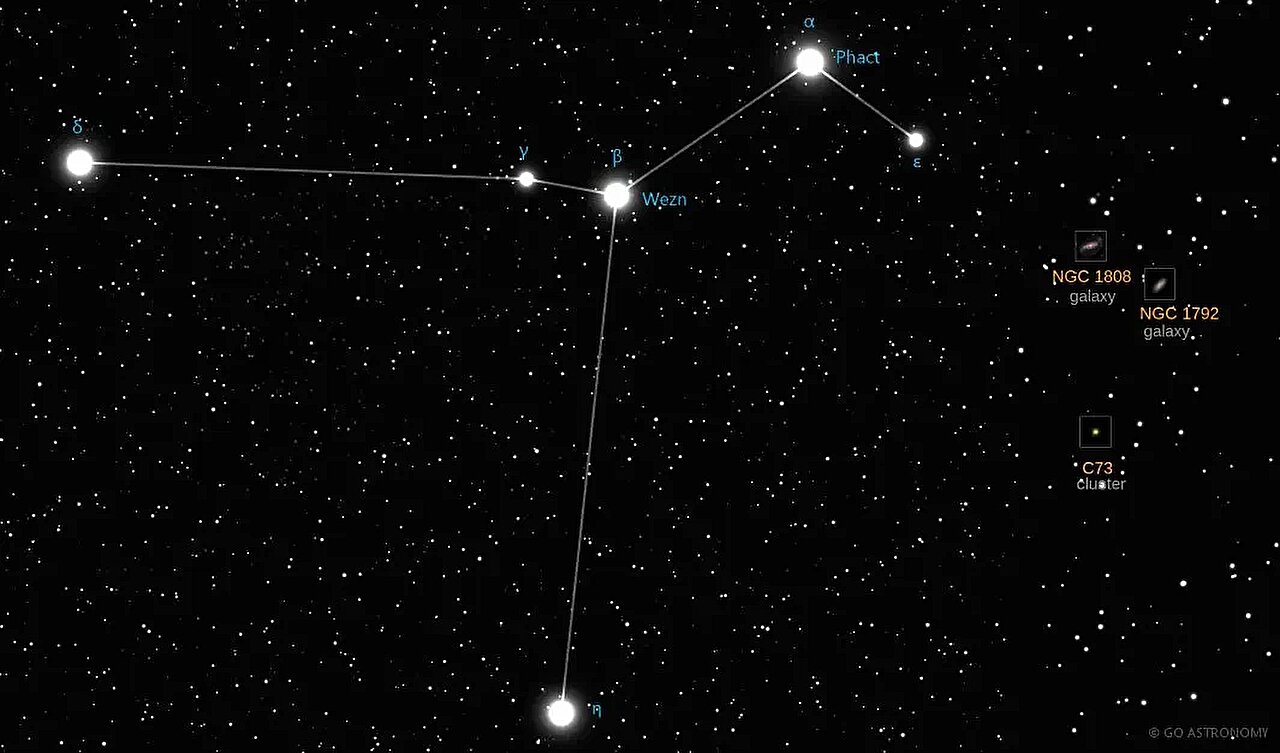
One of the most intriguing demonstrations involves γ Columbae, a naked-eye B-type star that appears to be single.
Its observed surface chemistry includes substantial helium enrichment and a nitrogen enhancement of roughly a factor of seven. The researchers find that its chemical composition is consistent with a history in which the star gained material from a companion.
The computational reconstruction suggests that γ Columbae accreted approximately 0.8 solar masses of material containing CNO-equilibrium matter.
That is a remarkable amount of material to have incorporated into a star.
The modeling further constrains γ Columbae’s initial mass to less than about 5.2 solar masses, while the donor must have had an initial mass of at least roughly 14 solar masses under the relevant evolutionary assumptions. The resulting initial mass ratio was below 0.35, with the mass transfer being highly non-conservative.
In other words, the computer model reconstructs a binary relationship that is no longer directly visible.
The star remembers.
The simulation learns how to read the memory.
The computational model becomes a lab.
This is perhaps the most important aspect of the research from an HPC perspective.
Scientists cannot rewind a real binary star.
They cannot repeat its mass-transfer episode with different initial masses.
They cannot alter its mass-transfer efficiency and observe the result.
They cannot run the same star again with different mixing physics.
A computational model can do all of those things.
The researchers can examine how different assumptions affect the resulting abundance patterns and determine which regions of parameter space are compatible with observations.
The paper even includes a newly computed model in which the efficiency of slow mixing is increased by a factor of ten, illustrating how the predicted evolutionary path changes.
That is the power of simulation.
The computer provides experiments that the universe does not.
Why the size of the model grid matters
The problem becomes especially challenging because massive-star evolution involves numerous interacting parameters.
The initial masses of the two stars matter.
So does their mass ratio.
So does the orbital configuration.
So does how efficiently material is transferred.
So do rotation, tides, and internal mixing.
The paper emphasizes that the researchers’ model grid fixes several uncertain physical parameters, including mass-accretion efficiency and thermohaline-mixing efficiency. Those uncertainties limit the parameter space currently covered by the calculations.
That is not a weakness of computational science.
It is one of its greatest strengths.
Once a model exposes where uncertainty remains, researchers know exactly where future calculations and observations need to improve.
The computer isn’t simply producing an answer.
It is identifying the next scientific question.
From individual stars to the evolution of galaxies
The significance extends beyond individual stellar systems.
Massive binary interactions can determine whether stars merge, how they explode, and what remnants they leave behind. Those outcomes influence the chemical, mechanical, and radiative feedback massive stars provide to their surrounding galaxies.
That means the seemingly small question of whether one star gained mass from another can eventually connect to much larger questions:
How do massive stars die?
Which stars produce supernovae?
How are black holes and neutron stars formed?
How are heavy elements distributed?
How does stellar feedback shape galaxies?
And how do populations of massive stars evolve across cosmic time?
Computational stellar evolution provides a bridge between those scales.
A new way to identify “single” stars
One of the paper’s most intriguing conclusions is that many stars that appear to be single may actually be survivors of binary interaction.
The authors find that stars showing characteristic CN-cycle signatures can naturally arise as mass gainers, offering an explanation for their chemical properties that is simpler than some alternatives.
The distinction can be made computationally because the predicted abundance patterns of mass gainers differ from those expected from ordinary single-star rotational mixing.
The models show that binary accretion can produce substantially higher N/C ratios than rotational mixing alone for moderate N/O values.
That gives astronomers a new diagnostic.
A star that looks alone may not have lived alone.
Its surface can reveal the difference.
Supercomputing the invisible
There is an important lesson here for the broader scientific supercomputing community.
Not every HPC breakthrough produces a spectacular animation of a galaxy or a record-breaking simulation.
Sometimes the computer’s most important contribution is subtler.
It allows researchers to explore a space of possibilities that nature has already explored once, but will never repeat for us.
In this case, the universe performed the experiment millions of years ago.
The evidence is still arriving through telescopes.
The supercomputer provides the laboratory in which scientists can reconstruct what happened.
What comes next
The researchers see considerable potential in expanding the approach to larger samples of stars.
They argue that more systematic and precise abundance measurements could reduce uncertainties in the physics of mass transfer and improve the ability to identify stars enriched by previous binary interactions.
Future observations could therefore feed directly into increasingly sophisticated computational model grids.
More stars provide more constraints.
More constraints expose weaknesses in existing models.
Improved models produce better predictions.
And better predictions can be tested against still more observations.
It is a scientific feedback loop powered by both telescopes and computing.
The supercomputer as a cosmic historian
High-performance computing is transforming astrophysics into a reconstructive discipline. By using supercomputing clusters like Bonna to model binary evolution, researchers can now reverse-engineer stellar histories through several key methodologies:
- Diagnostic Mapping: Mapping relationships between chemical fingerprints and the binary systems that produced them.
- Predictive Trajectories: Using temporal maps to trace a star’s evolutionary path backward in time based on surface abundance shifts.
- Decoupling Variables: Isolating individual physical processes, such as rotational or thermohaline mixing, to analyze their unique contributions.
- Identifying “Hidden” Binaries: Recognizing apparent single stars as former mass-gainers by decoding their chemical records.
- Defining Unknowns: Using model limitations to create a precise roadmap for future research and observations.
This computational shift allows scientists to turn a star’s chemical surface into a narrative, decoding events that occurred long before humans began observing the sky. When the universe provides a “crime scene” but no witnesses, supercomputing provides the necessary logic to reconstruct the past.