

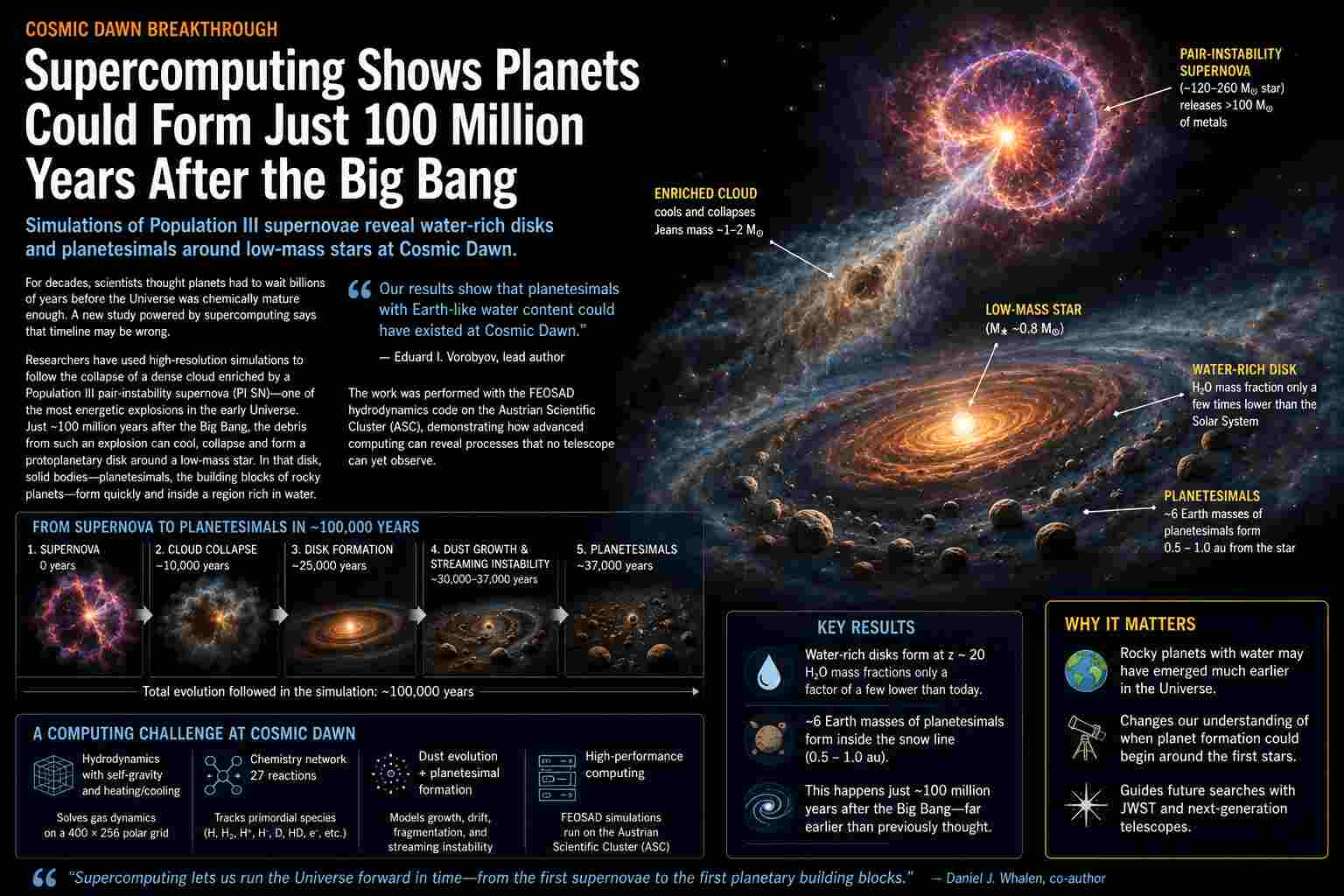
High-resolution simulations on the Austrian Scientific Cluster show that water-rich planetesimals could have formed around low-mass stars only about 100 million years after the Big Bang, far earlier than the conventional picture of planet formation might suggest.
The first stars did not merely illuminate the young Universe.
According to a new computational study, they may also have begun building planets almost immediately afterward.
Using detailed hydrodynamic simulations, researchers have modeled the evolution of a protoplanetary disk around a low-mass star formed from gas enriched by an earlier Population III pair-instability supernova. The calculations follow the transformation of primordial material into dust, the growth of that dust, the emergence of gravitational structures within the disk and, ultimately, the formation of planetesimals, the building blocks of planets.
The simulations were performed using the FEOSAD numerical framework on the Austrian Scientific Cluster (ASC). Rather than observing an ancient planetary system directly, the researchers have effectively reconstructed its formation computationally.
The result is remarkable: the models produce approximately 6 Earth masses of planetesimals over the simulated disk evolution, with a substantial fraction of the material water-rich.
For SuperComputing News, however, the most compelling aspect is not simply that the early Universe may have formed planets.
It is that high-resolution computation allows scientists to experiment on an era of cosmic history that no telescope can directly revisit.
A Planetary System Before the Solar System Had a Chance to Exist
The Universe was initially dominated by hydrogen and helium.
The heavier elements required for rocky planets, carbon, oxygen, silicon, iron, and others, were manufactured inside stars and distributed into space when those stars died.
That creates an obvious question: How quickly could planet formation begin?
The new simulations investigate one possible pathway.
A massive first-generation star undergoes a pair-instability supernova, enriching its surrounding environment with heavy elements. That material subsequently collapses to form a low-mass protostar and its surrounding disk.
The researchers then follow what happens inside that disk.
The simulation places this process at approximately 100 million years after the Big Bang.
That is extraordinarily early.
Yet the computation suggests that once even a modest amount of heavy elements becomes available, the basic machinery of planet formation may begin operating surprisingly quickly.
The Computer Becomes a Laboratory for Cosmic Dawn
There is no possibility of observing the formation of these particular systems directly.
They existed more than 13 billion years ago.
Instead, researchers must construct a numerical representation of the physical environment and allow the equations governing gas, dust, gravity, and chemistry to determine what happens.
The simulations use FEOSAD, a two-dimensional radiation-hydrodynamics code designed to model the evolution of protoplanetary disks.
The calculation simultaneously follows gas and dust while incorporating gravitational dynamics, heating and cooling, dust evolution, and the conversion of dust into planetesimals.
That combination makes the calculation substantially more than a simple orbital simulation.
It is an evolving multiphysics system.
Gas changes the gravitational environment.
Temperature influences the disk.
Dust grows and migrates.
Dust concentration changes the conditions for gravitational and aerodynamic instabilities.
And those instabilities can ultimately produce planetesimals.
The computer has to keep all of these processes interacting consistently.
Modeling a Cosmic Dawn Disk
The researchers simulate the disk using a 400 × 256 polar grid, following approximately 100,000 years of evolution.
Near the inner boundary, the spatial resolution reaches roughly 0.01 astronomical units.
That resolution is significant because the interesting physics occurs across vastly different spatial scales.
The disk itself extends across astronomical distances, while dust concentration and planetesimal formation involve much smaller structures.
A computational model therefore has to balance physical detail against the enormous cost of resolving the system.
This is one reason high-performance computing is so important to the work.
The simulation was performed on the Austrian Scientific Cluster, providing the computational resources needed to evolve the disk and its coupled physical processes.
From Supernova Debris to a Protostar
The simulation begins with material enriched by a Population III pair-instability supernova.
That material undergoes gravitational collapse.
Approximately 24,000 years after the beginning of the simulated collapse, a protostar forms, followed roughly 1,000 years later by the emergence of its disk.
This sequence is important.
The simulation isn’t simply inserting a mature protoplanetary disk into the early Universe.
It follows the transition toward the disk itself.
Once the disk develops, gravity begins shaping its structure.
By approximately 21,000 years after protostar formation, the model produces prominent spiral structures associated with gravitational instability.
Those spirals become part of the mechanism by which material moves through the disk.
The Chemistry of a Young Planetary System
The simulation also incorporates a chemical network specifically designed for low-metallicity environments.
The model includes 27 reactions involving primordial species such as hydrogen, molecular hydrogen, ionized hydrogen, negative hydrogen ions, deuterium, HD, and electrons.
That chemistry matters because the thermal evolution of the gas affects the dynamics of the disk.
Temperature influences pressure.
Pressure influences gravitational stability.
And temperature and density also influence how dust behaves.
The researchers use numerical root-finding procedures, including Newton-Raphson iteration with bisection fallback, to solve the energy equation within the simulation.
This is a useful reminder that a modern astrophysical simulation is not one equation running on a computer.
It is a tightly coupled numerical system in which chemistry, thermodynamics, radiation, and gravity continually interact.
The Critical Transition: Dust Becomes Planetary Building Material
Planets don’t form directly from a diffuse gas disk.
Small solid particles first have to grow.
Those particles can collide and stick, becoming progressively larger grains.
Eventually, however, another problem emerges.
If particles simply grow and drift inward toward the star, much of the solid material could disappear before becoming planets.
One of the mechanisms that can overcome this problem is the streaming instability.
When solids become sufficiently concentrated relative to the gas, aerodynamic interactions can amplify those concentrations.
The resulting dense regions can collapse into much larger solid body planetesimals.
The simulation explicitly follows the dust evolution and evaluates the conditions under which streaming instability can occur.
This is the computational bridge between microscopic dust grains and the first genuine planetary building blocks.
Six Earth Masses of Planetesimals
The most dramatic result emerges during the later stages of the calculation.
The modeled disk produces approximately six Earth masses of planetesimals before luminosity bursts terminate the planetesimal-formation phase at roughly 37,000 years.
Put another way, the simulation does not merely show that dust can survive around an early low-mass star.
It demonstrates a pathway by which that dust can become a substantial reservoir of solid planetary material.
And it happens astonishingly quickly on cosmic timescales.
The Universe has barely begun its evolution when the computational model is already producing the ingredients for planetary systems.
These May Have Been Water-Rich Worlds
Perhaps the most intriguing aspect is the composition.
The modeled disk is substantially enriched in oxygen-bearing material, and its H₂O mass fraction is only a few times lower than that of the present-day Solar System.
That opens an extraordinary possibility.
Some of the first planetary building blocks in the Universe may not have been dry, primitive rocks.
They could have contained significant amounts of water.
Of course, the simulation does not demonstrate that habitable planets actually formed.
It demonstrates something more fundamental: the physical conditions necessary for producing water-rich planetesimals may have existed remarkably early.
A Computationally Visible Planet-Formation Factory
The simulation provides researchers with something impossible to obtain observationally: a detailed movie of the formation process.
The calculation can be inspected at different times to determine:
- where gas accumulates;
- where spiral structures emerge;
- where dust concentrates;
- how dust migrates;
- when gravitational instability develops;
- where streaming instability becomes possible; and
- how much planetesimal material ultimately forms.
The simulation therefore acts as a kind of virtual laboratory for planetary formation at cosmic dawn.
Researchers can ask “what if?” questions that cannot be posed observationally.
What happens if the metallicity changes?
What happens if the stellar mass changes?
What happens if the initial disk conditions differ?
What happens to the water fraction?
What happens to the planetesimal mass?
Those experiments can be performed numerically.
Why High-Performance Computing Changes the Question
The important distinction is that the researchers are not using computation merely to process observations.
The simulation itself is producing new scientific knowledge.
Without numerical modeling, there is no direct way to watch a low-metallicity disk evolve for tens of thousands of years while simultaneously tracking its gas, dust, chemistry, gravitational instability, and planetesimal formation.
That makes this a particularly strong supercomputing story.
The computer isn’t an accessory.
It is the experimental apparatus.
A Multiscale Problem in Space and Time
Planet formation is inherently multiscale.
A star forms from material distributed across astronomical distances.
A disk develops spiral structures on scales of fractions of astronomical units to many AU.
Dust grains are microscopic.
The streaming instability concentrates those grains into dense regions.
Planetesimals eventually become kilometer-scale bodies.
The simulation has to represent these processes within one computational framework.
The 400 × 256 grid and approximately 0.01-AU inner resolution provide the numerical resolution needed to follow the relevant disk dynamics while maintaining a computationally manageable domain.
This is exactly the kind of compromise that defines computational astrophysics: enough resolution to capture the physics, enough scale to capture the system.
The First Planetary Systems May Have Been Surprisingly Fast
The findings challenge an intuitive assumption about cosmic evolution.
It is tempting to imagine the early Universe as a chemically primitive place in which planets could not emerge until much later generations of stars had enriched the cosmos.
The simulation presents a more complicated picture.
Once a first generation of massive stars has produced heavy elements, subsequent star-forming environments may acquire enough material for dust and planetesimal formation surprisingly quickly.
The study therefore suggests that the Universe may have begun producing planetary building blocks far earlier than conventional expectations based on later-generation planetary systems might imply.
And the computation puts a timescale on that possibility.
From the First Stars to the First Worlds
There is a beautiful sequence hidden inside the numerical experiment:
First stars → supernova → heavy elements → gravitational collapse → low-mass star → disk → dust → instability → planetesimals.
Each step is connected to the next.
The supernova provides the raw ingredients.
Gravity concentrates them.
The disk organizes them.
Dust evolution converts atomic material into solids.
Instabilities concentrate those solids.
And eventually, planetesimals emerge.
The simulation allows researchers to watch that chain unfold.
The Bigger Supercomputing Story
This research demonstrates why astrophysical simulations are becoming increasingly important as telescopes push farther back toward the beginning of cosmic history.
Observatories such as JWST can reveal ancient galaxies and stars.
But they cannot rewind the Universe and watch those systems form.
Numerical models can.
They allow scientists to reconstruct plausible histories and test whether the laws of physics permit particular structures to emerge under early-Universe conditions.
In this case, the answer appears to be yes.
Planetary building blocks may have emerged almost as soon as the Universe became chemically capable of making them.
Computing a Planetary Future in the Young Universe
There is an inspiring irony to this study: researchers are using humanity’s most advanced computing technology to investigate a period when the universe possessed almost none of the complexity we associate with the modern era. High-performance simulations act as a virtual laboratory, reconstructing the moment when simple atoms began transitioning into stars, protoplanetary disks, and the raw materials for worlds.
These findings challenge the assumption that planet formation was a late development in cosmic history; instead, it may have been one of the universe’s earliest acts of chemical complexity. The simulations demonstrate that a low-mass star could form just 100 million years after the Big Bang, spawning a disk capable of producing substantial quantities of planetesimals. Furthermore, because these disks were surprisingly rich in water-bearing material, these early building blocks may have been far more dynamic than the dry, primitive rocks one might expect from the early universe. Ultimately, while the first worlds may have formed in the silence of the cosmic dawn, it took the power of a supercomputer to finally bring that process to light.