

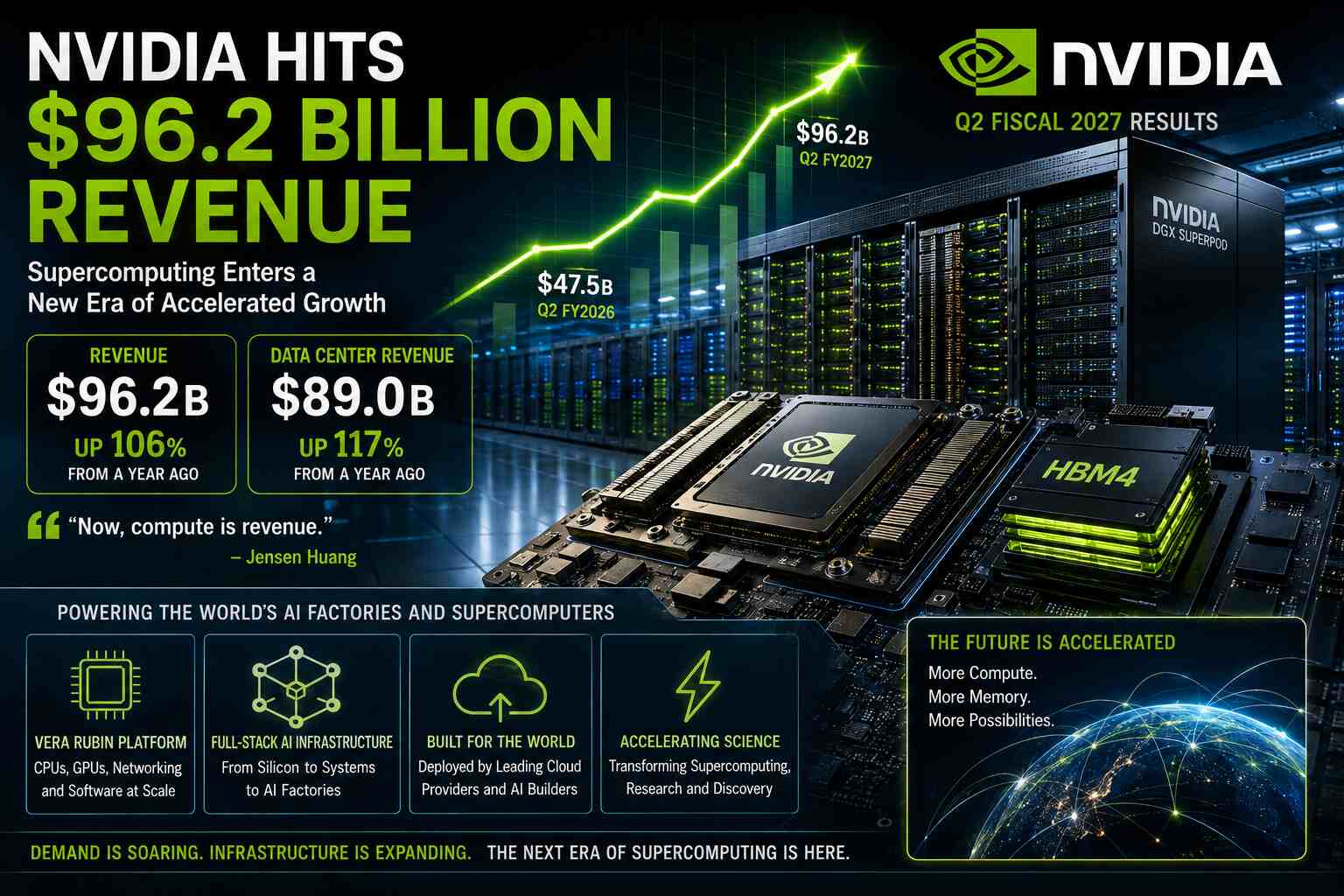
With Data Center revenue reaching $89 billion, up 117% year over year, NVIDIA's latest results show that accelerated computing is no longer a specialized segment of the technology industry. It is becoming the economic foundation of a new generation of supercomputing infrastructure, and memory may be the component that determines how expensive that future becomes.
While the supercomputing industry historically gauged progress through performance metrics such as teraFLOPS, petaFLOPS, and exaFLOPS, NVIDIA's recent financial results indicate a shift toward a new performance indicator: revenue generation per unit of compute.
NVIDIA reported quarterly revenue of $96.2 billion, a significant 106% year-over-year increase, with Data Center revenue accounting for $89.0 billion, up 117% year-over-year and 18% sequentially. Alongside a 75% gross margin and $59.7 billion in GAAP net income, these figures underscore the rapid transition of accelerated computing from specialized HPC laboratories to the fundamental infrastructure supporting global AI production.
With projected revenue of $108 billion for the fiscal third quarter and a consistent 74% gross margin, NVIDIA shows no signs of decelerating. This period of rapid expansion, however, presents a significant challenge: as the global demand for computational power increases, the costs of the critical components required to support that infrastructure are rising in tandem.
Compute Has Become the Infrastructure
NVIDIA CEO Jensen Huang summarized the transformation bluntly: “Now, compute is revenue.”
The company says AI infrastructure is now being built at full speed, with its Vera Rubin platform entering full production.
That statement represents a profound change for HPC.
For decades, computing was largely treated as a capital expense supporting another business.
Now computing itself is becoming an economic asset.
AI companies sell inference.
Cloud providers sell accelerated compute.
Scientific institutions consume GPU cycles.
Enterprises build private AI infrastructure.
Governments are building sovereign AI systems.
And supercomputing centers increasingly combine traditional simulation with machine learning and AI workloads.
The result is a market in which computing capacity has become productive infrastructure in its own right.
The Numbers Are Almost Difficult to Comprehend
Consider the trajectory.
NVIDIA's fiscal Q1 2027 Data Center revenue was $75.2 billion, already up 92% from a year earlier.
Three months later:
$89.0 billion.
That represents an additional $13.8 billion in quarterly Data Center revenue.
Year over year, the increase is approximately $48 billion in a single quarter.
This isn't incremental growth.
It is an infrastructure cycle.
And increasingly, that cycle encompasses the entire computing stack:
GPU → HBM → CPU → networking → storage → rack → cooling → power → data center.
The supercomputer is becoming an integrated industrial system.
Vera Rubin Moves the Industry Beyond the GPU
One of the most significant details in NVIDIA's results is that the company is no longer presenting its future simply as a succession of faster GPUs.
The Vera Rubin platform encompasses CPUs, GPUs, networking, storage, and software designed to operate as a complete AI factory.
NVIDIA says Vera Rubin is ramping into full production, with racks being deployed by customers including CoreWeave, Google Cloud, Microsoft Azure, Oracle Cloud Infrastructure and Nebius.
NVIDIA also highlighted Spectrum-6 networking, Vera CPUs, Groq 3 LPX inference accelerators, BlueField-4 infrastructure and its DSX platform for designing and operating AI factories at scale.
This is increasingly recognizable as supercomputer architecture, even when the workload is described as AI rather than traditional HPC.
The dividing line between AI infrastructure and supercomputing infrastructure is becoming increasingly difficult to draw.
And That's Why Server Prices Matter
Now to the question many SuperComputing News readers are likely asking:
Will server prices go up?
The answer appears to be yes, at least for some NVIDIA-based AI systems, and particularly those with large memory configurations.
Before NVIDIA released its results, Reuters reported that some major customers had been told that prices for servers containing NVIDIA AI chips could increase by more than 15% in many cases, with the increases expected for systems shipping in early 2027. The report attributed the increases primarily to soaring memory costs and said configurations involving Vera Rubin and Grace Blackwell would be affected differently depending on memory configuration. Reuters noted that it could not independently verify the report and that NVIDIA had not commented at the time.
That report now looks particularly significant in light of NVIDIA's earnings.
The demand isn't collapsing.
It is accelerating.
And the memory required by these systems is enormous.
The Memory Problem May Be Bigger Than the GPU Problem
This may be the most important hardware story hiding behind NVIDIA's spectacular numbers.
Modern AI accelerators don't operate alone.
They require enormous amounts of high-bandwidth memory, or HBM, to keep their computational engines fed with data.
As accelerator performance increases, memory bandwidth and capacity must increase with it.
That creates a difficult supply-chain equation.
The industry is simultaneously demanding:
- more GPUs;
- more HBM;
- more server DRAM;
- more CPUs;
- more networking silicon;
- more SSDs;
- more advanced packaging;
- more substrates;
- more power infrastructure; and
- more cooling capacity.
The memory industry is already warning that supply may not expand quickly enough.
Micron has specifically warned that when demand for DRAM or HBM exceeds available supply, manufacturers may have to prioritize production and allocate limited capacity among customers, potentially resulting in elevated pricing and downstream supply-chain disruption.
Will Memory Prices Rise?
This is where the answer becomes more nuanced.
Yes, memory pricing is under pressure, but not every memory product will necessarily rise by the same amount.
The strongest pressure is on AI-oriented memory, particularly HBM.
At the same time, the enormous amount of manufacturing capacity being directed toward AI memory can affect conventional DRAM availability.
Reuters reported in July that average DRAM and NAND prices had already risen substantially amid AI-driven demand, while major memory manufacturers were expanding capacity.
The result is a fascinating feedback loop:
More AI compute → more HBM → more memory capacity devoted to AI → tighter conventional memory supply → higher memory costs → more expensive servers.
And that means NVIDIA's extraordinary success could have consequences far beyond NVIDIA.
The Supercomputer Bill Is Becoming a Memory Bill
Consider a modern rack-scale AI system.
The GPU is the obvious centerpiece.
But the GPU is only one component.
A production AI supercomputer also needs:
HBM + system memory + CPU memory + networking + storage + power delivery + cooling + rack infrastructure.
As systems become more memory-intensive, the cost contribution from memory grows.
This is particularly important because AI workloads are increasingly becoming memory-bound rather than purely compute-bound.
A processor capable of enormous mathematical throughput is useless if the architecture cannot deliver data quickly enough.
That is why HBM has become one of the most strategically important components in the AI infrastructure supply chain.
NVIDIA Is Already Responding to the Memory Challenge
The company's earnings release includes another important clue.
NVIDIA announced a multiyear technology partnership with SK hynix to advance next-generation memory for the global AI factory buildout.
That is not a minor supplier relationship.
It illustrates the degree to which memory has become a strategic component of the computing architecture.
NVIDIA needs the accelerator.
But the accelerator needs memory.
And the memory has to arrive in enormous quantities, at precisely the right performance, packaging and power characteristics.
The AI supercomputer is therefore increasingly a co-designed compute-and-memory system.
The Memory Industry Is Building for the Supercomputing Boom
SK hynix announced earlier this month that it would invest approximately 54 trillion won across new DRAM and NAND facilities in Yongin and Cheongju to expand its production base for growing AI-memory demand. The company said the investments are intended to support the long-term AI memory market and improve supply stability.
That is the kind of investment required when demand is no longer measured in thousands of chips.
It is measured in gigawatts of data-center capacity and millions of accelerators.
The memory industry is effectively becoming part of the supercomputing infrastructure industry.
Could Higher Server Prices Slow Supercomputing?
Not necessarily.
This is where the story becomes optimistic.
If a new generation of AI accelerators delivers substantially more useful work per watt, per rack and per dollar, customers may willingly pay more for the complete system.
In other words:
Higher hardware prices do not automatically mean higher computing costs.
A $10 million system that delivers twice the useful scientific throughput of a $7 million system may be the better investment.
The real metric isn't the purchase price.
It is:
Cost per useful computation.
For HPC, that can mean:
- time to solution;
- energy per simulation;
- cost per training run;
- cost per inference;
- scientific productivity per rack; and
- useful work per megawatt.
That is where the next generation of supercomputing competition will increasingly take place.
Efficiency Could Matter More Than Price
NVIDIA says the Vera Rubin platform is designed for this new environment.
The company's strategy is increasingly focused on complete systems rather than isolated accelerators.
That means combining:
compute + memory + networking + storage + software.
NVIDIA also highlighted that Blackwell led across categories in the MLPerf Training 6.0 benchmarks and AgentPerf, an infrastructure benchmark for agentic AI.
For HPC, benchmark leadership matters, but application efficiency matters even more.
A scientific center doesn't buy an accelerator because it has impressive theoretical specifications.
It buys it because researchers can solve problems faster.
The Supercomputing Industry Is Getting Bigger
NVIDIA's results also reveal how much the potential market has expanded.
The company says 35 new NVIDIA AI HPC supercomputers are in development across Europe.
That's an extraordinary signal for traditional HPC.
AI isn't replacing supercomputing.
It is expanding the market for accelerated computing and bringing HPC-style architectures into new industries.
Scientific research.
Drug discovery.
Climate modeling.
Fusion.
Materials science.
Engineering.
Digital twins.
Robotics.
National security.
Financial modeling.
Every one of these workloads can potentially consume accelerated compute.
The New Supercomputing Economy
There is another reason NVIDIA's results matter.
Earlier this month, NVIDIA announced partnerships with Apollo, BlackRock, Blackstone, Brookfield, Goldman Sachs and KKR to establish financing platforms intended to mobilize more than $500 billion of third-party capital for AI infrastructure. NVIDIA described compute and full-stack AI infrastructure as an investable asset class.
Put that together with today's earnings.
We now have:
Demand.
Capital.
Compute.
Memory.
Infrastructure.
The pieces of a new industrial economy are coming together.
Server Makers May Have More Pricing Power
This is an important consequence for companies building AI servers.
Traditional server manufacturing is typically a competitive, relatively low-margin business.
AI servers are different.
They incorporate extremely expensive accelerators, high-bandwidth memory, advanced networking, sophisticated power delivery and liquid cooling.
When critical components become scarce, the economics of the entire rack change.
The reported 15%-plus price increases are therefore significant, not because every AI server will necessarily rise exactly 15%, but because they demonstrate that the supply chain is gaining the ability to pass rising component costs downstream.
Server makers may have little choice.
If HBM costs rise, someone has to absorb the increase.
It can be:
NVIDIA.
The server manufacturer.
The cloud provider.
The AI company.
Or ultimately:
the customer.
The early indications are that at least some of the cost is being passed along.
But Scarcity Could Also Accelerate Innovation
There is an optimistic side to this.
When a resource becomes expensive, engineers have an enormous incentive to use it more efficiently.
Memory scarcity could accelerate research into:
- memory compression;
- sparsity;
- quantization;
- better caching;
- memory pooling;
- near-memory computing;
- processing-in-memory;
- optical interconnects;
- advanced packaging;
- larger shared memory architectures;
- improved software scheduling; and
- algorithms designed around data locality.
In other words, the memory squeeze could help create better computers.
Supercomputing Is Becoming a Supply-Chain Science
There is a lesson here for HPC administrators.
Building the next supercomputer isn't simply a matter of selecting the fastest processor.
Procurement teams increasingly have to think about:
HBM availability.
DRAM allocation.
Network bandwidth.
Power delivery.
Cooling capacity.
Rack density.
Advanced packaging.
Lead times.
Total cost of ownership.
The machine room itself is becoming part of the computational architecture.
The 1-Gigawatt Supercomputer Is Coming Into View
The industry's scale is also changing the physical definition of a supercomputer.
NVIDIA and its partners are now discussing AI factories at gigawatt scale.
Its recent PORTS-Pike project in Ohio, for example, involves an initial 4.25 IT-gigawatt capacity with an option for another 3.75 IT gigawatts, while OpenAI is expected to be the customer for an 8-IT-gigawatt campus.
That is no longer simply a computer installation.
It is an industrial facility.
Power plants, substations, cooling systems, fiber networks, buildings and semiconductor supply chains all become part of the computer.
The definition of "supercomputer" is expanding accordingly.
A Remarkable Positive Signal for HPC
It would be easy to focus exclusively on the risks:
Memory shortages.
Higher server prices.
Power constraints.
Supply-chain bottlenecks.
Increasing capital requirements.
Those challenges are real.
But NVIDIA's results tell a much more encouraging story.
The world is investing extraordinary amounts of money into computing because computing is producing extraordinary amounts of economic and scientific value.
That is good news for the supercomputing industry.
Every new AI factory expands demand for:
- accelerators;
- networking;
- memory;
- storage;
- cooling;
- power infrastructure;
- software;
- system integration;
- data-center engineering; and
- computational expertise.
The supercomputing ecosystem is expanding with it.
The Most Important Number May Not Be $96.2 Billion
NVIDIA's $96.2 billion quarter is remarkable.
Its $89 billion Data Center business is even more remarkable.
But perhaps the most important number for SuperComputing News readers is 117%.
That is the year-over-year growth rate of Data Center revenue.
It tells us that the world's appetite for accelerated computing is not merely continuing.
It is accelerating.
And NVIDIA expects another leap, forecasting $108 billion in revenue in the coming quarter.
That means the infrastructure buildout remains in full swing.
The Great Compute Expansion
We may eventually look back at this period as the moment when computing stopped being simply a component of the economy and became one of its fundamental physical resources.
Just as electricity transformed industrial production, abundant computation is transforming scientific discovery, engineering and artificial intelligence.
The difference is that this new infrastructure requires extraordinary amounts of silicon, memory, networking, electricity and cooling.
And that means the next great supercomputing race won't be won by processors alone.
It will be won by whoever can integrate the entire system most effectively.
The Memory Challenge Could Become the Next Supercomputing Opportunity
As computing evolves into an essential economic asset, the industry is shifting from pure performance metrics to revenue-per-compute efficiency. With AI demand driving a massive infrastructure expansion, memory has become a critical bottleneck. The future of the supercomputing economy now hinges on integrating high-bandwidth memory with accelerated compute, where long-term success will be measured by cost-effectiveness and application efficiency rather than raw hardware pricing.