

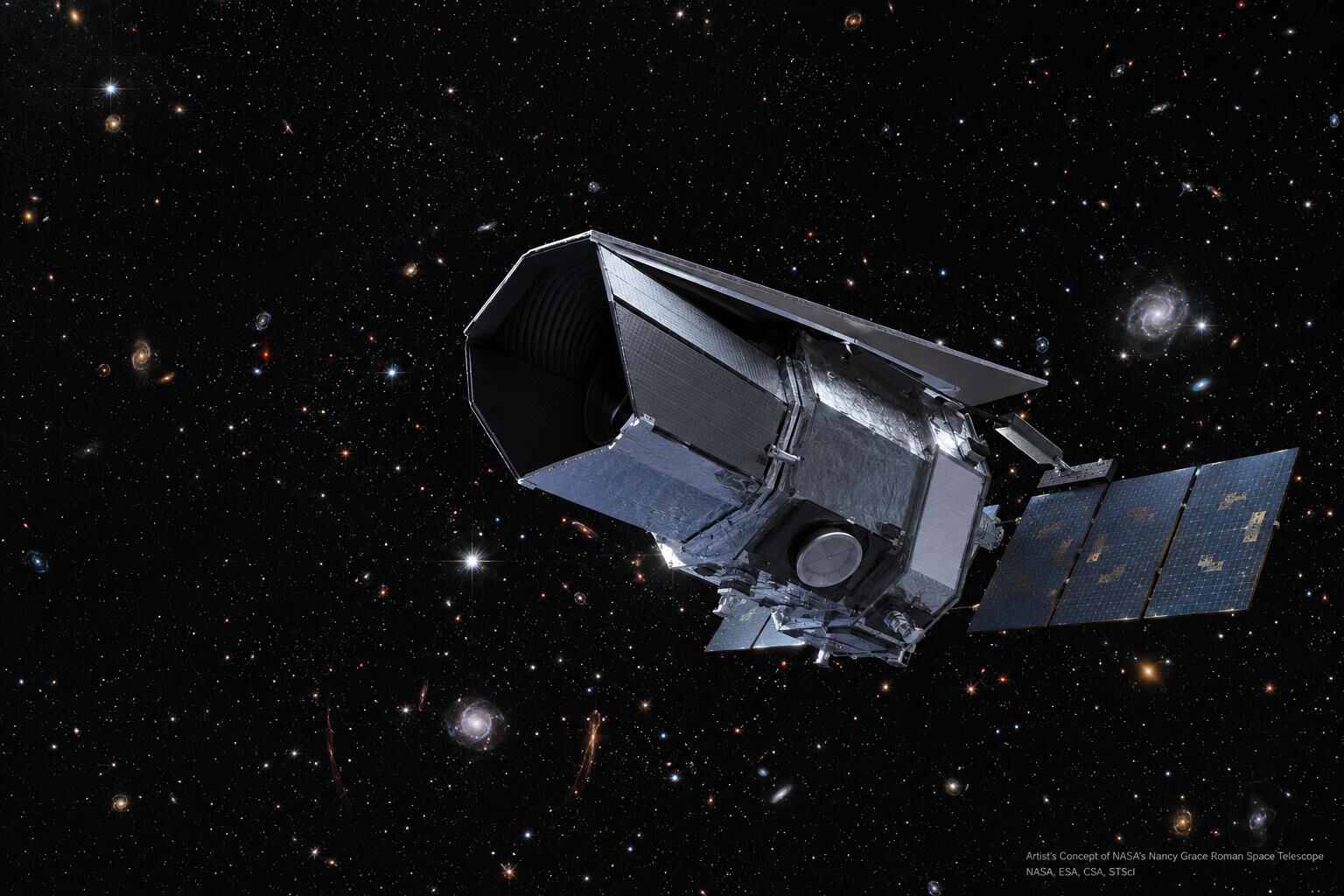
The Nancy Grace Roman Space Telescope has embarked on a mission that promises to reshape our understanding of the universe fundamentally. While its initial imagery will be significant, the telescope's most profound breakthrough lies in its unprecedented data-production scale. Following its successful launch on August 30 via a SpaceX Falcon Heavy, the observatory is currently en route to the Sun-Earth Lagrange point L2. Once operational, it will generate approximately 1.4 terabytes of scientific data daily, the highest transmission rate in the history of NASA’s astrophysics missions. This massive volume of information effectively transforms the Roman Space Telescope from a traditional observatory into a distributed supercomputer.
Beyond capturing images of the cosmos, the mission necessitates a complex computational infrastructure, encompassing data transmission, storage, calibration, image reconstruction, statistical analysis, and the integration of artificial intelligence alongside human scientific expertise. The ultimate objective is to unlock transformative discoveries hidden within one of the most extensive astronomical datasets ever compiled.
A telescope built for the age of big data
Roman is designed to survey enormous regions of the sky while maintaining the sharp infrared vision needed to investigate dark matter, dark energy, exoplanets, galaxies, black holes, and transient astronomical phenomena.
Its Wide Field Instrument contains a 300-megapixel infrared camera, built around 18 4K detectors. NASA says Roman will survey the universe roughly 1,000 times faster than Hubble, creating an unprecedented combination of field of view, resolution and observing speed.
That speed comes with a computational price.
NASA estimates that Roman will collect more than 20,000 terabytes, roughly 20 petabytes, of data during its five-year primary mission.
For comparison, NASA previously reported that Webb produces roughly 50–60 gigabytes of data per day, while Hubble produces around 3 gigabytes. Roman’s planned 1.4-terabyte daily science downlink therefore represents a dramatic escalation in astronomical data production.
This isn’t simply a storage challenge.
It is a high-performance computing challenge.
How do you move 1.4 terabytes across a million miles?
Roman’s communications architecture has been engineered around the enormous data volume.
The spacecraft carries a steerable High-Gain Antenna (HGA) capable of operating in both S-band and Ka-band frequencies. S-band, at approximately 2 GHz, handles lower-rate spacecraft communications, including commands and engineering telemetry. Ka-band, operating at approximately 26 GHz, provides the high-speed science-data link.
The Ka-band system can transmit science data at up to 500 megabits per second.
At that rate, moving 1.4 TB of data would theoretically require roughly 6.2 hours of continuous maximum-rate transmission. In reality, NASA’s architecture uses multiple ground-station contacts over several hours each day rather than maintaining a single uninterrupted connection.
That distinction is important.
Roman isn’t connected to Earth like a broadband satellite sitting in geostationary orbit. It is nearly a million miles away, and its communications system must carefully schedule contacts, point its antenna toward Earth, and move data through a global network of giant radio antennas.
NASA says Roman’s ground system will use multiple contacts to downlink the approximately 1.4 TB of science data generated each day.
The spacecraft’s data recorder provides another critical buffer.
Roman carries a 10-terabyte science data recorder, allowing observations to accumulate onboard before they can be transmitted to Earth.
In computing terms, the spacecraft effectively has a large local storage tier sitting between the instrument and the global network.
The architecture looks something like this:
Infrared detectors → onboard electronics → science data recorder → Ka-band transmitter → high-gain antenna → Deep Space Network/ground stations → ground processing → archive → AI/ML analysis → astronomers
Every stage has to work.
A global communications network
During launch and early operations, Roman initially communicates through NASA’s Near Space Network.
About 70 minutes after launch, NASA’s Deep Space Network assumes communications duties for the journey to L2. NASA reported that the spacecraft first communicates through the Canberra Deep Space Communication Complex in Australia, followed by Madrid in Spain and Goldstone in California. This geographic distribution allows mission controllers to maintain communications as Earth rotates.
Once Roman reaches its operational environment, its ground infrastructure will continue to rely on widely separated antennas.
NASA identifies ground-station support including White Sands, New Mexico; ESA’s New Norcia facility in Australia; JAXA’s GREAT facility in Japan; and Deep Space Network assets.
The architecture is a classic distributed-systems solution to a space problem.
Instead of depending upon one ground station, NASA distributes communications capability around the planet.
The real challenge begins after the data reaches Earth.
Getting 1.4 TB of data from L2 to Earth is only the beginning.
Once the bits arrive, the Roman ground system has to turn raw detector measurements into scientifically meaningful information.
NASA has divided those responsibilities across a distributed collection of institutions, including NASA Goddard, the Space Telescope Science Institute (STScI), and Caltech/IPAC.
STScI serves as Roman’s Science Operations Center, while IPAC operates the Science Support Center.
The Science Operations Center is responsible for observation scheduling, data processing, and archiving. IPAC handles specialized processing including spectroscopy and microlensing science.
This is where Roman begins to look remarkably similar to a modern HPC environment.
Raw data flows into automated processing pipelines. Those pipelines perform calibration, remove detector-level artifacts, transform observations into scientifically useful products, and generate increasingly sophisticated data products.
For Wide Field Instrument data, Roman’s automated pipelines process data as it arrives from the spacecraft. The resulting products are ingested into NASA’s Mikulski Archive for Space Telescopes, or MAST, where they are made available to the scientific community.
Where will all that data be stored?
The short answer is: not on one giant hard drive.
Roman’s long-term data infrastructure is distributed across NASA’s science data ecosystem.
The mission was designed around an archive expected to contain more than 20 petabytes during the first five years of operations.
STScI’s MAST will serve as the primary public archive for Roman data. NASA’s current architecture also emphasizes cloud-based computing so researchers can work with enormous datasets without having to download everything to local computers.
That approach represents an important philosophical shift in scientific computing.
For decades, researchers often downloaded datasets and then brought the data to their computing resources.
Roman increasingly reverses the model: Bring the computation to the data.
STScI has described this strategy as bringing astronomers to the data rather than sending massive datasets to individual astronomers. Roman’s Science Operations Center is also developing the Roman Research Nexus, a cloud-based science platform providing researchers with access to data, computing and software resources.
This is essentially the same principle driving modern HPC, cloud computing and hyperscale data analytics.
Moving 20 petabytes around the internet repeatedly would be inefficient.
Putting high-performance computing resources close to the archive is much more sensible.
From raw photons to scientific knowledge
Roman’s data will not arrive as ready-to-publish astronomical photographs.
The processing pipeline progressively transforms the information.
At the lowest levels, raw detector information must be corrected for instrumental effects and converted into useful images. Higher-level processing can then combine observations, build catalogs, and extract specialized scientific information.
For spectroscopy, for example, IPAC’s Science Support Center will identify, extract, calibrate, and fit spectra from Roman’s grism and prism observations. Those processes produce higher-level scientific data products that are returned to the Roman archive.
This creates a hierarchy of data products.
Raw observations → calibrated exposures → mosaics/catalogs → extracted scientific measurements → specialized scientific products
Each step requires increasingly sophisticated algorithms and increasingly significant computing resources.
And that is where artificial intelligence enters the picture.
AI becomes the astronomical triage system.
There is simply no practical way for humans to inspect every potentially interesting event in a dataset of this scale.
Roman could monitor hundreds of millions of stars, detect enormous numbers of galaxies, and capture transient events that change on timescales ranging from minutes to months.
NASA explicitly expects machine learning, artificial intelligence and citizen scientists to help sift through Roman’s data and flag significant findings for astronomers to investigate.
This does not mean AI replaces astronomers.
Instead, it becomes a computational discovery layer.
Machine-learning systems can examine enormous populations of objects simultaneously, identify statistical outliers, and search for patterns that conventional rules might overlook.
For example, algorithms could help identify:
- unusual changes in stellar brightness;
- candidate gravitational microlensing events;
- potentially interesting supernovae;
- unusual galaxy structures;
- transient phenomena;
- candidate exoplanet signals;
- unexpected correlations across enormous astronomical catalogs.
Researchers are already developing machine-learning approaches specifically for Roman’s cosmological datasets. NASA-supported Roman research, for example, is exploring ML methods designed to extract information from large-scale-structure observations that traditional analysis techniques may not fully capture.
The computational objective isn’t simply to process more data.
It is to extract more information from the same data.
Citizen scientists become part of the computing ecosystem.
Perhaps the most inspiring aspect of Roman’s architecture is that humans remain inside the loop.
AI can identify unusual objects.
Automated pipelines can classify millions of observations.
Supercomputing systems can perform enormous statistical calculations.
But human beings can recognize something unexpected.
Citizen scientists can therefore become another layer of the discovery pipeline, helping inspect and classify potentially important findings that automated systems flag.
The result is a new model of astronomy:
Space telescope + high-speed communications + distributed storage + HPC/cloud computing + AI/ML + citizen scientists + professional astronomers.
The telescope provides the observations.
The network moves them.
The archive preserves them.
Supercomputers transform them.
AI searches them.
Humans decide what matters.
The supercomputing problem hidden inside a space telescope.
Roman demonstrates something increasingly important across science: the instrument itself is becoming only one component of the computational system.
The telescope produces the raw observations, but the scientific discovery ultimately depends upon an enormous digital infrastructure surrounding it.
Consider the scale.
At 1.4 TB per day, Roman’s planned five-year mission corresponds to approximately 2.6 petabytes of raw science data per year and more than 20 PB over the mission’s five-year primary period, depending on the exact operational schedule and data-product accounting. NASA’s ground-system planning has already anticipated an archive exceeding 20 PB.
And raw data is only the beginning.
Calibrated images, catalogs, spectra, derived measurements, simulations, and higher-level products add additional computational and storage requirements.
Researchers will also need simulations to understand what Roman should see under different cosmological models.
That creates another HPC workload.
To determine whether an observation supports a particular theory of dark energy, for example, scientists need enormous simulated universes against which observations can be compared.
The telescope therefore becomes part of a loop:
Observe → process → simulate → compare → infer → refine models → observe again.
That is fundamentally a computational-science workflow.
Astronomy’s next supercomputer may be the archive itself.
Roman’s most consequential technological legacy may ultimately be the infrastructure built to handle its data.
The mission’s data system is designed around a world in which researchers don’t necessarily download entire datasets. Instead, scientists can query massive archives, bring computation to the data, and use cloud-based environments to analyze information where it resides.
That is increasingly how modern supercomputing works.
The largest scientific problems are no longer defined solely by floating-point operations per second.
They are also defined by:
How quickly can data move?
How efficiently can it be stored?
How intelligently can it be filtered?
How much information can algorithms extract from it?
How can thousands of researchers collaborate without duplicating petabytes of data?
Roman will confront all five questions simultaneously.
A new kind of cosmic observatory
The Nancy Grace Roman Space Telescope represents a sophisticated convergence of advanced astronomy and high-performance computational science. By generating 1.4 terabytes of data daily, the mission transforms the traditional observatory model into a distributed, planet-scale data pipeline. From its L2 vantage point, the telescope utilizes high-speed Ka-band communications and global ground networks to feed an intricate infrastructure of cloud-based archives, automated processing pipelines, and AI-driven discovery layers.
This architecture fundamentally shifts the paradigm of scientific inquiry by moving the researcher to the data rather than the data to the researcher. By integrating machine learning to identify anomalies and enlisting citizen scientists to validate findings, the mission creates an unprecedented ecosystem for discovery. Ultimately, the Roman Space Telescope demonstrates that the next frontier of exploration is not merely the view through the lens, but the computational intelligence required to extract profound insights from the cosmic torrent. As humanity prepares to navigate these 20 petabytes of mission data, we are effectively learning how to compute our way toward the next era of astrophysical discovery.