

A new multitask deep-learning system called BiteNetI shows how GPU computing and algorithmic efficiency can transform a problem that once demanded specialized prediction pipelines into a high-throughput scientific workload, opening new possibilities for molecular biology, drug discovery, and AI-driven structural science.
For decades, one of the central challenges in computational biology has been deceptively simple to describe: given the three-dimensional structure of a protein, where will biologically important ions bind?
The answer can determine how proteins fold, communicate, catalyze chemical reactions and interact with other molecules. Calcium, sodium, potassium, zinc, iron, magnesium and other ions participate in an enormous range of biological processes. Yet identifying their binding sites with atomic-level precision is computationally difficult because ion coordination depends on the detailed three-dimensional arrangement of atoms surrounding each potential site.
A new study published in Communications Biology https://www.nature.com/articles/s42003-026-10659-1 points toward a different way of attacking the problem.
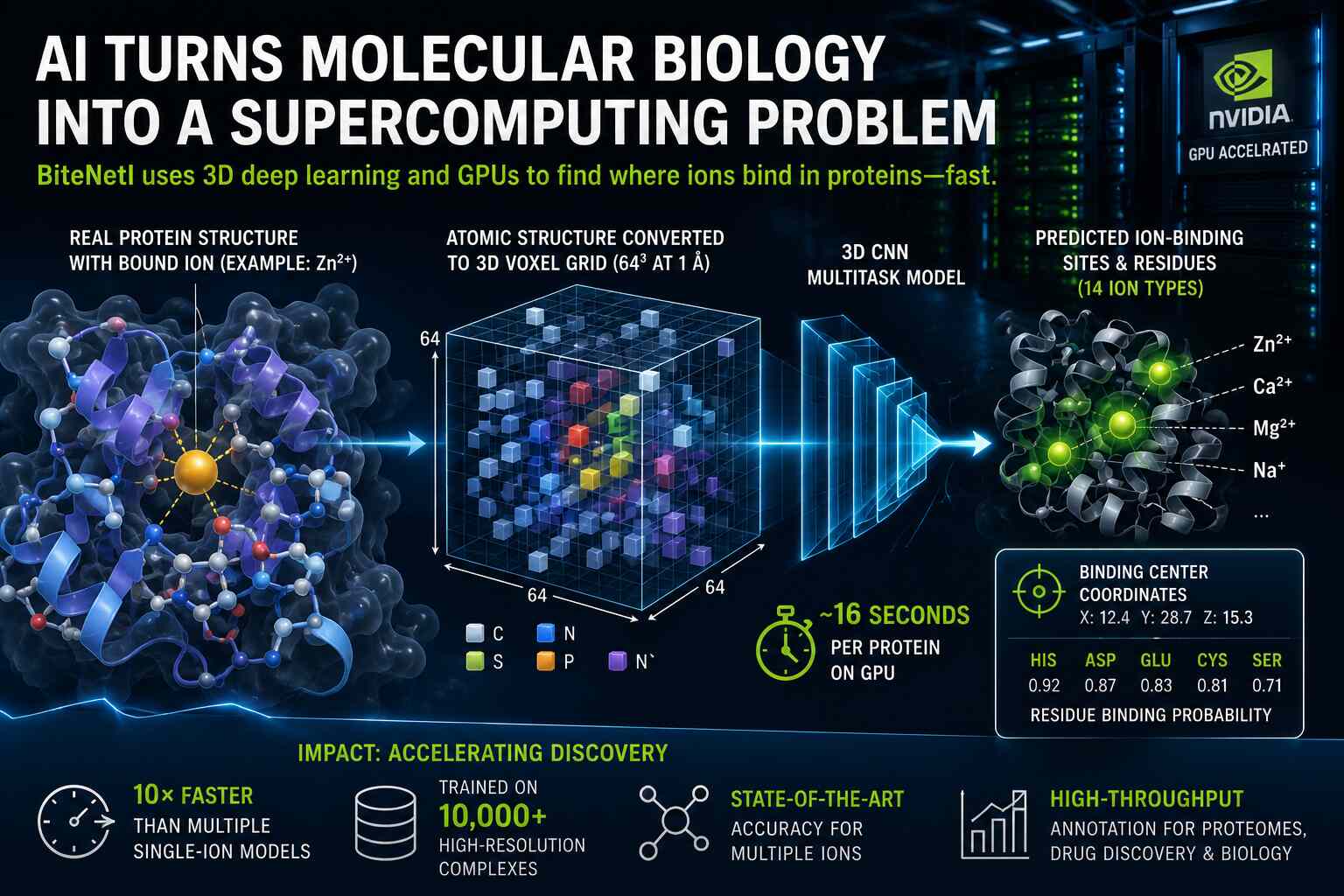
Researchers Igor Kozlovskii and Petr Popov have developed BiteNetI, a multitask deep-learning framework that uses three-dimensional convolutional neural networks to identify ion-binding centers and predict the residues involved in binding. The system was trained on more than 10,000 high-resolution protein–ion complexes and is designed to recognize 14 biologically relevant ion types within a single model.
The significance extends beyond another improvement in computational biology.
BiteNetI illustrates a broader transformation taking place across scientific computing: the fastest path to scientific discovery is increasingly not simply building larger computers, but designing algorithms that make better use of the computers we already have.
Turning Molecular Structure Into a GPU Workload
Traditional computational approaches to molecular structure can become expensive because accurately modeling interactions between proteins and ions requires detailed representations of atomic geometry and, in some cases, computationally intensive molecular dynamics or quantum-mechanical calculations.
Machine learning offers an alternative.
Instead of calculating every physical interaction explicitly, BiteNetI learns structural patterns associated with ion-binding sites from experimentally determined protein–ion complexes.
The researchers represent a protein structure as a three-dimensional computational volume consisting of 64 × 64 × 64 voxels, with each voxel corresponding to a spatial resolution of 1 angstrom. The representation contains 11 atom-type channels, allowing the neural network to encode the three-dimensional distribution of different atoms around potential binding regions.
That turns a molecular structure into something that can be processed much like a volumetric image.
The analogy is useful, but the computational problem is considerably more demanding than ordinary image recognition.
A conventional photograph contains pixels arranged in two dimensions. BiteNetI operates on a three-dimensional representation of molecular space, where the position and identity of atoms determine the chemical environment. The network must therefore learn spatial relationships extending in three dimensions while distinguishing between subtle structural configurations that can determine whether an ion can actually coordinate with a protein.
The architecture repeatedly applies convolution, batch normalization and nonlinear activation operations before progressively downsampling the representation. The resulting features feed predictions for both binding probability and binding-center coordinates.
This is precisely the kind of workload for which modern GPU architectures are exceptionally well suited: enormous numbers of relatively small mathematical operations performed across highly structured data.
One Model Instead of an Army of Models
Perhaps the most important architectural decision in BiteNetI is that it does not treat every ion as an entirely separate computational problem.
The model is multitask by design.
Instead of maintaining independent prediction systems for different ion species, BiteNetI learns shared structural representations and then produces predictions across its supported ion classes.
That matters enormously for scalability.
The researchers report that the single multitask model is approximately 10 times faster than several single-task models while maintaining nearly the same performance, with an average processing time of approximately 16.0 ± 0.5 seconds per structure.
That is more than an incremental performance improvement.
In large-scale scientific computing, the cost of a workflow is determined not only by the speed of an individual calculation but by how efficiently the calculation can be replicated across thousands or millions of inputs.
A model that takes seconds rather than minutes can fundamentally change what becomes practical.
The researchers report that a single forward pass requires roughly 0.31 seconds per orientation, while processing 50 randomly sampled orientations averages approximately 16 seconds per structure. The authors argue that this makes large-scale structural annotation feasible when protein structures are available.
That distinction is important.
The achievement is not that one protein can be analyzed quickly. The larger opportunity is that thousands of proteins can potentially be processed as a computational batch.
That is where AI begins to look less like a software feature and more like scientific infrastructure.
More Than 10,000 Protein–Ion Complexes
Training a model capable of making meaningful predictions about molecular geometry requires substantial and carefully curated data.
BiteNetI was trained using a dataset containing approximately 10,000 high-resolution protein–ion structures. The researchers designed the dataset split to account for similarities in protein sequence, structure and binding sites, helping reduce the possibility that the model could simply memorize highly similar examples appearing on both sides of the benchmark.
That is an important consideration for scientific machine learning.
A model can appear extremely accurate if its training and test data are too similar. True scientific usefulness requires generalization: the ability to recognize meaningful structural patterns in proteins it has not effectively seen before.
BiteNetI’s results suggest that the approach can generalize strongly across multiple ion classes.
The authors report state-of-the-art performance across their benchmarks, including improvements of roughly two- to three-fold in accuracy for calcium, sodium and potassium under reported evaluation metrics.
The researchers also found particularly strong performance for more clearly coordinated ions such as zinc, iron, manganese and cobalt. More diffuse or context-dependent interactions involving ions such as sodium, potassium, chloride, sulfate and phosphate remain more difficult.
That distinction provides an important window into where AI is succeeding, and where molecular complexity still wins.
The Numbers Matter
One of the strongest examples comes from zinc.
In a benchmark involving 132 Zn²⁺ binding sites across 54 protein assemblies, BiteNetI achieved a precision of 0.81, recall of 0.78 and F1 score of 0.80, compared with 0.76, 0.68 and 0.72, respectively, for the Metal3D predictor.
On a nonredundant subset containing 51 zinc sites across 23 assemblies, BiteNetI reached 0.78 precision, 0.92 recall and 0.85 F1, compared with Metal3D’s 0.71 precision, 0.69 recall and 0.70 F1.
The implications become more interesting when considering the scale of modern structural biology.
The protein universe is vastly larger than the number of structures researchers can manually inspect. As experimental methods and computational structure-prediction systems continue producing enormous numbers of protein models, the bottleneck increasingly shifts from generating structures to interpreting them.
AI can potentially become the layer between those enormous structural databases and human researchers.
Instead of asking scientists to inspect proteins one at a time, computational systems can scan large collections, identify candidate ion-binding regions and prioritize the structures most worthy of deeper analysis.
That is a classic supercomputing problem.
Challenging AlphaFold 3, With an Important Caveat
BiteNetI was also compared with AlphaFold 3, providing an intriguing benchmark against one of the most prominent AI systems in structural biology.
The comparison, however, needs to be interpreted carefully.
BiteNetI assumes that a protein structure already exists and specializes in identifying ion-binding sites within that structure. AlphaFold 3 approaches a fundamentally different problem: it can predict entire protein–ligand complexes from sequence and ligand information without requiring the same pre-existing protein structure.
The authors explicitly caution that the comparison should not be interpreted as a completely fair head-to-head contest. Some of the benchmark data may also overlap with AlphaFold 3’s training data.
Even so, the comparison is revealing.
BiteNetI slightly outperformed AlphaFold 3 for several ion classes, while AlphaFold 3 performed somewhat better for carbonate and sodium in the reported benchmarks.
The larger lesson is not that one model has defeated another.
It is that specialized AI systems can sometimes outperform much broader models when the computational task is narrowly defined.
That could become increasingly important as scientific AI matures.
Rather than building one enormous model to perform every possible scientific task, researchers may increasingly deploy specialized, highly optimized models that act as computational accelerators within larger scientific workflows.
The Algorithm Becomes Part of the Supercomputer
There is a deeper lesson here for the HPC community.
For much of the supercomputing era, progress was commonly associated with increases in processor speed, memory bandwidth, node counts and FLOPS.
Those metrics remain important.
But AI-driven scientific computing is changing the definition of computational performance.
If an algorithm can eliminate unnecessary calculations, reuse learned representations, exploit GPU parallelism and reduce a multi-stage workflow to a single optimized inference pipeline, it can produce an effective performance improvement that no hardware upgrade alone can match.
BiteNetI is a compelling example.
Its three-dimensional convolutional architecture transforms molecular geometry into a highly parallelizable tensor workload. Its multitask design allows structural features learned for one ion class to contribute to predictions for others. And its inference pipeline reduces the time required to evaluate structures to a scale compatible with high-throughput annotation.
This is algorithmic acceleration.
And algorithmic acceleration is becoming just as important to scientific computing as hardware acceleration.
From Protein Structures to Scientific Discovery
The ultimate importance of BiteNetI may not be measured by its benchmark scores.
It may be measured by what scientists can do with the additional computational capacity it creates.
A workflow that can rapidly identify likely ion-binding sites across large structural databases could help researchers investigate enzyme mechanisms, protein regulation, metalloproteins and other biological systems in which ion coordination is fundamental.
It could also help prioritize candidates for more expensive computational or experimental investigation.
The architecture does not eliminate those expensive methods.
Instead, it can act as a front-end screening layer, narrowing a huge search space before researchers commit significantly more computational resources to individual candidates.
That is one of the most powerful patterns emerging in modern computational science:
Use inexpensive AI inference to decide where expensive physics should be applied.
Rather than running the most computationally demanding simulation against every possible candidate, researchers can first use machine learning to identify the most promising regions of the search space.
The resulting system becomes a computational funnel—broad and fast at the top, precise and expensive at the bottom.
Accuracy Still Depends on Reality
The approach is not without limitations.
BiteNetI’s accuracy depends on the quality of the structure supplied to it. The researchers note that lower-resolution structures can compromise the precise coordination geometry needed to identify binding sites, particularly when atoms are missing or poorly resolved. Their datasets were restricted to structures at or below approximately 2 Å resolution; expanding to structures at or below 3 Å could roughly double the available training set.
That creates an important boundary condition.
AI cannot recover molecular information that is fundamentally absent from its input with unlimited reliability.
The model also performs differently depending on the physical character of the ion interaction. Strongly coordinated ions are easier to identify than ions whose binding is more diffuse and heavily dependent on broader molecular context. Some predicted false positives correspond to small molecules or cofactors rather than the intended ion-binding sites.
These limitations do not diminish the achievement.
They define the next computational challenge.
A New Role for GPUs in Biology
The rise of systems such as BiteNetI points toward a future in which GPU-accelerated computing becomes deeply embedded in everyday molecular research.
The traditional scientific-computing workflow often involved constructing a physical model, discretizing it, solving equations numerically and spending substantial computing time exploring possible outcomes.
AI introduces another layer.
Researchers can now train models to recognize patterns embedded in enormous collections of previous calculations and experimental observations. Once trained, those models can execute predictions extraordinarily quickly.
That does not make physics obsolete.
It creates a partnership between physics and computation.
The most powerful scientific workflows may ultimately combine experimental measurements, molecular simulations, large-scale HPC, AI inference and human expertise into a single computational pipeline.
BiteNetI represents one small but significant step in that direction.
The Bigger Supercomputing Opportunity
The future of scientific computing may therefore depend less on choosing between supercomputers and AI than on combining them.
Supercomputers can generate enormous quantities of scientific data.
AI can learn from that data.
GPUs can accelerate the inference.
High-performance storage can feed the models.
High-speed networks can move structures and predictions between computational stages.
And researchers can use the resulting information to decide which experiments or simulations deserve the next allocation of computing resources.
That creates a feedback loop in which computation increasingly determines what computation should happen next.
BiteNetI demonstrates the concept at molecular scale.
A protein structure enters the system. A three-dimensional neural network transforms it into a computational representation. Shared features are extracted across multiple ion classes. Binding probabilities and coordinates are predicted. And within seconds, a structure can be annotated for potential binding sites.
The calculation is fast because the hardware is powerful.
But it is fast primarily because the algorithm has been designed to exploit that hardware intelligently.
That may be the most important lesson.
The next generation of scientific supercomputing will not be defined solely by how many FLOPS a machine can deliver.
It will increasingly be defined by how much useful science those FLOPS can produce.
BiteNetI offers a glimpse of that future: a world where molecular complexity meets GPU-scale computation, where artificial intelligence becomes an accelerator for scientific reasoning, and where making computation smarter can be just as transformative as making computers faster.