

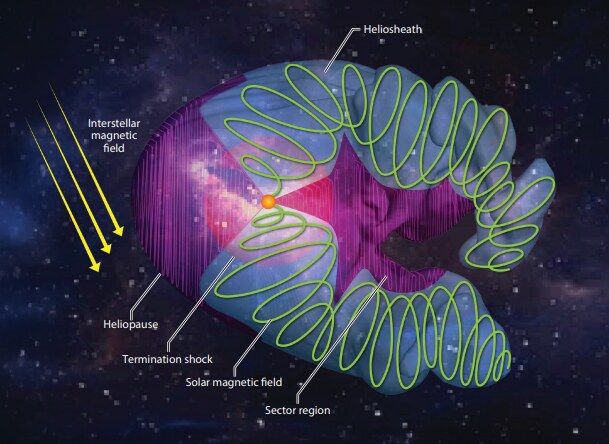
Advanced MHD simulations are allowing scientists to reconstruct the Sun’s journey through the Milky Way and model how encounters with dense interstellar clouds may have transformed Earth’s radiation environment, atmosphere, and climate.
For billions of years, Earth has orbited within the heliosphere, an expansive, protective bubble generated by the Sun. While this invisible structure often goes unnoticed, it has played a critical role in shaping the environmental conditions necessary for life to evolve.
Recent advancements in supercomputing simulations are enabling scientists to reconstruct how this shield has evolved as the Sun has traversed the Milky Way, indicating that Earth’s cosmic environment has historically been dynamic rather than static. A comprehensive review by Boston University astronomer Merav Opher, published in the Annual Review of Astronomy and Astrophysics https://www.annualreviews.org/content/journals/10.1146/annurev-astro-120425-053711, details a new generation of numerical models. These models integrate spacecraft observations, astronomical surveys, magnetohydrodynamic simulations, and climate modeling to analyze the heliosphere’s state over the past 10 million years. This research offers a robust computational framework for understanding how the Sun’s changing galactic neighborhood may have influenced Earth’s climate and radiation environment.
On August 24, NASA highlighted this research, showcasing simulations from the SHIELD DRIVE Science Center that reconstruct the heliosphere's trajectory through the galaxy and analyze the potential impacts of interstellar cloud encounters on our planet. Ultimately, this work represents a significant intersection of astrophysics and high-performance computing.
Earth Lives Inside a Computationally Complex Shield
The heliosphere is produced by the continuous solar wind, a supersonic flow of charged particles streaming outward from the Sun.
Today, that flow creates a vast cavity in the surrounding interstellar medium. The heliosphere extends roughly 120 astronomical units in the direction of the Sun’s motion, encompassing the known planets. It also acts as a radiation shield: the review notes that the present-day heliosphere blocks roughly 70% of galactic cosmic rays with energies up to 200 MeV.
But the heliosphere is not a rigid shell.
It is a dynamic plasma structure whose size depends on the competition between solar-wind pressure and the external pressure of the interstellar medium.
That makes modeling it exceptionally difficult.
The simulation must account for flowing plasma, magnetic fields, neutral hydrogen, charge exchange, energetic particles, turbulence, shocks, and the geometry of the surrounding interstellar environment.
And all of those processes interact.
The research community has therefore moved beyond simple hydrodynamic representations toward increasingly sophisticated magnetohydrodynamic, or MHD, simulations. The review notes that computer simulations have advanced substantially with parallel computing, enabling researchers to explore the global structure of the heliosphere in ways that were previously impossible.
This is precisely where supercomputing becomes a scientific instrument.
Instead of observing the entire heliosphere directly, which is impossible, researchers construct numerical representations of it and allow the equations of plasma physics to evolve the system computationally.
The computer becomes a laboratory for an environment hundreds of astronomical units across.
The Sun Is Moving Through a Changing Galaxy
The Sun is not stationary.
It moves through the Milky Way at approximately 19 parsecs per million years, carrying the entire Solar System through regions of the interstellar medium with dramatically different densities and physical properties. Over its 4.6-billion-year history, the Sun has therefore experienced an enormous variety of galactic environments.
Modern astronomical observations are now making it possible to reconstruct portions of that journey.
The Gaia mission has dramatically improved measurements of nearby stars and interstellar structures, allowing researchers to investigate the Sun’s trajectory over tens of millions of years. Those astronomical reconstructions can then be combined with geological records of Earth’s ancient environment.
The result is an extraordinary computational problem: Can scientists reconstruct where the Sun was millions of years ago, determine what interstellar material it encountered, calculate how that material compressed the heliosphere, and then model what happened to Earth?
The answer is increasingly yes.
But it requires a chain of numerical models.
When the Interstellar Medium Pushes Back
The physics begins with pressure balance.
The heliosphere’s stand-off distance depends strongly on the relative density and velocity of the interstellar medium and the solar wind. In simplified form, the stand-off distance scales with the square root of the ratio between solar-wind and interstellar ram pressures. Thermal and magnetic pressure also contribute.
Under today’s relatively diffuse interstellar conditions, the heliosphere is enormous.
But the surrounding environment can become vastly denser.
The review describes simulations involving cold interstellar clouds with densities thousands of times greater than the neutral hydrogen density surrounding the Solar System today. A representative cloud associated with the Local Leo of Cold Clouds has been estimated at approximately 3,000 hydrogen atoms per cubic centimeter and a temperature near 20 kelvin. Using a relative velocity of approximately 14.1 km/s, modeling indicates that the heliosphere could have collapsed to approximately 0.22 AU.
For comparison, Earth’s orbit is approximately 1 AU.
In other words, the computational model produces a scenario in which the Sun’s protective bubble could have contracted to a region inside Earth’s orbit.
Another modeled encounter associated with the Local Bubble produced a heliosphere compressed to approximately 0.7 AU under assumed conditions. When additional effects associated with turbulence and gravitational acceleration of neutrals are considered, the density required to produce sub-AU compression can be substantially lower.
These are not merely geometric calculations.
The MHD simulations show that the collapse is asymmetric. The nose of the heliosphere contracts dramatically, while the heliotail remains extended in the opposite direction. Earth could consequently move in and out of the remaining heliospheric tail during its annual orbit.
That creates an extraordinarily complicated radiation environment.
Supercomputing Earth’s Cosmic-Ray Exposure
The consequences of a compressed heliosphere could extend well beyond the boundary of the Solar System.
When Earth is outside the heliosphere, galactic cosmic rays can reach the planet without the same level of filtering provided by today’s approximately 120-AU heliosphere.
But when Earth is inside the compressed system’s extended tail, another source of radiation becomes important.
The termination shock, the region where the supersonic solar wind slows dramatically, moves much closer to the Sun.
In the modeled Local Lynx of Cold Clouds encounter, the termination shock could move inward to approximately 0.118 AU. The shock also becomes substantially stronger because the high density of neutral hydrogen changes charge-exchange processes and the population of pickup ions in the solar wind.
The resulting simulations predict an intense population of heliospheric energetic particles.
According to the review, hybrid-model calculations indicate that the low-MeV heliospheric energetic-particle flux could be approximately 100 times higher than the 2003 Halloween solar proton event and roughly nine orders of magnitude above the interstellar galactic cosmic-ray flux at the relevant energies.
That is an extraordinary computational result because there is no spacecraft orbiting Earth that can measure such a prehistoric event.
Instead, researchers use physics-based models to reconstruct it.
The computational pipeline combines global heliospheric modeling with particle acceleration calculations and atmospheric simulations.
From Plasma Physics to Climate Physics
The next computational challenge is Earth itself.
Cosmic rays interacting with nitrogen and oxygen in the atmosphere generate cascades of secondary particles and chemical products, including NOy compounds. These chemical pathways can affect stratospheric ozone and atmospheric temperatures.
Researchers have therefore begun coupling atmospheric chemistry and cosmic-ray cascade models to investigate what enhanced radiation could have done to Earth’s atmosphere.
One study cited in the review used the Goddard Space Flight Center’s two-dimensional chemistry and dynamics model together with the Cosmic Ray Atmospheric Cascade: Cosmic Ray Induced Ionization model.
The simulations indicate that enhanced galactic cosmic rays during heliosphere-collapse scenarios could alter atmospheric NOx, HOx, and ozone chemistry. Under modeled conditions, surface-air temperature changes of approximately 1 kelvin occur regionally, with warming in parts of Europe and Russia and cooling in Siberia and Greenland.
This is a remarkable example of computational science operating across multiple scales.
The chain begins with the motion of the Sun through the galaxy.
That determines the external interstellar environment.
The interstellar environment changes the heliosphere.
The heliosphere changes the cosmic-ray environment.
Cosmic rays alter atmospheric chemistry.
Atmospheric chemistry changes radiative behavior.
And those atmospheric changes can feed into climate.
Each stage can be computationally demanding on its own.
Connecting them is substantially harder.
A Potential Link to Earth’s Ancient Climate
The most provocative aspect of the research is its connection to paleoclimate.
Deep-ocean sediment records show significant climate changes around 13–14 million, 6–7 million and 2–3 million years ago. The mechanisms responsible for some of these longer-duration transitions remain debated. The review notes that conventional orbital forcing does not readily explain the longer 2–3 million- and 6–7-million-year intervals.
The proposed connection is striking.
Modern reconstruction of the Sun’s trajectory indicates that it may have encountered dense interstellar structures around 2–3 million and 6–7 million years ago.
Modeling suggests that the resulting heliospheric compression could have exposed Earth to substantially different radiation and atmospheric conditions.
NASA describes simulations indicating that the Sun encountered cold interstellar clouds at least three times in the past several million years, with the resulting heliosphere shrinking to below Earth’s orbit. NASA also notes that the timing is consistent with evidence of interstellar material found in deep-sea sediments, Antarctic snow and lunar samples.
The correlation is intriguing.
But it is not proof of causation.
And that distinction is essential.
The review itself emphasizes that the climate effects remain an active research frontier. Researchers still need fully coupled simulations that connect the upper atmosphere, stratosphere, troposphere, oceans and Earth’s internal climate feedbacks.
That is where the next generation of supercomputing could become decisive.
The Digital Twin of Our Cosmic Neighborhood
NASA’s SHIELD DRIVE Science Center is pursuing what researchers describe as a model, or digital twin, of the heliosphere.
The goal is ambitious: combine spacecraft observations with computational modeling to reproduce how the heliosphere interacts with its galactic surroundings. NASA says the effort is intended to improve understanding of how the heliosphere responds to dense interstellar clouds and ultimately help scientists understand habitable star systems beyond our own.
The computational architecture required for such a system is fundamentally multi-physics.
A realistic model must represent solar-wind plasma, magnetic fields, neutral atoms and energetic particles. It must handle shocks, turbulence and instabilities while spanning an enormous range of spatial and temporal scales.
The research illustrates why parallel computing has become indispensable to heliophysics.
The earliest computer models of the heliosphere were hydrodynamic and omitted important magnetic effects. Modern simulations have demonstrated that magnetic tension can fundamentally alter the structure of the heliotail, producing jet-like structures and potentially a split or croissant-like configuration.
Even today, scientists disagree about the precise global shape of the heliotail.
That is not a failure of simulation.
It is precisely what makes simulation valuable.
Competing numerical models can expose which physical assumptions matter most and identify the observations required to distinguish between them.
The Supercomputer as a Time Machine
Perhaps the most inspirational aspect of this research is the role computation plays in recovering something that can never be directly observed.
No spacecraft was present 2.5 million years ago when the Sun may have encountered the Local Lynx of Cold Clouds.
No telescope photographed Earth’s atmosphere during that encounter.
There is no direct historical measurement of the heliosphere’s boundary at that time.
Instead, scientists reconstruct the event from surviving evidence and fundamental physics.
Gaia helps establish the galactic context.
Geological samples preserve traces of Earth’s climate.
Radioactive isotopes preserve clues about past cosmic radiation.
Voyager provides direct measurements of the modern heliosphere.
And supercomputers provide the numerical laboratory capable of connecting those observations.
The review notes that radioactive isotopes, including iron-60 and plutonium-244, appear in geological records around periods associated with proposed heliosphere encounters. Similar signatures have been reported in deep-sea sediments, ferromanganese crusts, Antarctic snow and lunar samples.
Researchers can then simulate whether a hypothesized encounter would generate measurable cosmogenic signatures.
For example, modeling of beryllium-10 production shows that a cloud encounter capable of compressing the heliosphere to approximately 0.2 AU could produce distinctive signals whose detectability depends strongly on the duration of the encounter and the geological archive in which researchers search for them.
The computer is effectively allowing scientists to perform a controlled experiment on Earth’s deep past.
The Limits Are Part of the Discovery
The science remains appropriately cautious.
Cold interstellar clouds are rare, evolve, and have uncertain sizes and trajectories. The probability of a specific encounter depends on assumptions about cloud motion, density and persistence. For example, the review reports a 68% probability under specific assumptions that the Sun crossed the tail end of the Local Ribbon of Cold Clouds during the relevant 2–3-million-year interval.
The climate connection also requires additional work.
Previous atmospheric studies have produced different results depending on model complexity. A two-dimensional atmospheric chemistry model found that proposed high-altitude noctilucent clouds would not cover Earth’s entire surface continuously during the modeled crossings. The review calls for future three-dimensional climate simulations that couple the stratosphere and troposphere with ocean and internal climate feedbacks. That is exactly where HPC has another opportunity to contribute.
More detailed climate models mean more grid cells, more physical variables, longer integrations, and more ensemble members.
Connecting them to heliospheric simulations creates a multi-scale computational problem unlike almost anything in conventional climate or astrophysical modeling.
A New View of Habitability
The implications extend far beyond Earth’s history.
If a star’s protective astrosphere changes dramatically as it travels through its galaxy, then habitability may depend on more than a planet’s distance from its star.
Two otherwise similar planets could experience very different radiation environments because their stars occupy different galactic neighborhoods.
The astrophysical environment becomes another variable in the equation for life.
That is why the concept of a habitable astrosphere is so compelling.
The question is no longer simply whether a planet sits in the right temperature range.
It becomes whether its star can maintain a sufficiently protective plasma environment as the entire planetary system moves through the galaxy.
And answering that question will require computation.
Supercomputing Opens a Window on Deep Time
The most compelling insight derived from this research is that supercomputing has transcended its role as a tool for accelerating mathematical solutions; it has evolved into a method for reconstructing environments that no longer exist. By mapping galactic structures, reconstructing stellar trajectories, modeling plasma dynamics, calculating radiation environments, simulating atmospheric perturbations, and projecting long-term climate impacts, researchers are increasingly able to reconcile theoretical predictions with geological evidence.
This computational framework narrows the chasm between the deep past and contemporary experimental capabilities. NASA’s research encapsulates a broader scientific vision: elucidating the Sun’s relationship with its galactic environment may reveal not only the foundations of Earth’s habitability but also the conditions that govern the survival of planets across other star systems. For the high-performance computing community, this represents a profound frontier. Future supercomputers may move beyond forecasting weather or designing materials to reconstructing the history of our universe, potentially answering one of science’s most enduring questions: what environmental factors enabled the emergence and persistence of life on Earth?