

The next frontier of high-performance computing is emerging not in traditional fields such as weather prediction, astrophysics, or nuclear simulations, but within the critical search for next-generation therapeutics.
A recent study published in Nature Biotechnology (https://www.nature.com/articles/s41587-026-03217-x) introduces an AI-enhanced computational platform capable of navigating vast chemical libraries through a synergy of machine learning, adaptive virtual screening, and extreme-scale cloud computing. This research addresses a significant challenge in computational science: how to navigate a chemical universe containing tens of billions of potential candidates without the necessity of exhaustive computation.
The findings suggest that the solution lies not in merely expanding supercomputing capacity, but in optimizing computational efficiency. To this end, researchers developed AdaptiveFlow, an open-source platform engineered for ultralarge virtual screening and cross-platform deployment. In a landmark demonstration, the system’s ligand-preparation workload achieved near-perfect linear scaling across more than 5.6 million Intel virtual CPUs on Amazon Web Services.
This breakthrough fundamentally shifts the paradigm of computational drug discovery. By transforming chemical search into a massively parallel process and utilizing AI to prioritize the most promising regions of chemical space, AdaptiveFlow effectively optimizes resource allocation where it is most scientifically impactful.
When the database becomes a supercomputer problem
Modern drug discovery increasingly begins not in a laboratory but inside a computational representation of chemical space.
The theoretical universe of drug-like molecules is estimated to contain more than 10^60 possibilities. No conventional computing system can enumerate, simulate, and experimentally evaluate anything remotely approaching that number.
Even the portion of chemical space that can be purchased or synthesized on demand has exploded. The study points to libraries that have grown from billions of compounds to trillions, while one of the largest ready-to-dock collections examined in the work, the Enamine REAL Space, contains approximately 69 billion compounds.
At that scale, virtual screening becomes an HPC problem.
A brute-force strategy would attempt to dock enormous numbers of molecules against a biological target, calculate their interactions, and rank the resulting candidates. But docking calculations are computationally expensive, and multiplying them by tens of billions quickly becomes impractical.
The fundamental challenge therefore becomes one of computational triage.
Which molecules should receive expensive calculations?
Which regions of chemical space are likely to contain useful candidates?
How can a supercomputing infrastructure process millions of independent calculations without allowing scheduling, data movement, and orchestration overhead to overwhelm the scientific workload?
AdaptiveFlow approaches those questions as an integrated HPC architecture.
Six million CPUs, one computational pipeline
The most dramatic demonstration involves the platform’s AdaptiveFlow Ligand Preparation (AFLP) component.
The researchers rewrote the software in Python and designed its workload around extremely fine-grained parallelism. Rather than treating a gigantic chemical library as one monolithic job, molecules are divided into collections and computational work units that can be distributed across large numbers of processors.
The system was able to execute ligand-preparation calculations using more than 5.6 million Intel vCPUs simultaneously.
The scaling behavior was described as essentially perfectly linear.
That is an important HPC result.
Perfect or near-linear scaling means that adding computational resources continues to produce approximately proportional increases in throughput. In real-world supercomputing, achieving that behavior at relatively small scales can be difficult; maintaining it across millions of concurrent CPU resources is considerably more challenging.
AdaptiveFlow’s architecture attacks several sources of inefficiency simultaneously.
Work is broken into relatively small subjobs, allowing the scheduler to distribute computational tasks across a huge pool of resources. Approximately 1,000 ligands can be grouped into collections, while subjobs and job arrays help reduce scheduling overhead while maintaining high levels of parallelism.
The architecture supports both Slurm-based HPC environments and AWS Batch, allowing the same computational concepts to extend from conventional supercomputing clusters into elastic cloud infrastructure.
That flexibility is increasingly important as scientific workloads become too large, or too intermittent, to justify running exclusively on fixed infrastructure.
The cloud becomes a scientific supercomputer.
The AdaptiveFlow demonstration also illustrates how the definition of a supercomputer is changing.
The computational infrastructure used in the study was built around AWS services including AWS Batch, Amazon S3, CloudFormation, and containerized workloads. The platform was also designed to take advantage of spot instances, allowing large computational workloads to exploit spare cloud capacity.
During the enormous library-preparation workload, less than 0.1% of the CPU hours used were interrupted by preemption.
That resilience is critical when a scientific application is operating at millions-of-CPU scale.
At that magnitude, failures are inevitable. The question is not whether individual compute resources will disappear, but whether the application architecture can absorb those failures without bringing the entire scientific workflow to a halt.
AdaptiveFlow’s short, independently executable subjobs provide that resilience. A failed unit of work can be rerun rather than forcing the entire calculation to restart.
The approach resembles an important principle from traditional HPC: break a large scientific problem into sufficiently independent pieces that the system can continue making progress even when individual computational elements fail.
The difference is scale and elasticity.
Instead of a fixed machine with a known number of processors, the cloud can provide an enormous pool of computational resources when the workload demands it.
AI does not replace HPC; it tells HPC where to work.
The most important innovation, however, may happen before the processors begin their calculations.
AdaptiveFlow incorporates Adaptive Target-Guided Virtual Screening (ATG-VS), which uses an 18-dimensional grid of molecular properties to organize chemical space.
That organization gives machine-learning methods a map.
Rather than blindly docking every molecule, the system can identify chemical subspaces that are more likely to contain useful compounds for a particular biological target. Computational resources can then be concentrated in those regions.
This creates a fundamentally different relationship between AI and high-performance computing.
Traditional HPC often asks:
How can we execute this calculation faster?
The AdaptiveFlow approach adds another question:
Do we need to execute this calculation at all?
That distinction could prove transformative.
If machine learning can reliably identify regions of chemical space that are likely to contain valuable candidates, the supercomputer no longer needs to spend equal amounts of computational effort everywhere.
It can spend more computation where the probability of scientific payoff is highest.
The researchers report that ATG-VS can reduce screening costs by up to 1,000 times for the 69-billion-compound REAL Space compared with exhaustive searches, while retaining strong enrichment of promising candidates.
The computational strategy therefore becomes a combination of AI-guided selectivity and HPC-scale execution.
More than 1,500 ways to search
AdaptiveFlow is not tied to a single docking algorithm.
The platform integrates more than 1,500 docking protocols, including GPU-accelerated approaches and machine-learning-based methods.
That matters because molecular docking is not one universal calculation. Different algorithms make different approximations about molecular interactions, protein flexibility, and binding configurations.
By providing a common computational framework for many docking approaches, AdaptiveFlow can turn the HPC infrastructure into a large experimental platform for computational chemistry.
The architecture also accommodates modern AI-based docking technologies, including deep-learning approaches.
According to the study, deep-learning docking and GPU acceleration can potentially provide an additional 10× to 100× increase in throughput.
Combined with the reduction in the amount of chemical space that must be searched, the resulting computational pipeline is dramatically different from simply attempting to brute-force billions of calculations.
The goal is not merely to build a faster molecular-docking machine.
It is to build a system that continuously decides what should be computed next.
A three-layer computational architecture
AdaptiveFlow is organized around three principal components.
AFLP, or AdaptiveFlow Ligand Preparation, prepares enormous molecular libraries for screening.
AFVS, the AdaptiveFlow Virtual Screening engine, performs the actual screening calculations.
And AFU, AdaptiveFlow Unified Workflow, connects computational stages into complete screening pipelines.
This modular design is significant for HPC because preparation, screening, machine-learning analysis, and downstream processing have different computational characteristics.
Some stages are CPU-intensive. Others can exploit GPUs. Data-intensive stages require high-throughput storage and efficient movement of molecular information. Scheduling-intensive stages require massive numbers of short jobs to be launched and completed efficiently.
The platform therefore treats drug discovery as a workflow-scale HPC problem, rather than simply a collection of individual scientific calculations.
The underlying infrastructure can operate across CPU and GPU systems and, where individual docking programs permit, ARM-compatible computing environments.
That portability could become increasingly important as heterogeneous computing becomes the norm across both cloud and traditional supercomputing centers.
Turning chemical space into a parallel data structure
One of the deeper implications of the work is that chemical space itself can be treated as a computational data structure.
Instead of viewing 69 billion molecules as 69 billion independent records, AdaptiveFlow organizes the library according to molecular properties.
The 18-dimensional representation provides a mechanism for partitioning the search space.
From an HPC perspective, this creates a hierarchy: chemical space → molecular subspaces → compound collections → computational subjobs → CPU/GPU resources.
Each level can be optimized independently.
The scientific problem is therefore transformed into a scheduling and resource-allocation problem that modern distributed computing infrastructure is exceptionally good at solving.
The result is an unusual convergence of disciplines: computational chemistry supplies the scientific models, machine learning supplies the intelligence for prioritization, and HPC supplies the massive parallel execution engine.
The proof is not only computational.
The researchers did not stop at demonstrating computational scalability.
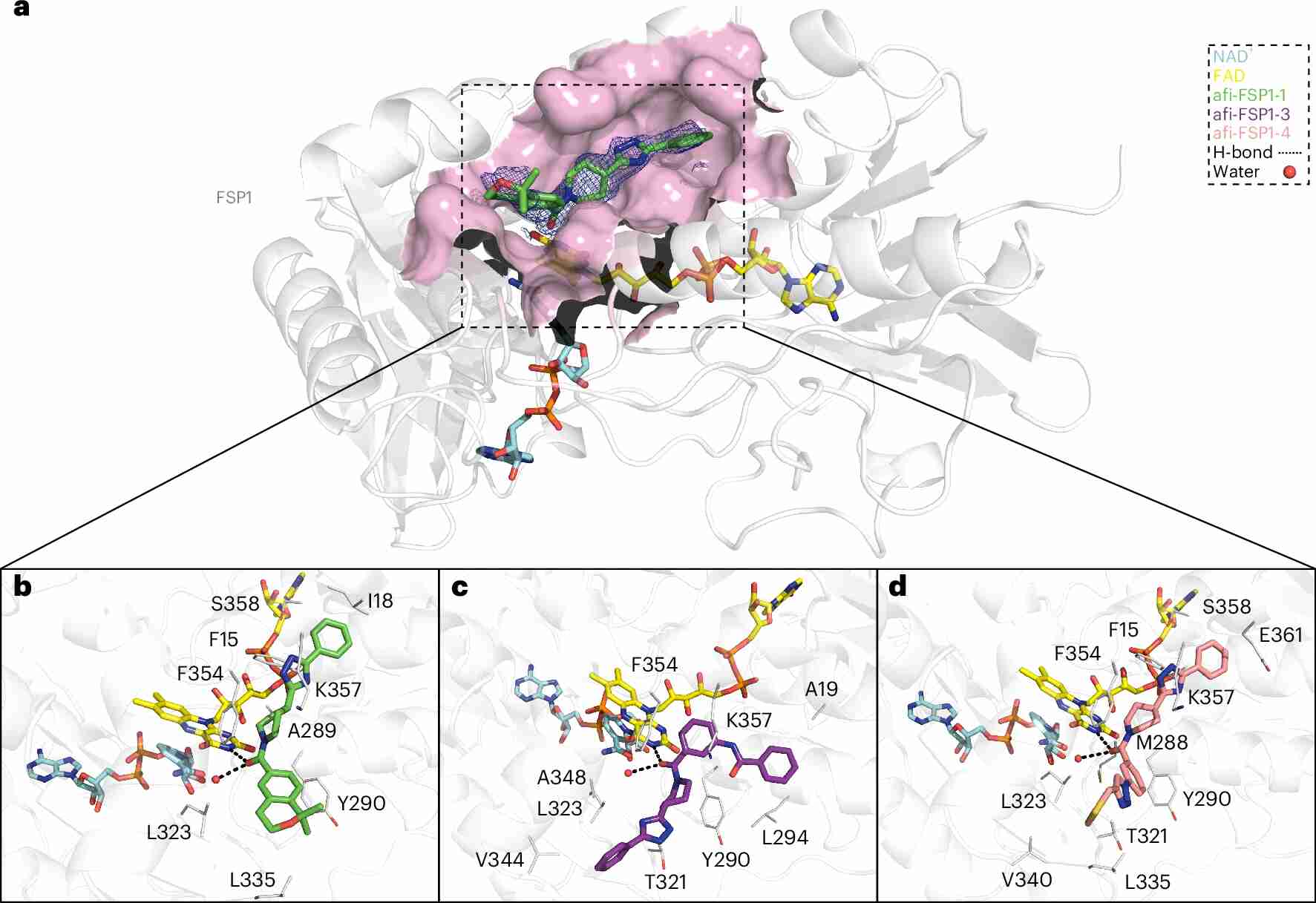
AdaptiveFlow was used to identify inhibitors against biological targets including FSP1 and PARP1, with experimental work providing evidence that some computationally identified compounds bind their intended targets.
For PARP1, the researchers conducted a primary screen of 100 million molecules and synthesized 160 candidates for experimental verification. Protein NMR and X-ray crystallography were used to validate direct binding.
The study also reports cellular experiments involving BRCA1-deficient triple-negative breast cancer cells and describes computationally identified PARP1/PARP2 inhibitors with selective activity.
For FSP1, the computational search produced nanomolar inhibitors, with co-crystal structures helping researchers understand their binding modes.
These results are important because they demonstrate the purpose of the HPC infrastructure.
The objective is not to produce impressive processor counts.
It is to turn processor cycles into scientific discoveries.
The new supercomputing equation
For decades, high-performance computing has largely been about increasing the number and performance of processors available to scientists.
More cores.
More memory.
Faster interconnects.
More GPUs.
More efficient algorithms.
AdaptiveFlow points toward another dimension of performance: Compute less, but compute the right things.
That could become one of the defining characteristics of AI-enhanced scientific computing.
A system capable of processing billions of candidates does not necessarily need to evaluate billions of candidates with the same expensive algorithm. Machine learning can serve as an intelligent filter, reducing the computational search space before the most expensive calculations begin.
Then HPC can apply enormous parallelism to the candidates that remain.
This is particularly powerful for problems where the search space is vast but useful solutions are comparatively rare.
Drug discovery is one example. Similar approaches could potentially be relevant to materials science, catalyst discovery, protein engineering, battery chemistry, and other scientific domains in which researchers confront enormous combinatorial spaces.
From brute force to intelligent force
The achievement of 5.6 million concurrent vCPUs is impressive on its own. But the more consequential achievement may be the combination of that scale with algorithmic intelligence.
The researchers have effectively connected two kinds of acceleration.
Hardware acceleration: distribute computational work across millions of CPU resources and, where appropriate, GPUs.
Algorithmic acceleration: use molecular-property organization, machine learning, and adaptive screening to avoid wasting computation on low-value regions of the search space.
The two approaches multiply one another.
If HPC makes an individual calculation faster, AI can make the overall search smaller.
If AI identifies a promising region, HPC can examine that region at extraordinary scale.
And if the system can dynamically move between those two processes, the boundary between algorithm design and supercomputer architecture begins to disappear.
Citizen-scale possibilities from supercomputer-scale discovery
The ultimate promise of this approach extends beyond the processors themselves.
The study describes an open-source platform that can make ultralarge screening workflows more accessible to researchers using HPC clusters and cloud resources.
That matters because the world’s largest computational discoveries increasingly depend on software ecosystems, not just machines.
A scientific platform that can scale from conventional clusters to millions of cloud CPUs potentially gives researchers a common framework for experiments that once required highly specialized infrastructure.
The result is a new model of scientific computing in which the supercomputer becomes not merely a place where calculations happen, but part of an adaptive discovery loop.
AI proposes where to look.
HPC searches at extraordinary scale.
Experimental science determines what matters.
The results feed back into the computational models.
And the cycle begins again.
The next frontier is not bigger; it is smarter.
The 69-billion-molecule problem illustrates something fundamental about the future of supercomputing.
There will always be scientific problems for which simply adding more processors is not enough.
When the search space grows faster than available computing resources, efficiency becomes as important as raw performance.
AdaptiveFlow demonstrates one possible answer: combine extreme parallelism with artificial intelligence so that computing resources are directed toward the most scientifically promising regions of an enormous search space.
The researchers’ 5.6-million-vCPU demonstration provides the hardware-scale proof point. The 69-billion-compound library provides the computational challenge. The AI-guided reduction in search costs provides the algorithmic breakthrough.
Together, they suggest a future in which the world’s largest scientific computers do not simply calculate faster.
They calculate more intelligently.
For drug discovery, that could mean navigating chemical space that was once computationally unreachable. For high-performance computing more broadly, it offers a compelling vision of what comes next: machines that combine massive parallelism with machine intelligence to transform impossible searches into tractable scientific experiments.
The age of brute-force scientific computing is not necessarily ending.
But it may be evolving into something far more powerful: intelligent force at supercomputer scale.