

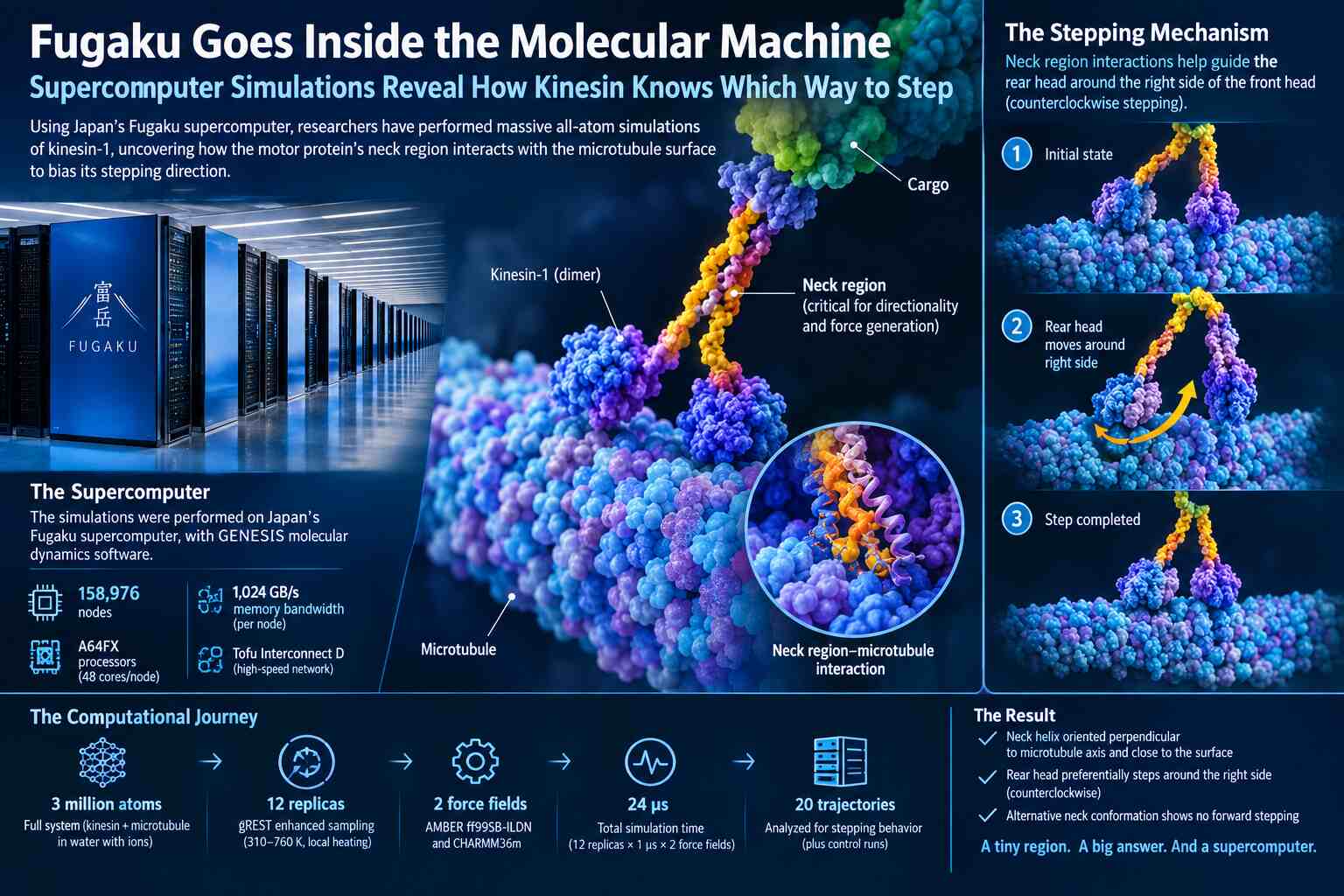
What if one of the most important questions about a molecular motor is not where it goes, but how it knows which way to turn? Researchers in Japan used the Fugaku supercomputer to investigate that question, running massive all-atom molecular dynamics simulations of kinesin-1. This molecular motor walks along microtubules carrying cargo through living cells. The result is a remarkably detailed look at a tiny piece of molecular machinery that has remained difficult to resolve experimentally.
The simulations suggest that a previously unresolved region of kinesin, called the neck, physically interacts with the microtubule surface and helps bias the motor's stepping trajectory. Rather than simply moving directly over the leading motor head, the rear head preferentially swings around its right side in a counterclockwise trajectory. But the scientific result is only half of the story. The other half is the machine that made the investigation possible.
The researchers built a molecular system containing approximately three million atoms and used the GENESIS molecular dynamics package on Fugaku to follow the behavior of the system at atomic resolution. For the difficult conformational-sampling problem, they employed generalized replica exchange with solute tempering, or gREST, while running simulations under two independent molecular-mechanics force fields.
The question becomes almost irresistible for an HPC audience: How much supercomputing does it take to make a molecular machine reveal how it walks?
A molecular motor with a steering problem
Kinesin-1 is a biological machine that converts chemical energy from ATP hydrolysis into mechanical motion. It moves along microtubules, long protein filaments that function as intracellular tracks, and transports cellular cargo. Kinesin generally operates as a dimer, with two motor heads alternately interacting with the microtubule in a hand-over-hand stepping process.
At first glance, that might seem straightforward. One foot attaches. The other moves forward. Then they switch. Repeat.
But molecular-scale mechanics rarely cooperate with such simple descriptions. The two kinesin heads are connected through a region containing a flexible neck linker of roughly 12 amino acids and a subsequent neck helix of about 30 amino acids. The neck linker changes conformation depending on the nucleotide state of the motor head, while the neck helix contributes to formation of the coiled-coil connecting the two motor domains. That neck is therefore not just biological plumbing. It is part of the mechanical transmission system. And scientists had lacked a sufficiently detailed atomic-level picture of how that region behaves while kinesin is actually attached to its microtubule track.
Experimental structural methods can reveal extraordinary detail, but flexible molecular regions can remain difficult to resolve. That left researchers with a particularly computational question: If the microscope cannot easily show the missing structure, can a supercomputer calculate it?
Enter Fugaku
The research team, led by Song-Ho Chong of Kumamoto University and Ryota Iino of the Institute for Molecular Science and SOKENDAI in Japan, turned to molecular dynamics. Their paper, published in Biophysical Journal, reports that all of the molecular dynamics simulations were performed using GENESIS on the Fugaku supercomputer.
That choice is significant.
Fugaku is not simply a large machine in the conventional sense. The system contains 158,976 nodes, each built around a Fujitsu A64FX processor. Each node provides 48 computational cores, 32 GiB of HBM2 memory, and approximately 1 TB/s of memory bandwidth. The complete system has about 4.85 PiB of memory and a theoretical double-precision peak of 537 PFLOPS in boost mode. Its processors are connected using the Tofu Interconnect D, a high-performance network designed for large-scale distributed computing.
But the researchers did not need to run the entire machine to make their scientific point. The paper does not report the number of Fugaku nodes used, so it would be wrong to translate the experiment directly into a Fugaku-wide FLOPS figure. What the paper does reveal is more interesting scientifically: the computation required several different forms of parallel molecular exploration.
Three million atoms is where the fun begins
The researchers constructed a model of dimeric human kinesin-1 attached to a structurally realistic microtubule. The full simulation system contained approximately three million atoms. For some of the enhanced-sampling calculations, the researchers reduced the model to roughly two million atoms by removing selected tubulin subunits that were not required for studying the neck region.
That is an enormous number of interacting particles.
Every atom contributes to the molecular system through interactions with other atoms, with the calculation repeatedly evaluating forces and updating positions and velocities. The researchers used a periodic cubic water box approximately 300 Å on each side, added potassium and chloride ions to neutralize the system, and set the salt concentration to approximately 100 mM to represent physiological conditions.
The simulation was equilibrated at 310 K and 1 atmosphere before production calculations.
And then comes a detail that HPC engineers will immediately recognize. The simulation timestep was only 3.5 femtoseconds.
That is
[
3.5\times10^{-15}\ {\rm seconds}.
]
3.5\times10^{-15}\ {\rm seconds}.
]
The researchers used hydrogen-mass repartitioning to enable this relatively long timestep while maintaining appropriate integration behavior. A microsecond of simulated molecular time therefore requires an extraordinary number of integration steps:
[
\frac{10^{-6}}{3.5\times10^{-15}}
\approx 2.86\times10^8
]
\frac{10^{-6}}{3.5\times10^{-15}}
\approx 2.86\times10^8
]
or approximately 286 million timesteps per microsecond. And that is for only one trajectory.
The problem wasn't simply simulating the molecule, it was finding the right conformation
Here is where the computational strategy becomes particularly interesting. The missing neck structure is flexible. A conventional molecular dynamics trajectory can spend a long time trapped in one region of conformational space.
If the system rarely crosses the energetic barriers separating important configurations, simply running longer may not be an efficient way to discover them. The researchers therefore used generalized replica exchange with solute tempering, or gREST. The technique selectively modifies the effective temperature or interaction scaling of a chosen molecular region while keeping the remainder of the molecular environment at physiological conditions.
In this experiment, the target was the kinesin neck-linker region. The objective was to make the difficult part of the molecule explore conformational space more aggressively without effectively heating the entire three-million-atom biological system.
That is an elegant HPC workload. Instead of simply throwing more timesteps at the problem, the researchers changed the sampling strategy.
Twelve replicas explore the molecular landscape
The gREST calculation used 12 replicas.
Their effective solute temperatures were:
[
310,\ 332,\ 357,\ 385,\ 415,\ 449,\ 486,\ 530,\ 577,\ 630,\ 690,\ 760\ {\rm K}.
]
310,\ 332,\ 357,\ 385,\ 415,\ 449,\ 486,\ 530,\ 577,\ 630,\ 690,\ 760\ {\rm K}.
]
Importantly, these were effective temperatures applied to the selected solute region. The solvent and nonsolute regions remained at 310 K. Replica exchange between adjacent temperatures was attempted every 3,000 molecular-dynamics steps, with the temperature spacing selected to achieve an exchange acceptance ratio of approximately 0.25. Each replica ran for 1 microsecond. And the researchers repeated the entire 12-replica calculation using two different force fields:
- AMBER ff99SB-ILDN
- CHARMM36m
That produced 24 microseconds of aggregate simulation time for the gREST calculations.
In other words, the supercomputer was not being asked a simple question such as: "Where is the neck?"
It was being asked:
"Across a large ensemble of thermally enhanced trajectories, force-field assumptions and conformational states, which structures does this flexible region actually occupy, and which ones remain physically stable when the full molecular environment is considered?"
That is a much harder computational problem.
The HPC trick: parallel replicas, shared scientific question
Replica-exchange molecular dynamics is naturally suited to parallel computing. Each replica can perform its own molecular-dynamics trajectory independently for most of the calculation. Periodically, neighboring replicas exchange information according to the statistical mechanics of the method.
Conceptually:
[
R_1(T_1)
\leftrightarrow
R_2(T_2)
\leftrightarrow
R_3(T_3)
\leftrightarrow
\cdots
\leftrightarrow
R_{12}(T_{12}).
]
R_1(T_1)
\leftrightarrow
R_2(T_2)
\leftrightarrow
R_3(T_3)
\leftrightarrow
\cdots
\leftrightarrow
R_{12}(T_{12}).
]
The trajectories are therefore largely parallel, but the replicas occasionally communicate. This is exactly the sort of workload for which a massively parallel system such as Fugaku is useful: large computational kernels execute concurrently while high-speed interconnects handle the synchronization and exchange operations.
The researchers used GENESIS, a molecular-dynamics package designed for hybrid-parallel and multiscale biomolecular simulations. The software has specifically been developed for multiple computational platforms and enhanced-sampling algorithms.
The simulation did not simply produce a picture
The output from these trajectories was not a single molecular snapshot. It was an enormous statistical sample of molecular configurations. The researchers tracked the position of the neck helix and then applied principal-component analysis to reduce the dimensionality of the sampled conformational data. They subsequently applied k-means clustering. The resulting conformational ensemble separated primarily into two major clusters. Cluster 1 was sampled more frequently than cluster 2.
This is another important computational-science point. The supercomputer generates trajectories.
The scientists then need statistical and dimensionality-reduction methods to determine what those trajectories actually mean.
The workflow therefore becomes:
[
\text{MD}
\rightarrow
\text{sampling}
\rightarrow
\text{PCA}
\rightarrow
\text{clustering}
\rightarrow
\text{representative structures}.
]
\text{MD}
\rightarrow
\text{sampling}
\rightarrow
\text{PCA}
\rightarrow
\text{clustering}
\rightarrow
\text{representative structures}.
]
The supercomputer is effectively converting an astronomical number of microscopic interactions into a manageable set of physically interpretable states.
The same answer survived two force fields
Perhaps the most reassuring result came from repeating the enhanced-sampling analysis with a second molecular-mechanics force field. The dominant conformation appeared under both AMBER ff99SB-ILDN and CHARMM36m. In that state, the neck helix was oriented approximately perpendicular to the long axis of the microtubule and positioned close to its surface. That cross-model consistency matters because molecular dynamics does not calculate "nature" directly. It calculates the behavior implied by a chosen force field. Different force fields encode different approximations of the underlying molecular interactions. If two independent parameterizations produce substantially different structural conclusions, confidence in the prediction falls. Here, the dominant structural state was reproduced.
There was, however, an important computational caveat.
The CHARMM simulation exhibited partial destabilization of the microtubule architecture during its 1-microsecond trajectory. The researchers therefore used the AMBER model for the subsequent walking simulations to preserve structural integrity.
That is precisely the kind of detail that is easy to lose in a conventional science story but important to computational scientists. The supercomputer did not magically eliminate model uncertainty. It exposed it.
Then Fugaku had to make the molecule walk
Finding the neck conformation was only the first computational challenge. The researchers next wanted to know whether that structure actually influenced kinesin's motion. This turned the calculation into a different kind of HPC workload. The complete kinesin walking cycle is computationally expensive and occurs on timescales that are difficult to reach through straightforward atomistic molecular dynamics. The researchers therefore focused on the initial stage of stepping, in which the rear kinesin head moves forward approximately half a step. They initially attempted 20 independent simulations, each lasting several hundred nanoseconds. But the result was a computational reality check.
The rear head did not spontaneously detach in any of those trajectories. The researchers concluded that the required detachment dynamics likely occurred on timescales beyond what was practical with their available computational resources.
So they changed the computational experiment.
Sometimes the fastest route through a supercomputer is to remove something
To make the stepping event observable, the researchers created a controlled local void beneath the rear kinesin head by removing the underlying tubulin subunit and neighboring subunits.
They also used an ADP-bound rear head, which has weaker microtubule affinity.
The artificial setup was designed to isolate the mechanical effect of strain transmitted through the neck linker.
This is a useful lesson for computational science.
The objective of a simulation is not always to reproduce every physical event exactly as it occurs in nature.
Sometimes the correct strategy is to construct a controlled computational experiment that isolates the physical mechanism being tested.
In this case, the researchers were not attempting to simulate an entire biological lifetime.
They were asking a narrower question: Given a particular neck conformation, what trajectory does the rear head prefer when it is allowed to step?
Twenty trajectories become the experiment
The team then ran 20 independent simulations starting from the dominant cluster-1 neck conformation.
In many trajectories, the rear head moved toward the microtubule plus end within approximately 100 nanoseconds.
The trajectories were not identical.
Some passed near the microtubule surface.
Others moved over the top.
A few even showed clockwise deviations.
But statistically, a clear directional tendency emerged: the rear head preferentially traveled around the right side of the front head, corresponding to counterclockwise stepping when viewed from above.
That is where the supercomputer's value becomes visible.
One trajectory could be an accident.
Twenty independent trajectories provide an ensemble from which a directional tendency can begin to emerge.
And then they removed the favorable neck conformation
The researchers performed another computational control experiment. They started 20 simulations from the alternative cluster-2 neck conformation. This structure folded back and interacted only weakly with the microtubule surface. The rear head failed to move forward in any of those trajectories. That comparison is powerful. It suggests that internal strain in the kinesin neck is not sufficient by itself. The neck also needs the appropriate physical interaction with the microtubule surface.
The supercomputer therefore helped turn an observational question into a mechanistic one:
[
\text{neck conformation}
+
\text{microtubule interaction}
\rightarrow
\text{stepping trajectory}.
]
\text{neck conformation}
+
\text{microtubule interaction}
\rightarrow
\text{stepping trajectory}.
]
What Fugaku actually contributed
It would be easy to describe this as another example of "a supercomputer simulating a protein."
That undersells what happened.
The computational challenge involved several layers:
Atomic scale
Approximately three million atoms were represented in the complete system.
Time scale
The molecular dynamics used a 3.5-femtosecond integration timestep.
Sampling problem
The neck region could occupy many conformations, requiring enhanced sampling.
Parallelism
Twelve replicas explored different effective solute-temperature states.
Model uncertainty
Two independent force fields were tested.
Statistical analysis
Principal-component analysis and clustering were used to identify dominant conformational states.
Ensemble dynamics
Twenty independent stepping trajectories were then used to investigate directional behavior.
This is not simply computational horsepower.
It is computational methodology built around the architecture of the supercomputer.
Fugaku is particularly interesting for molecular dynamics
Fugaku's architecture is well suited to workloads in which enormous numbers of arithmetic operations must be performed on large collections of interacting particles. Its A64FX processors use Armv8.2-A with 512-bit SVE vector processing, while each node provides high-bandwidth HBM2 memory. The system's network connects its nodes through Tofu Interconnect D.
For molecular dynamics, memory bandwidth and communication efficiency can be just as important as theoretical floating-point peak. A simulation repeatedly performs operations involving particle coordinates, velocities, forces, neighbor information and molecular interaction terms. The workload must therefore move data efficiently while maintaining the synchronization required by a distributed molecular system.
Fugaku provides approximately 1,024 GB/s of memory bandwidth per node, a feature RIKEN identifies as one of the system's characteristics. Its 158,976-node architecture provides a very large computational envelope for applications that can scale across the machine.
The researchers' use of GENESIS demonstrates how such a system can be converted from raw compute capacity into a scientific instrument.
The surprising part: the supercomputer did not replace the experiment
The simulation did something experiments could not easily do. It exposed a possible atomic-level mechanism for the steering behavior. But the researchers are careful about the limitations. The model used a truncated kinesin construct. The stepping calculation artificially removed microtubule subunits to trigger detachment. And the model omitted flexible E-hooks, disordered, negatively charged C-terminal regions of tubulin that can influence the molecular environment around the microtubule surface. The authors therefore do not present the simulation as the final word on kinesin's complete walking cycle.
In fact, the full walking cycle remains computationally difficult. That may be one of the most revealing conclusions of the study. Even with a machine capable of hundreds of petaflops, a three-million-atom model and sophisticated enhanced sampling, the complete biological process remains difficult to reproduce atom by atom over its full timescale.
The problem is not simply that today's computers are too slow.
It is that biological systems contain multiple interacting spatial and temporal scales.
From atoms to supercomputing
A kinesin motor operates at nanometer scales. Its structural components are only a few dozen amino acids long. Yet understanding the motor requires calculations involving millions of atoms and trajectories extending across hundreds of nanoseconds or microseconds. That mismatch between tiny physical objects and enormous computational requirements is precisely why molecular science has become a major HPC application.
The research also illustrates why future advances in molecular simulation will depend on more than faster processors.
They will require:
- better force fields,
- more efficient molecular-dynamics kernels,
- improved sampling algorithms,
- higher-bandwidth memory,
- faster interconnects,
- larger parallel ensembles,
- better statistical analysis,
- and ultimately multiscale methods that connect atomistic simulations to much longer biological timescales.
The supercomputer becomes the platform on which all of those methods interact.
The next question is much harder
The researchers have established a compelling computational mechanism for the initial directional bias of kinesin stepping.
But the obvious next question is almost painfully simple: Can Fugaku, or its successors, simulate the whole walk?
That means restoring the missing molecular components, eliminating the artificial detachment mechanism, including flexible microtubule E-hooks, and extending the trajectories far enough to capture the full nucleotide-dependent stepping cycle. The computational cost rises rapidly. The current study already found that spontaneous detachment was not observed in 20 several-hundred-nanosecond trajectories. A complete walking cycle could therefore require vastly more sampling, more sophisticated enhanced-sampling methods, or a combination of simulation approaches.
And that is where the story gets particularly interesting for HPC.
The next breakthrough may not come from simply running the same simulation on a larger machine. It may come from changing how the simulation searches molecular state space.
A supercomputer becomes a microscope
There is something almost poetic about the result. Researchers were trying to see something too small and too dynamic for conventional structural techniques to resolve completely. So they built it computationally. They gave the molecular system millions of atoms. They gave it physical interactions. They gave it temperature. They gave it time. Then they asked Fugaku to follow what happened.
The result was not merely a prettier molecular picture. It was a proposed mechanical explanation for how kinesin biases its next step. The researchers' simulations indicate that the neck region forms a coiled-coil structure positioned close to the microtubule surface, and that this interaction helps steer the rear motor head around the right side of the leading head. For a molecular biologist, that is a new piece of the kinesin mechanism. For an HPC engineer, it is something else: a demonstration of how a petascale supercomputer can turn an experimentally inaccessible molecular timescale into a computationally explorable one.
And perhaps that is the most curious part of all.
Fugaku did not merely calculate where a molecular motor was.
It helped reveal why the motor chooses where to go next.