

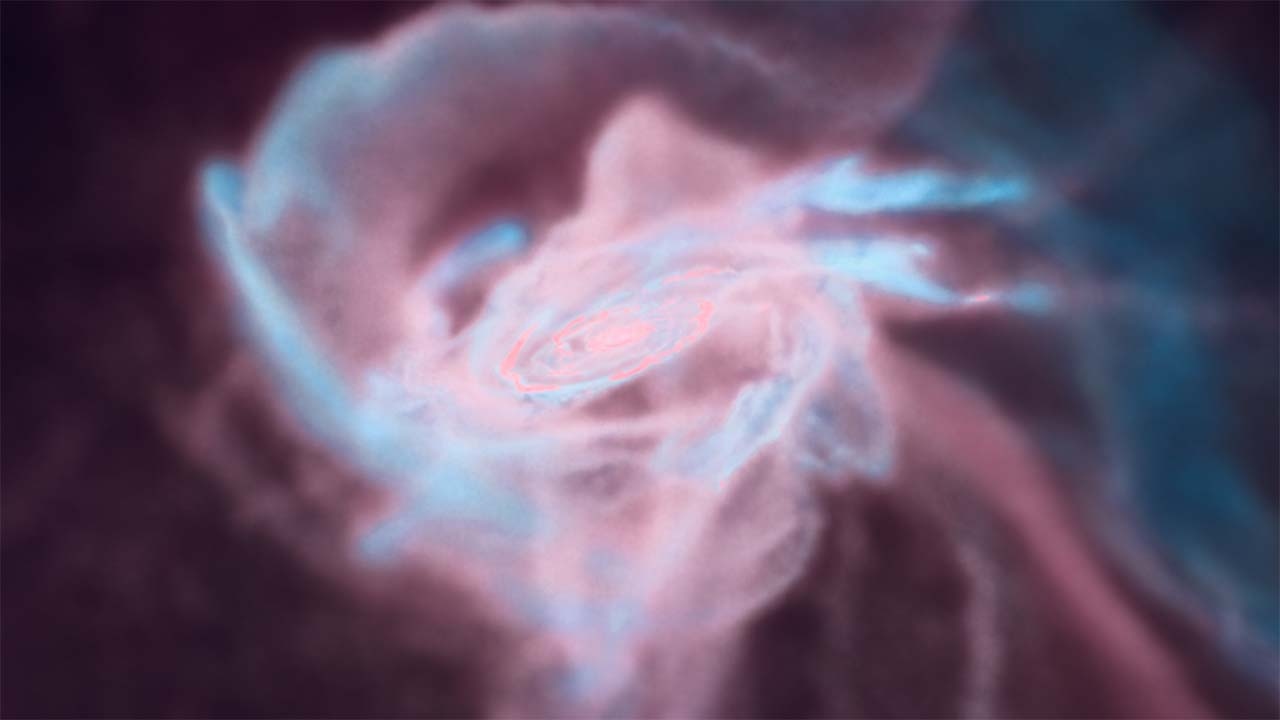
ATERUI III simulations connect the cosmic web to individual gas clouds, supermassive stars and rapidly growing black holes, offering a computational explanation for JWST’s mysterious ‘Little Red Dots’
Researchers utilizing the ATERUI III supercomputer at the National Astronomical Observatory of Japan have provided a computational framework to explain the existence of unexpectedly large supermassive black holes in the early Universe. By conducting high-resolution, radiation-hydrodynamic simulations, the study (Nature's academic paper: https://www.nature.com/articles/s41586-026-10985-8) illustrates how external far-ultraviolet radiation can suppress gas fragmentation, leading to a concentrated accumulation of matter that fosters the growth of massive protostars and subsequent black-hole seeds. Furthermore, the simulation demonstrates that these rapidly growing black holes are temporarily obscured by dense gas, providing a compelling theoretical explanation for the "Little Red Dots" observed by the James Webb Space Telescope. This research highlights the efficacy of specialized high-performance computing architectures in bridging the gap between cosmological simulations and synthetic observations.
This Is a Supercomputing Problem Before It Is a Black-Hole Problem
The central achievement is not simply that researchers simulated a black hole.
It is that they attempted to simulate the environment that creates one.
The paper uses the moving-mesh AREPO code to perform three-dimensional radiation-hydrodynamic calculations. The simulation must simultaneously account for gravity, gas dynamics, radiation, chemistry, star formation, and black-hole accretion across vastly different physical scales.
That is precisely the kind of workload for which conventional single-scale astrophysical models begin to break down.
At the largest scale, the researchers begin with a cosmological dark-matter simulation covering a 16 h⁻¹-megaparsec comoving volume using 4,096³ dark-matter particles. Each dark-matter particle has a mass of approximately 5.13 × 10³ h⁻¹ solar masses, allowing the simulation to identify minihalos down to approximately 10⁵ h⁻¹ solar masses.
That is already a substantial numerical problem.
But the researchers do not stop at cosmological structure.
They construct halo merger trees, incorporate semi-analytic models of early galaxy formation, follow primordial and metal-enriched star formation, supernova feedback, chemical enrichment, and local Lyman-Werner radiation fields, and then select a candidate halo for a much more expensive radiation-hydrodynamic calculation.
The simulation subsequently zooms into a region approximately 400 kiloparsecs across, surrounding a target halo in a 3.8-sigma overdensity.
That is a classic HPC strategy:
Find the needle in the cosmological haystack, then spend enormous computational resources examining the needle.
ATERUI III: The HPC Engine Behind the Experiment
The calculations were performed on the XD2000 system at the Center for Computational Astrophysics of NAOJ, the machine known as ATERUI III.
ATERUI III is not a conventional general-purpose supercomputer deployment. NAOJ designed it specifically for simulation astronomy.
The HPE Cray XD2000 system has a theoretical peak performance of 1.99 petaflops and 32,256 CPU cores across 288 nodes. It is divided into two different computing environments.
System M emphasizes memory bandwidth, while System P emphasizes memory capacity. System M provides 3.2 TB/s of memory bandwidth per node, while System P provides 512 GB of memory per node.
For this study, the research team used ATERUI III’s System M, taking advantage of its high-speed memory subsystem for the large-scale simulation workload.
That design decision is significant.
Astrophysical hydrodynamics is not simply a race to maximize floating-point operations. A simulation can spend enormous amounts of time moving particle and cell data through memory, updating neighboring cells, evaluating gravitational interactions, and exchanging information between distributed computational domains.
For these workloads, memory bandwidth can matter as much as peak FLOPS.
ATERUI III’s System M is built around Intel Xeon CPU Max 9480 processors and provides 128 GB of high-bandwidth memory per node. Across its 208 System M nodes, the subsystem delivers approximately 665 TB/s of aggregate memory bandwidth according to NAOJ specifications.
That makes ATERUI III an interesting example of a broader HPC principle: The best supercomputer for a scientific problem is not necessarily the machine with the largest theoretical FLOPS number. It is the machine whose architecture matches the computational structure of the problem.
4,096³ Particles Are Only the Beginning
The simulation’s numerical hierarchy becomes even more impressive when the researchers zoom in.
The baseline cosmological calculation uses 4,096³ dark-matter particles. A higher-resolution follow-up increases the effective resolution of the zoom region to 8,192³, reducing the dark-matter particle mass to approximately 542 h⁻¹ solar masses and the baryonic particle mass to approximately 99.2 h⁻¹ solar masses.
The higher-resolution calculation produced essentially the same black-hole growth behavior as the fiducial simulation, providing an important numerical-resolution check.
This is exactly the sort of test HPC researchers want to see.
A spectacular visualization is not enough.
A simulation can always produce a beautiful result. The harder question is whether the result survives when the computational mesh or particle resolution changes.
Here, the researchers found that the major black-hole growth result was relatively insensitive to the increased numerical resolution.
That does not eliminate every uncertainty, but it gives the computational result considerably more credibility.
The Physics Gets Expensive When the Universe Gets Interesting
The computational difficulty rises dramatically once the primordial gas begins collapsing.
The radiation-hydrodynamic calculation uses adaptive mesh refinement, refining regions when the local cell size falls below 16 times the local Jeans length. The purpose is to capture gravitational collapse while avoiding artificial fragmentation.
The code also follows a non-equilibrium primordial chemical network involving eight species: e⁻, H, H⁺, H₂, H⁻, D, D⁺ and HD.
The simulation includes molecular and atomic cooling, free-free and free-bound emission, ionization, photodissociation and photodetachment processes. Radiation from stars and black holes is also coupled to the gas.
This is where the HPC workload becomes much more than an N-body calculation.
At every stage, the simulation is effectively asking:
- Where is the gas?
- How fast is it moving?
- How dense is it?
- What is its temperature?
- Which chemical species are present?
- How is radiation changing those species?
- Is the gas cooling?
- Is gravity overcoming pressure?
- Are stars forming?
- How much radiation are those stars producing?
- Is that radiation suppressing or accelerating further collapse?
- Is a black hole accreting?
- How does its radiation feed back into its environment?
And all of those questions are coupled.
The Computer Finds a Cosmic Traffic Jam
The simulations reveal a remarkable environmental effect.
A luminous neighboring galaxy located roughly 10 kiloparsecs away bathes the target halo in intense far-ultraviolet radiation. Instead of simply triggering star formation, the radiation suppresses molecular hydrogen cooling and delays the normal fragmentation of gas into many smaller stars.
Meanwhile, gravity continues pulling material into the halo.
The result is effectively a cosmic traffic jam.
Gas accumulates rather than efficiently fragmenting.
When collapse eventually begins, enormous amounts of material become available to a small number of rapidly growing protostars.
In the simulation, some protostars reach 5–9 × 10⁵ solar masses.
That is dramatically larger than the roughly 10⁵-solar-mass scale associated with conventional direct-collapse models.
Those supermassive stars subsequently collapse to form black-hole seeds of approximately 10⁶ solar masses.
The significance for HPC is profound.
The computer is not merely calculating a black hole.
It is calculating the conditions under which the black hole becomes possible.
From 1 Million to 30 Million Solar Masses
Once the massive seed forms, the simulation enters another computationally difficult regime.
The newly formed black hole becomes embedded in dense, optically thick gas. Radiation becomes trapped, allowing material to fall inward at rates several to tens of times the conventional Eddington limit for a short period.
The simulation follows this rapid growth.
By approximately redshift z ≈ 10, the black holes have grown beyond 10⁷ solar masses. By z ≈ 8, the model reaches approximately 3 × 10⁷ solar masses in the most massive system. (Nature)
The computation therefore bridges an enormous dynamic range: cosmic structure → dark-matter halo → gas reservoir → collapsing cloud → protostars → supermassive star → black-hole seed → accretion disk → overmassive black hole.
That is an extraordinary numerical pipeline.
The Simulation Also Has to Become a Telescope
One of the most important aspects of the study is that the researchers do not stop once a massive black hole appears.
They ask what the simulated object would actually look like.
The high-resolution calculations resolve the dense gas around one black hole down to approximately 500 astronomical units. The simulated circum-black-hole environment reaches hydrogen densities above 10¹⁰ cm⁻³.
The model produces strong Hα emission and substantial Thomson optical depth.
At 26,000 years after black-hole formation, the simulated Hα luminosity within 10⁴ AU reaches approximately 1.5 × 10⁴³ erg/s, with a Thomson optical depth of 10.2 at that radius. Hundreds of thousands of years later, the environment evolves substantially as the dense gas dissipates.
This is an important HPC concept: simulation is becoming synthetic observation.
The supercomputer does not simply calculate where matter goes.
It calculates what the resulting astrophysical system should emit.
That allows the researchers to compare the simulated universe against JWST observations.
The result is a computational loop: Physics → simulation → synthetic spectrum → telescope → comparison → improved physical model.
Why “Little Red Dots” Matter to HPC
JWST’s LRDs initially appeared to be another observational mystery.
The simulations now provide a possible computational explanation: they may represent a short-lived, heavily obscured phase in the formation and rapid growth of massive black holes.
Dense gas around the black hole can produce strong Balmer features and broad Hα emission through electron scattering. The simulated systems transition from heavily obscured LRD-like objects toward less obscured, more conventional AGN-like states on timescales of roughly 0.1–1 million years.
The computer therefore connects an observational signature to a physical evolutionary sequence.
That is precisely where simulation supercomputing becomes more than an engineering exercise.
It becomes a scientific laboratory.
Supercomputers Are Becoming Cosmic Time Machines
There is something inspirational about what is happening here.
Humanity cannot travel back to the first billion years of cosmic history.
We cannot place a sensor beside a primordial protostar.
We cannot watch a supermassive star collapse into a black hole.
We cannot wait 600 million years to observe what happens next.
But we can build mathematical representations of those environments and give them enough computational resolution to evolve.
ATERUI III effectively becomes a laboratory in which researchers can perform experiments on a Universe that no longer exists.
And the scale of that laboratory is expanding.
NAOJ describes ATERUI III as part of the emergence of “simulation astronomy”, a computational branch of astronomy in which supercomputers numerically solve physical equations that cannot be solved analytically.
This study is a powerful demonstration of that idea.
The HPC Lesson: Resolution Is a Scientific Instrument
For the supercomputing community, perhaps the most important lesson is not the headline black-hole mass.
It is the way the researchers use computational resolution as a scientific instrument.
The workflow moves through multiple levels:
16 h⁻¹ Mpc cosmological volume
↓
4,096³ dark-matter particles
↓
Target halo identification
↓
~400-kpc zoom region
↓
adaptive radiation hydrodynamics
↓
8,192³ effective high-resolution follow-up
↓
protostellar fragmentation
↓
supermassive-star formation
↓
black-hole formation
↓
500-AU circum-black-hole zoom
↓
synthetic observable signatures
That is a textbook example of hierarchical HPC.
No single numerical resolution can efficiently represent every scale simultaneously.
Instead, the simulation spends computational resources where the physics becomes important.
And There Is Still More Computing Ahead
The researchers are careful about what their simulation does not yet include.
For example, the model does not include kinetic feedback from accreting black holes such as jets or winds. The authors explicitly describe the resulting calculation as a fiducial model and an upper limit on black-hole growth under the assumption that such kinetic feedback is absent.
The paper also notes that the present simulation does not resolve the full galactic-scale gas inflows required to sustain long-term Eddington accretion.
Those limitations point directly toward the next generation of HPC workloads.
More physics.
More resolution.
Longer time integration.
Larger cosmological volumes.
More black holes.
More radiation.
More detailed feedback.
And eventually, more direct connections between simulated populations and the growing JWST observational catalog.
The computational challenge is therefore not disappearing.
It is expanding.
From Petaflops to Scientific Discovery
ATERUI III has a theoretical peak performance of 1.99 petaflops, which is tiny compared with today’s largest general-purpose exascale machines.
But peak FLOPS alone completely misses the point.
This research demonstrates why specialized HPC architectures remain valuable.
A system optimized for memory bandwidth, scientific simulation, and the specific numerical characteristics of astrophysical workloads can turn computational resources into scientific experiments.
The researchers used ATERUI III’s XD2000 system for calculations that combine gravity, hydrodynamics, adaptive resolution, radiation transport, chemistry, star formation and black-hole physics.
The result is not simply another simulation.
It is a possible explanation for one of JWST’s strangest discoveries.
And that may be the most compelling future for supercomputing: not merely calculating faster, but making questions that once seemed computationally impossible experimentally accessible.
The Universe left humanity a puzzle written in photons.
JWST found the clues.
ATERUI III helped researchers build the laboratory needed to understand them.
And somewhere inside that numerical laboratory, a million-solar-mass black-hole seed emerged from primordial gas and began growing into the kind of cosmic monster that the early Universe apparently had been building all along.
For supercomputing, that is the real story: when enough computational power, physical modeling, and numerical resolution converge, the computer stops merely calculating the Universe and starts allowing us to experiment with it.