

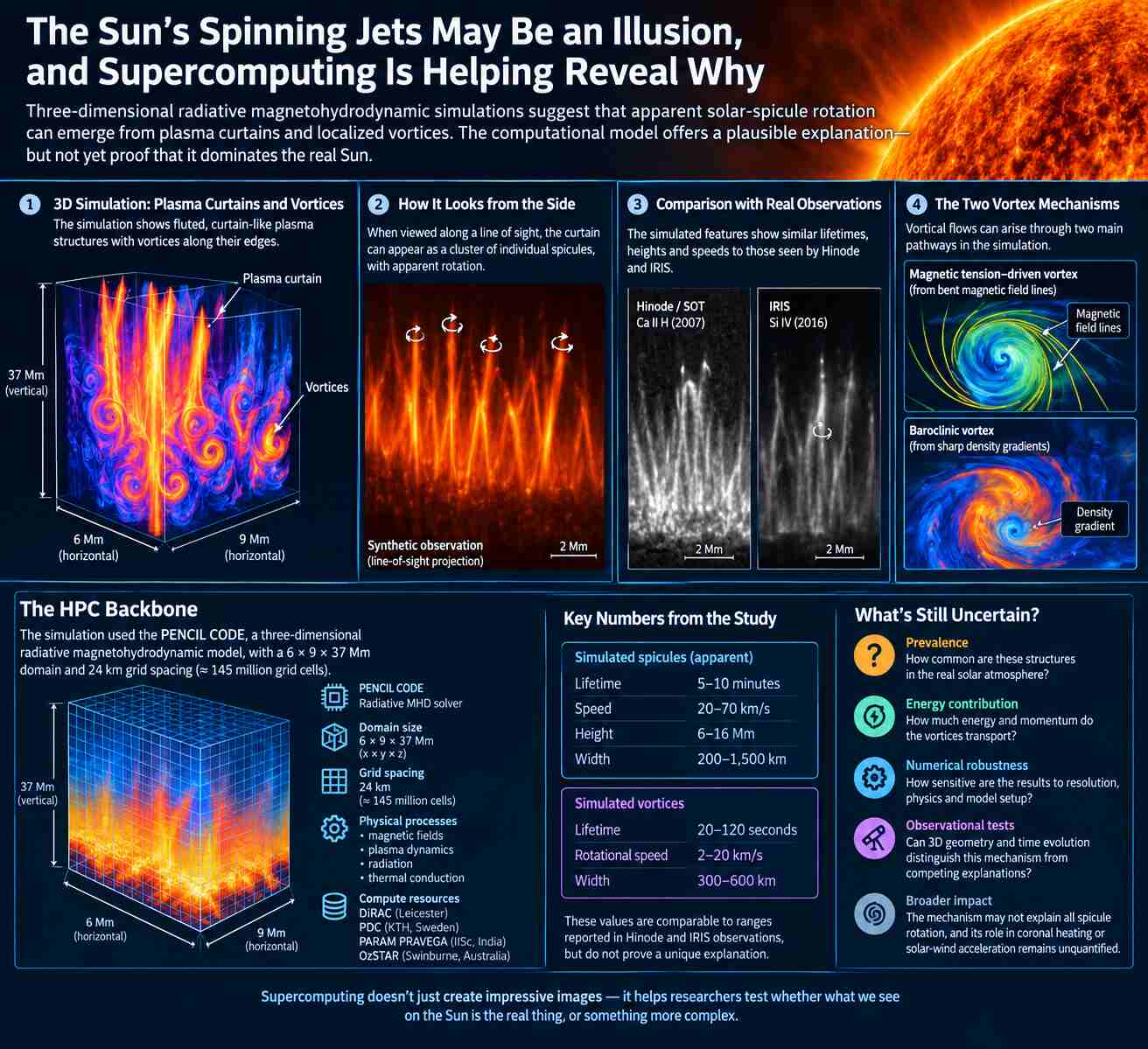
Three-dimensional radiative magnetohydrodynamic simulations suggest that apparent solar-spicule rotation can emerge from plasma curtains and localized vortices. The computational model offers a plausible explanation, but not yet proof that it dominates the real Sun.
Solar spicules, rapidly evolving jets of plasma extending from the chromosphere, have long been studied for their potential role in energy and momentum transport within the Sun’s atmosphere. However, recent research published in The Astrophysical Journal https://iopscience.iop.org/article/10.3847/1538-4357/ae8999 suggests that their observed rotation may, in some cases, be an optical illusion.
Using three-dimensional radiative magnetohydrodynamic (rMHD) simulations, the study proposes that these apparent spinning jets are actually sections of broader, curtain-like plasma formations, where localized vortices create rotational signatures when viewed along a specific line of sight.
Led by Sahel Dey, Piyali Chatterjee, and Robertus Erdélyi, this work highlights the power of high-performance computational physics to investigate phenomena that remain difficult to interpret through telescopic observation alone.
While the model offers a compelling alternative mechanism, the researchers emphasize the inherent limits of simulation-based evidence, noting that further study is needed to determine how common this phenomenon is and its broader significance in solar physics.
Turning a solar image into a three-dimensional physics problem
Spicules are observed as narrow, elongated features, but a telescope records projected emission rather than a direct, complete view of the three-dimensional plasma. Distinct structures can overlap along the line of sight, while changes in geometry and brightness can make connected structures appear separate.
The researchers investigate whether a fluted, curtain-like arrangement of plasma can explain some of the apparent rotation, splitting, merging, and transverse motion associated with spicules.
In the proposed picture, a broad plasma structure produces multiple jet-like features when viewed from the side. Strong density gradients develop near its boundaries, while vortical flows form in the surrounding plasma. When the evolving structure is projected into a synthetic observation, its appearance can resemble a cluster of independently moving or rotating jets.
This is a problem well suited to three-dimensional simulation. A two-dimensional model would restrict the geometry and flow patterns available to the plasma, making it harder to investigate the relationship between the underlying structure and its projected appearance.
The simulation provides access to both the physical plasma configuration and the synthetic emission an observer might measure. That makes it possible to ask a more demanding question than whether a model can produce something that looks like a spicule. Can the modeled dynamics produce observable signatures with characteristics comparable to those found in solar data?
The computational scale: a large, coupled 3D model
The team used the PENCIL CODE to run a three-dimensional radiative magnetohydrodynamic simulation covering a domain approximately 6,000 × 9,000 × 37,000 kilometers, with a reported grid spacing of 24 kilometers.
That combination of domain size and spatial resolution is significant. The model must follow plasma dynamics over a volume extending from the lower solar atmosphere toward coronal heights, while retaining enough spatial detail to represent relatively narrow structures and sharp gradients.
A simple estimate illustrates the numerical scale. If the stated dimensions and 24-kilometer spacing are applied uniformly in all three directions, the domain corresponds to roughly 250 × 375 × 1,542 grid cells, or about 145 million spatial cells. This is an order-of-magnitude estimate from the reported domain and spacing, not a quoted benchmark or a claim about the exact array dimensions used in the production run.
At that scale, the solver must repeatedly update a large three-dimensional collection of coupled physical quantities. The relevant workload includes the evolution of plasma flow and magnetic fields, alongside the thermal and radiative processes included in the model. The scientific result depends on the interaction of those processes over time, not on any one field or equation considered in isolation.
The model incorporates radiation and thermal conduction as well as magnetized plasma dynamics. This matters because the appearance and evolution of narrow solar structures are tied to more than fluid motion alone. Thermal evolution and the resulting plasma properties influence the structures produced by the simulation and the emission used to compare them with observations.
The computational demand therefore comes from the combination of three-dimensional spatial detail, coupled physical processes, and time-dependent evolution. A large grid is only one part of the cost: the simulation must advance the system through enough time to follow the formation, evolution and disappearance of transient features.
There is an important qualification, however. Grid spacing is not the same as effective physical resolution. It does not, by itself, establish that every dynamically important scale is resolved or that numerical effects are negligible. That requires evidence from convergence tests, sensitivity studies, and a clear account of the numerical treatment. The reported resolution makes the calculation substantial, but it should not be treated as a stand-alone guarantee of accuracy.
Why the HPC angle is more than a large grid
The scientific value of this kind of computation lies in the ability to inspect a simulated system in ways that observations alone cannot provide.
A telescope can record apparent motion, brightness, and spectral signatures. The numerical model can additionally expose the three-dimensional flow field, the organization of magnetic structures and the development of vorticity within the modeled plasma. Researchers can then generate synthetic observations from the model and compare those projected signatures with real data.
That workflow connects several computationally intensive tasks:
- Evolving the physical system: solving the coupled, time-dependent equations governing the modeled magnetized plasma and its thermal behavior.
- Resolving structure: representing narrow features and steep density gradients within a large spatial domain.
- Tracking transient dynamics: following the formation and evolution of features whose lifetimes can be measured in seconds or minutes.
- Generating observational comparisons: translating the three-dimensional model into projected emission that can be assessed against telescope observations.
The distinction between the three-dimensional state and the synthetic image is particularly important. Without that step, researchers risk comparing a simulated physical object directly with an observational feature that is only its projected appearance.
The study acknowledges support from several high-performance computing facilities: the DiRAC HPC Facility at the University of Leicester, the PDC Center for High Performance Computing at KTH in Stockholm, PARAM PRAVEGA at the Indian Institute of Science in Bangalore, and OzSTAR at Swinburne University.
These acknowledgements establish the computational infrastructure involved, but the paper’s scientific result should not be confused with a system-performance report. The available information does not provide a basis for assigning a particular fraction of the work to each facility, estimating total core-hours, comparing processor architectures, or claiming a specific speedup. Those would require documented run configurations and performance measurements.
For HPC readers, that distinction is important: the paper demonstrates the scientific use of substantial computational modeling, not a benchmark of the machines on which it ran.
Two mechanisms for producing swirling plasma
The simulation identifies two pathways associated with coronal swirling conduits, or CoSCo structures.
The first is driven primarily by magnetic tension. In a magnetized plasma, magnetic-field lines resist bending and can exert forces as the field and surrounding material evolve. Those forces can contribute to organized swirling flows.
The second pathway involves baroclinic vorticity generation near sharp density gradients around spicule boundaries. Baroclinic effects arise when pressure and density gradients are misaligned, allowing fluid vorticity to develop.
The two mechanisms offer different routes to similar-looking motions. In the simulation, vortical flows can form as vertically extended rotating plasma columns that reach coronal heights. Some of the modeled spicules appear to feed these swirling structures directly.
This is a potentially important distinction for interpreting observations. A rotational signature may not map neatly to the rotation of one discrete jet: it may reflect the interaction between a jet-like feature, a larger plasma structure, and a surrounding vortex.
But identifying both mechanisms in one numerical model does not establish their relative prevalence in the solar atmosphere. Nor does it tell us how much energy or momentum each carries. Those are quantitative questions that require dedicated analysis and observational constraints.
Does the model match what telescopes see?
The researchers compare their simulated behavior with observations from the Solar Optical Telescope aboard Hinode and the Interface Region Imaging Spectrograph (IRIS).
The observational sequences include Hinode/SOT Ca II H data from November 7, 2007, spanning approximately 56 minutes, and IRIS Si IV data from October 19, 2016, spanning approximately 39 minutes.
The simulated spicule-like features have lifetimes of roughly five to ten minutes, apparent speeds of about 20–70 kilometers per second, heights of approximately 6–16 megameters and widths of around 200–1,500 kilometers.
The associated vortices have widths comparable to the 300–600-kilometer scale of spicules, rotational speeds of roughly 2–20 kilometers per second and average lifetimes in the range of 20–120 seconds.
These similarities make the proposed mechanism worth investigating. The model generates features with scales and timescales that overlap those found in observations, rather than producing a wholly unrelated phenomenon.
Yet this is not a unique identification of the underlying physics. Different three-dimensional configurations can produce similar projected images. A stronger test would quantitatively compare the distributions of observed and simulated properties, including the frequency of the signatures, their time evolution, viewing geometry, and measurement uncertainties.
The critical question is not simply whether the synthetic image looks plausible. It is whether the model makes predictions that distinguish it from competing explanations.
What the computation has not yet established
There are several gaps between a plausible numerical mechanism and a general explanation of solar-spicule rotation.
First, prevalence remains uncertain. The simulation shows how curtain-like structures and vortices can generate apparent spinning signatures. It does not establish how often this occurs across different solar regions or magnetic conditions.
Second, the physical contribution of the vortices needs quantification. Their frequency, energy content and role in transporting energy and momentum would help determine whether they are merely part of the observed dynamics or an important contributor to the solar atmosphere’s energy budget.
Third, numerical robustness matters. Narrow structures and steep gradients can be sensitive to spatial resolution and the treatment of physical transport. Systematic resolution studies, tests of model assumptions, and comparisons across simulation setups would help establish how robustly the result follows from the modeled physics.
Fourth, the observational test needs to discriminate among explanations. Better constraints on three-dimensional geometry and time evolution could help separate genuine rotation of an individual structure from apparent rotation generated by projection and interactions with surrounding plasma.
The work does not establish a quantified contribution from the proposed mechanism to coronal heating or solar-wind acceleration. Those remain broader scientific questions. A simulation of vortical structures extending to coronal heights is not, on its own, a measurement of their contribution to the energy balance of the corona.
A computational result that needs a stronger test
The research does not posit that solar spicules are merely optical illusions; the structures are physically real, and genuine rotational motion may indeed occur. Rather, the study demonstrates that certain observed spinning signatures can emerge from more complex three-dimensional configurations than the visual data alone might imply.
This highlights the critical utility of high-performance computing, which enables researchers to investigate underlying physical structures, generate synthetic observations, and rigorously test whether a proposed mechanism can replicate the measurable features of an actual system.
However, the computational precision that renders a model compelling can also be visually persuasive before all underlying uncertainties are resolved. High-resolution results do not automatically equate to robust findings, and alignment with select observational properties is not definitive proof that a specific mechanism dominates in nature.
The necessary next steps involve quantifying the prevalence and physical contribution of these vortices, testing the model’s sensitivity to resolution and foundational assumptions, and developing observational comparisons capable of systematically ruling out competing explanations.
For HPC practitioners, the broader takeaway is that computational science yields its most significant results when models extend beyond mere replication. To be truly effective, the approach must expose underlying mechanisms, quantify uncertainties, and generate predictions that can be empirically challenged. In this instance, supercomputing has successfully transformed an ambiguous solar signature into a testable physical hypothesis, the general validity of which will be determined by further inquiry.