

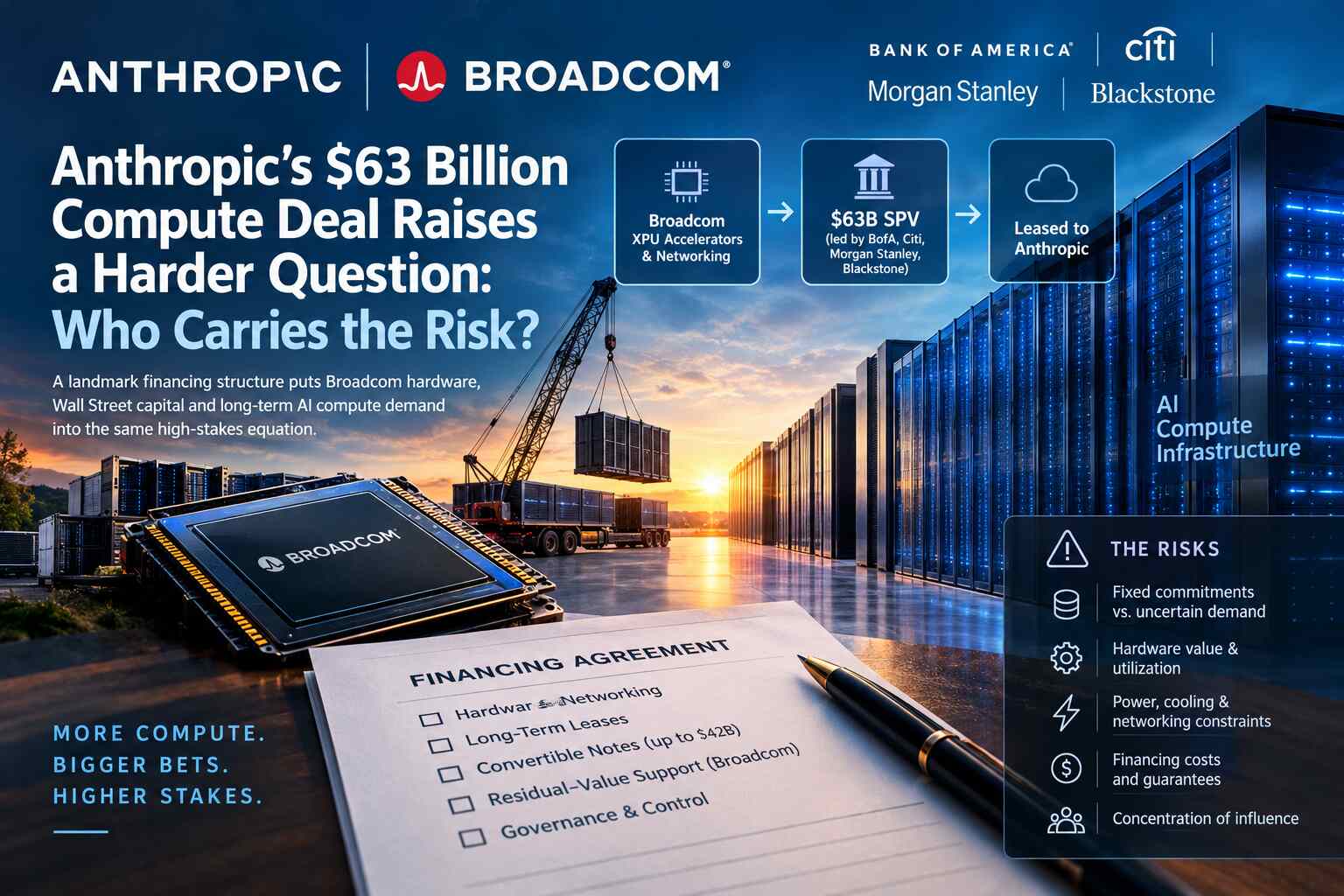
This landmark financing arrangement integrates Broadcom hardware, Wall Street capital, and long-term AI compute demand into a complex, high-stakes equation. While the underlying technology is undoubtedly essential, the long-term economic viability remains to be demonstrated.
Anthropic’s expanding artificial intelligence business creates a challenge that goes well beyond model development: how do you finance enough computing infrastructure to keep growing without locking the company into obligations that become hard to sustain?
A $63 billion financing arrangement announced October 26 by Bank of America, Blackstone, Citi and Morgan Stanley offers a revealing answer. The financial institutions will provide committed financing through a newly formed special-purpose vehicle (SPV) to purchase Broadcom XPU accelerators and networking equipment, which will then be leased to Anthropic. Equipment deliveries are expected to begin in 2027.
The structure is designed to mobilize huge amounts of capital for AI computing without requiring the equipment to be financed through a conventional, direct purchase by Anthropic alone.
But it also raises a more consequential question for the supercomputing industry: What happens if the computing capacity being financed becomes more expensive to operate, less valuable than expected, or harder to monetize than the contracts assume?
This arrangement does not necessarily indicate a failure of Anthropic’s business model; rather, it underscores that financing next-generation AI infrastructure has evolved into a sophisticated endeavor involving hardware suppliers, financial institutions, investment firms, and complex leasing structures. Analyzing these complex, interdependent financial and operational structures is critical to properly assessing the true economic viability of the current AI infrastructure expansion.
A $63 billion bet on computing capacity
The financing vehicle will purchase Broadcom’s XPU AI accelerators and networking solutions and lease them to Anthropic. Bank of America, Citi and Morgan Stanley are arranging the first-lien financing, while Blackstone is the sole provider of the committed portion of the second-lien financing. Broadcom is providing residual-value support to the SPV in an amount equivalent to the first-lien financing.
The arrangement places several distinct interests around the same pool of computing hardware.
Anthropic needs access to compute capacity. Broadcom supplies the accelerators and networking technology. The financial institutions provide capital to acquire the equipment. The SPV owns the financed hardware and leases it to Anthropic. Broadcom’s residual-value support is intended to protect the financing structure against a shortfall in the equipment’s value relative to the senior debt, subject to terms that have not been fully disclosed.
That last point matters. A guarantee or residual-value commitment can reduce a lender’s exposure, but its actual protection depends on contractual conditions, valuation methods, exclusions and limits. The announced structure does not, by itself, establish that every party is protected against every possible loss.
Nor should the $63 billion figure be mistaken for Broadcom revenue, Anthropic revenue or a measure of computing capacity already delivered. It represents the scale of the committed financing arrangement. Hardware procurement, delivery, installation and lease commencement still matter.
The first equipment deliveries are expected in 2027. Until the systems are deployed and operational, the announcement remains a financing commitment tied to future infrastructure.
Broadcom’s multiple roles deserve scrutiny
The broader relationship between Anthropic and Broadcom is more complicated than a conventional chip purchase.
Anthropic’s registration-related disclosures, as summarized in secondary reporting reviewed for this article, describe a separate convertible-note facility of up to $42 billion involving Broadcom or a designated financing partner. The notes reportedly carry 9% interest paid in kind, meaning accrued interest is added to the outstanding balance rather than paid in cash.
That facility must be distinguished from the $63 billion SPV.
Under the note arrangement described in the reporting, Anthropic could borrow money to help fund quarterly lease payments. The SPV, by contrast, is designed to finance the purchase of equipment that will be leased to Anthropic. The two structures have different purposes, counterparties, and risk mechanics.
The available information does not confirm that the banks participating in the SPV are the designated financing partner referenced in Anthropic’s disclosures. That relationship should not be presented as fact.
Nevertheless, the broader structure raises a legitimate question about concentration of commercial influence. Broadcom supplies the hardware, participates in the leasing relationship and has a role in financing arrangements. It also provides residual-value support for the SPV’s senior financing.
This does not establish misconduct or prove that the arrangement is unsound. It does mean that pricing, hardware availability, financing terms, and equipment values are linked in ways that deserve careful examination.
For HPC operators, this is a reminder that the cost of compute is determined by more than the accelerator’s purchase price. Contract terms, financing costs, deployment schedules, networking infrastructure, and the availability of replacement hardware can all affect the economics of a large computing installation.
The hardware must earn its keep
For supercomputing professionals, the most important question is not simply whether Anthropic can obtain enough accelerators. It is whether the resulting infrastructure can be operated efficiently and generate sufficient economic value over the life of the commitments.
An AI compute installation is a tightly coupled system. Accelerators must communicate efficiently across high-speed interconnects, access model parameters and training data, and operate within the power and cooling limits of the facility. Network congestion, memory bottlenecks, underutilized accelerators, and inefficient workload scheduling can all reduce effective throughput.
The financial implications are direct.
A cluster that delivers high sustained utilization and strong useful throughput can spread infrastructure costs across a large volume of productive work. A cluster that is delayed, poorly utilized, or constrained by power, cooling, networking, or software efficiency can leave expensive hardware generating less value than anticipated.
The same distinction applies to inference. The number of tokens generated is not, by itself, a sufficient measure of economic performance. The relevant metrics include useful throughput, latency, workload mix, cost per unit of service, energy consumption, and the revenue the service ultimately supports.
The public announcement does not disclose enough technical detail to calculate Anthropic’s expected utilization, cost per token, accelerator-hours, or return on the equipment financed by the SPV. It would therefore be premature to declare the transaction economically attractive or unattractive on the basis of its headline size alone.
But these are precisely the measurements that will determine whether the arrangement succeeds.
Fixed commitments meet uncertain demand
The central financial tension is straightforward: AI revenue can fluctuate, while long-term equipment leases and minimum-capacity commitments can be difficult to cancel.
The research reviewed for this article in the secondary reporting on Anthropic’s registration disclosures as showing $16.3 billion in revenue for the first half of 2026 and approximately $112.4 billion in cash at June 30, alongside $19.3 billion in short-term investments. It also reports a substantial increase in compute costs compared with the prior year.
Those figures suggest a company operating at extraordinary scale, with significant financial resources and substantial infrastructure needs. They do not eliminate the risks associated with future commitments.
The same briefings describe multiple categories of future compute obligations involving cloud providers, equipment suppliers and other counter parties. The reported totals vary because they cover different scopes, including minimum payments, broader commitments and optional capacity. They must not be added together as though they represented a single, verified liability.
That distinction is crucial. A minimum payment obligation is not the same as an optional capacity reservation. A lease payment is not the same as an equipment purchase. A financing commitment is not the same as a cash outflow already incurred.
Even so, the underlying exposure deserves attention. If a company commits to paying for capacity regardless of whether it uses that capacity, demand must remain sufficiently strong, or the infrastructure must support other economically valuable workloads, to justify the obligation.
If model efficiency improves and less compute is needed for a given task, that could lower operating costs. It could also change how much infrastructure a company needs to reserve. Conversely, more capable models, agentic workloads and rising customer adoption could increase demand. The direction is not predetermined.
The risk lies in the timing and mismatch: infrastructure commitments are made today against assumptions about technology, demand and revenue over several years.
The $80.7 billion loss requires context
Anthropic’s reported financial results also require more care than a single headline number can provide.
The research brief cites secondary reporting of an $80.7 billion net loss for the first half of 2026, much of it attributed to non-cash revaluation charges associated with convertible notes and similar instruments. The same reporting describes a first-half operating loss of approximately $693 million and an operating profit in the second quarter.
These are different measures of financial performance.
A non-cash revaluation charge can substantially affect reported net income without representing an equivalent cash payment during the period. Operating profit or loss offers another view of business performance, while cash flow and contractual payment schedules are essential to assessing liquidity.
None of these measures should be used in isolation.
The appropriate questions are how much cash the company consumes to operate and expand, how much additional capital it may need, what obligations fall due and whether revenue growth translates into durable operating economics.
The full registration statement should be examined directly before definitive conclusions are drawn from the reported figures. The research available for this article relied in part on secondary summaries of the filing, so the distinctions and figures attributed to those summaries should be verified against the original disclosure.
Who bears the downside?
The SPV structure distributes different kinds of risk among its participants, but the details matter more than the headline amount.
Anthropic faces the operating and contractual challenge of using the leased infrastructure to generate enough value to justify its payments. The lenders face credit and collateral risks under the financing structure. Blackstone’s second-lien position has a different priority from the senior financing. Broadcom faces its own contractual exposure through its residual-value support and its broader commercial relationship with Anthropic.
The equipment itself also presents a valuation problem. Accelerators and networking systems can be highly productive assets, but their resale value depends on their generation, condition, compatibility, energy efficiency, and usefulness in the market when they are eventually sold or redeployed.
Rapid technological change creates uncertainty. Newer accelerators may offer better performance per watt or lower costs for particular workloads. Older equipment may remain useful for inference or other workloads, but that depends on the economics and technical requirements at the time.
A residual-value guarantee can help address this uncertainty. Its effectiveness, however, cannot be judged without understanding its precise terms and the financial capacity of the party providing the support.
The critical unanswered questions include the guarantee’s limits, the valuation methodology for the equipment, the lenders’ assumptions about collateral recovery and the consequences if Anthropic defaults or the equipment becomes less valuable than expected.
Those are not reasons to assume the transaction will fail. They are the questions that distinguish a genuinely resilient financing arrangement from one whose apparent security depends on optimistic assumptions.
Governance adds another layer
The reported registration disclosures also describe an unusual governance structure that gives founders and a long-term-benefit trust substantial influence over voting and board composition.
That arrangement is relevant because public investors may have limited ability to change the company’s strategic direction even if they disagree with its risk tolerance or infrastructure spending.
The details should be evaluated separately from the financing transaction. Governance arrangements do not prove that management will make poor decisions, just as a large financing commitment does not establish that the underlying investment is imprudent.
Still, investors considering an AI infrastructure business need to understand who controls capital allocation, how competing interests are balanced, and what mechanisms exist to challenge major commitments.
For a company operating at this scale, governance and infrastructure economics are closely related. Decisions about model development, computing capacity, hardware suppliers and long-term contracts can shape financial performance for years.
What HPC operators should watch next
The most revealing milestones will arrive as the transaction moves from financing announcement to physical deployment.
First, the expected 2027 equipment deliveries will show whether the financing structure can translate committed capital into operational computing capacity on schedule.
Second, the industry should watch for evidence about utilization and infrastructure efficiency. Sustained accelerator utilization, useful workload throughput, energy efficiency, and cost per unit of AI service will matter far more than the amount of hardware purchased.
Third, the terms of Broadcom’s residual-value support and the distinction between the $63 billion SPV and the separate convertible-note facility warrant continued scrutiny. Further disclosures could clarify how much risk remains with the lenders, Broadcom and Anthropic.
Finally, the broader AI infrastructure market will provide a test of whether similar financing structures become commonplace. If the model spreads, investors and operators will need to distinguish productive financing that accelerates deployment from arrangements that depend on continuously rising demand and asset values.
The key question is not whether AI needs more computing power. The industry has strong reasons to expect continued demand for advanced compute. The question is whether the capital structures supporting that demand can withstand slower growth, changing hardware economics, or periods of lower utilization.
The real test is operational and financial
Anthropic’s $63 billion compute financing deal highlights a shift toward complex infrastructure leasing. While the headline figure demonstrates massive scale, long-term success depends on operational efficiency and sustained economic value rather than initial capital. The primary risk lies in balancing fixed, long-term lease commitments against the unpredictable future demand for AI compute capacity.