

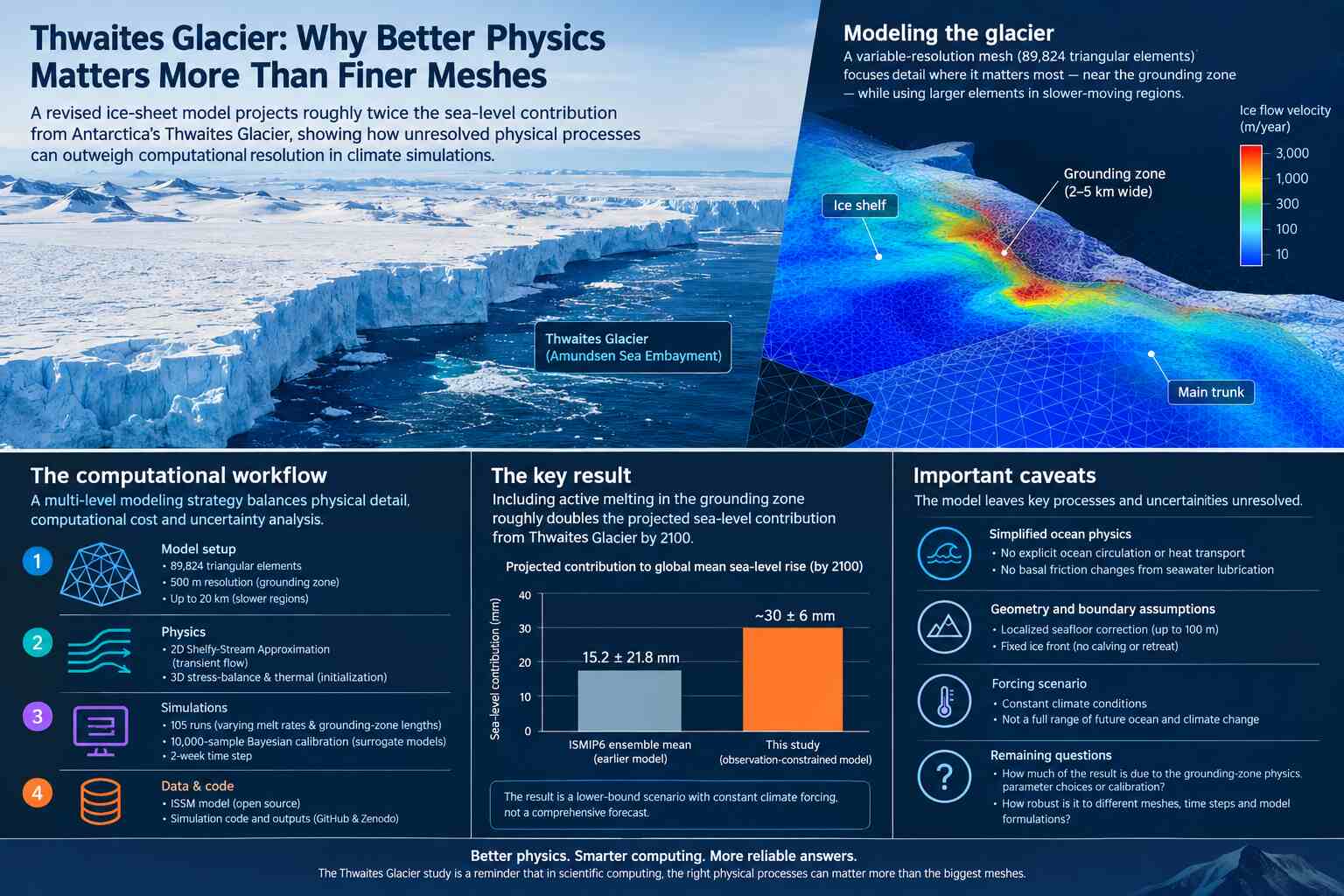
A revised ice sheet model projects roughly twice the sea-level contribution from Antarctica’s Thwaites Glacier, highlighting how unresolved physical processes can outweigh computational resolution in climate simulations.
A supercomputer can solve an enormous set of equations at high spatial resolution, but that does not guarantee the model captures the physical processes that matter most. A new study published in Nature Communications https://www.nature.com/articles/s41467-026-77976-1 illustrates that distinction with a consequential revision to projections of Thwaites Glacier, one of Antarctica’s most closely watched ice systems.
The researchers report that incorporating active melting in the glacier’s grounding zone, the transition where grounded ice begins to float, approximately doubles Thwaites Glacier's modeled contribution to global mean sea-level rise by 2100 compared with the mean of a widely used earlier model ensemble.
The finding is significant not simply because the projected number is larger, but because it exposes a modeling problem: a process operating across a relatively narrow region can influence the behavior of an entire glacier system. For the high-performance computing community, the study offers a case study in the relationship between numerical resolution, physical parameterization, observational calibration, and uncertainty.
It is also a result that warrants careful qualification. The reported projection comes from a particular model configuration and forcing scenario, not a definitive forecast of how much sea level Thwaites Glacier will contribute under every plausible future climate.
The grounding zone becomes a computational priority
Thwaites Glacier drains a substantial portion of the West Antarctic Ice Sheet. Its future behavior depends on interacting processes, including ice deformation, basal conditions, ocean-driven melting, the geometry of the bed beneath the ice, and changes in the glacier’s grounding line.
The grounding zone is especially challenging to represent numerically. It is where ice transitions from resting on bedrock to floating in seawater, and where ocean water can intrude beneath the grounded ice. Melting in this region can alter the boundary conditions governing ice flow and retreat.
In the study, the researchers incorporated active melting across grounding zones approximately 2 to 5 kilometers wide. The parameterization represents seawater intrusion and melting beneath ice that remains grounded, a process that conventional model configurations may not adequately capture.
That scale creates an important computational challenge. A model must represent a localized process without losing the larger-scale dynamics that determine how the glacier responds over decades.
The team used the Ice-sheet and Sea-level System Model (ISSM), a numerical framework for simulating ice-sheet evolution. Its mesh contains 89,824 triangular elements, with spatial resolution reaching approximately 500 meters near the grounding zone and becoming progressively coarser, up to 20 kilometers, in slower-moving regions.
This variable-resolution approach allocates computational effort where the modeled physics is most sensitive. It is a familiar strategy in scientific computing: concentrate degrees of freedom in regions with strong gradients or complex boundary behavior while using larger elements where the solution varies more gradually.
But mesh refinement alone cannot compensate for a missing physical process. The study’s central implication is that how the grounding zone is represented can matter as much as, or more than, simply increasing the number of grid elements.
A multilevel modeling strategy
The researchers combined several numerical approaches to represent glacier dynamics at different levels of complexity.
For much of the transient glacier-flow calculation, they used the Shelfy-Stream Approximation, a two-dimensional treatment commonly applied to ice flow dominated by horizontal motion and longitudinal stresses. Higher-order, three-dimensional stress-balance and thermal calculations were used during model initialization.
The distinction matters. Full three-dimensional stress and thermal calculations can be computationally demanding, particularly when models must be run repeatedly to explore parameter sensitivity and calibrate against observations. Using a less expensive approximation for the transient phase can make larger experimental ensembles feasible, but it also means that the model’s results depend on the adequacy of the selected approximation for the processes being studied.
The researchers conducted 105 numerical simulations spanning different melt rates and grounding-zone lengths. They then used Bayesian calibration against observations of retreat, thinning, and acceleration over approximately 1996–2023.
Their calibration procedure included a prior ensemble of 10,000 samples evaluated using surrogate models. Surrogate modeling is a common technique for reducing the cost of uncertainty analysis: an approximation of the expensive simulation is used to explore parameter combinations that would otherwise require many more full model runs.
The simulations used a fixed transient time step of two weeks. This is a modeling choice, not proof by itself that every relevant physical timescale is resolved. Temporal accuracy depends on the numerical scheme, model dynamics, and the timescales of the processes being represented.
Taken together, the workflow reflects a practical tension in computational glaciology. Researchers need sufficient physical detail to represent important mechanisms, but they also need a tractable modeling system that can be calibrated, tested and run across a meaningful range of uncertain parameters.
The projection: approximately twice the earlier ensemble mean
The study projects that Thwaites Glacier could contribute up to approximately 30 ± 6 millimeters of global mean sea-level rise by 2100 under the specified constant-climate-forcing scenario.
The researchers compare that result with a mean contribution of approximately 15.2 ± 21.8 millimeters in the earlier ISMIP6 ensemble. The comparison indicates a substantial increase in the modeled contribution when grounding-zone melting is represented.
The figures should not be read as two directly interchangeable forecasts with identical assumptions and uncertainty structures. The ensemble mean and spread describe a different modeling framework, while the new result is associated with a particular observation-constrained model configuration and scenario.
Nor does the phrase “up to” mean that 30 millimeters is the most likely outcome under every future climate trajectory. It is a conditional projection arising from the study’s selected assumptions.
The authors characterize their result as a lower-bound scenario because it isolates the effect of grounding-zone melting rather than incorporating all possible future increases in ocean warming. That distinction is important: a result designed to isolate one physical mechanism cannot, by itself, quantify the full range of future glacier response.
For scientific computing, the more consequential point is the sensitivity of the projection to the representation of a process that occupies a comparatively narrow part of the modeled domain. A change in physical formulation produced a materially different long-term result without requiring the conclusion that a vastly larger mesh alone would have delivered the same improvement.
What the model still leaves unresolved
The study is not a complete simulation of every ocean–ice interaction that could influence Thwaites Glacier. Its grounding-zone melt treatment uses a simplified parameterization rather than explicitly resolving ocean circulation and heat transport throughout the cavities beneath the ice shelves.
That is a significant limitation. The melt rate imposed by such a parameterization cannot capture every possible feedback between ocean dynamics, heat delivery, cavity geometry, and ice retreat. The model’s results therefore remain sensitive to how grounding-zone melting is specified.
The study also does not model changes in basal friction caused by seawater lubrication. Such changes could affect how grounded ice slides over its bed. The model applies a localized correction to seafloor elevation of up to 100 meters, making bathymetric uncertainty another relevant consideration.
In addition, the ice front is held fixed, excluding calving and ice-front retreat from the modeled evolution. The forcing scenario maintains constant climate conditions and does not include interannual variability in thermal forcing through the end of the century.
These choices do not invalidate the study. They define the experiment the researchers conducted. Isolating a particular mechanism can be scientifically useful, especially when the aim is to determine whether that mechanism materially changes a model’s behavior. But the resulting projection should not be interpreted as a complete accounting of the glacier’s future.
The uncertainties also raise a broader modeling question: how much of the revised projection comes from the new grounding-zone physics, how much from its parameter choices, and how much from the observational calibration? Understanding those contributions is essential if the result is to inform the next generation of ice-sheet simulations.
Observations constrain the model, but do not eliminate uncertainty
Calibrating against observed retreat, thinning, and acceleration provides an important check against unconstrained forward simulations. It links model behavior to the glacier’s documented evolution over recent decades.
However, fitting observations from the historical period does not guarantee that the same parameterization will remain accurate as boundary conditions change. Several combinations of uncertain parameters can sometimes produce similar historical behavior while diverging under future conditions.
Bayesian calibration offers a formal framework for representing parameter uncertainty, but it does not automatically account for every form of model structural error. If a physical process is omitted or simplified, uncertainty in its representation can remain even when model parameters are well calibrated.
That distinction is particularly important when a study reports a narrower uncertainty range for a specific model result than the spread of a broad multimodel ensemble. The ranges may describe different sources of uncertainty and should not be compared as though they measure the same thing.
The practical next step is not simply to accept the larger number or reject it because the model is simplified. It is to test how robust the result remains when grounding-zone length, melt parameterization, bed geometry, basal conditions and alternative model formulations are varied systematically.
Reproducibility and the HPC opportunity
The work also presents a useful computational research pattern. A variable-resolution mesh concentrates effort near a critical boundary; a hierarchy of numerical approximations controls simulation cost; parameter sweeps explore sensitivity; and surrogate models support a larger calibration exercise.
That combination is relevant beyond glaciology. Similar trade-offs arise in computational fluid dynamics, combustion modeling, materials science, and multiphysics engineering. In each case, the highest-value improvement may come from representing the right mechanism rather than uniformly increasing spatial resolution or allocating more compute hours to an unchanged model.
The study’s availability of ISSM and the grounding-zone parameterization through GitHub and Zenodo, along with reproduction code and model outputs on Zenodo, offers other researchers a route to inspect and test the computational approach.
For the HPC community, useful follow-up work would include independent reproduction of the reported simulations, sensitivity studies across mesh and time-step choices, comparisons with alternative ice-flow formulations, and quantified tests of how uncertainty in bathymetry and grounding-zone melting propagates into sea-level estimates.
Performance profiling would also help establish where the computational burden lies: in transient flow calculations, higher-order initialization, ensemble execution, or surrogate-model construction. The published mesh and run counts provide a starting point, but they do not by themselves establish the study’s wall-clock cost, scaling efficiency or hardware requirements. Those details should not be inferred without benchmark data.
Better physics before bigger machines?
The study regarding the Thwaites Glacier underscores that model formulation should be a primary consideration in scientific computing. Its findings suggest that omitting or underrepresenting localized physical processes can significantly alter long-term projections, even within frameworks that utilize spatially refined meshes and sophisticated numerical methods.
While computational resolution remains critical, as grounding-zone dynamics and ocean-ice coupling may indeed require finer spatial and temporal treatment, the utility of such computational investment is contingent upon the adequacy of the underlying physics and boundary conditions.
Consequently, this revised projection should be viewed as a significant, observation-constrained result rather than a definitive forecast of the glacier's contribution to sea-level rise. The broader methodological takeaway for the high-performance computing community is that increased simulation scale does not inherently guarantee greater fidelity, nor does model calibration eliminate structural uncertainty.
As climate models grow in ambition, the primary benchmarks for success should extend beyond grid size, floating-point performance, or the volume of simulations; they must prioritize the accurate representation of governing mechanisms, the transparency of assumptions, and the reproducibility of results. Ultimately, the next frontier in computational science depends as much on the refinement of encoded physical processes as it does on the advancement of the supercomputing infrastructure utilized to solve them.