

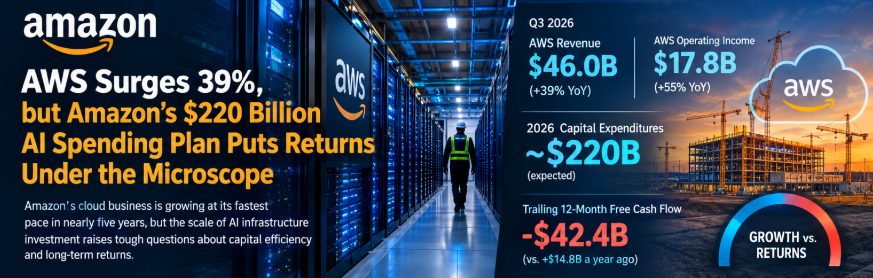
Amazon’s cloud business is growing at its fastest pace in nearly five years. Still, a $42.4 billion trailing-year free cash flow outflow underscores the financial stakes of building the next generation of AI infrastructure.
Amazon’s cloud business is accelerating, yet the infrastructure required to sustain this growth represents an increasingly significant financial commitment.
During the third quarter of 2026, Amazon reported $201.9 billion in revenue, with Amazon Web Services (AWS) contributing $46.0 billion, a 39% year-over-year increase. The company noted that AWS has achieved a $184 billion annualized revenue run rate, with operating income climbing to $17.8 billion, up from $11.4 billion in the prior year.
While these figures solidify AWS as a primary beneficiary of the surging demand for cloud computing and AI infrastructure, the current balance sheet and cash flow trajectory pose a critical question for the high-performance computing industry: how effectively can hyperscalers transform massive infrastructure investments into sustainable, profitable revenue?
Amazon maintains a capital expenditure forecast of approximately $220 billion for 2026. Concurrently, free cash flow for the trailing 12 months ending September 30 shifted to a $42.4 billion outflow, down from a $14.8 billion inflow during the same period last year—a deterioration Amazon attributes primarily to AI-driven investments in property and equipment.
Although Amazon retains strong operating momentum, the fundamental challenge remains: determining the extent of the productive capacity generated by this spending, the speed of its deployment, and whether the resulting returns will ultimately justify the scale of the investment.
AWS growth is accelerating
AWS revenue rose from $33.0 billion in the third quarter of 2025 to approximately $46.0 billion in the third quarter of 2026. The 39% increase was the segment’s fastest growth in nearly five years, according to Amazon.
Operating income increased approximately 55%, reaching $17.8 billion. AWS therefore remains a major profit engine for Amazon, not merely a business expanding its infrastructure footprint.
The results also point to demand extending beyond conventional cloud hosting. Amazon reported rapid growth in its Bedrock inference service, with year-over-year token volume increasing nearly 17-fold. The company said Fortune 500 customer spending on Bedrock was nearly seven times higher than a year earlier.
These figures suggest that enterprise AI workloads are becoming a more important component of cloud consumption. Inference services, managed model platforms and agent-based applications can generate recurring demand for compute, memory, storage, networking and data movement.
Yet token volume is not a direct measure of computing efficiency or profitability. The amount of hardware, energy, and memory bandwidth required to produce a given number of tokens depends on the model, precision, batching strategy, serving architecture, utilization, and service-level requirements. A rapid increase in token volume can indicate adoption, but it does not independently establish how profitably the workload is being served.
Amazon's reported financial performance is stronger evidence of commercial traction than token counts alone. The next question is whether that performance can keep pace with the capital required to deliver additional capacity.
The infrastructure bill is enormous
Amazon says it continues to expect approximately $220 billion in cash capital expenditures for 2026. The figure encompasses the company's capital investment program and should not be interpreted as an AWS-only or AI-only spending total.
Nevertheless, Amazon explicitly linked the recent increase in property and equipment purchases primarily to AI investment.
For a hyperscale computing provider, capital expenditures can encompass data-center buildings, electrical infrastructure, backup systems, cooling equipment, networking, servers, accelerators and other computing equipment. The specific mix matters because each category has different deployment timelines, depreciation profiles, capacity constraints, and useful lives.
AI infrastructure is especially demanding. Large accelerator clusters require high-bandwidth interconnects, sufficient memory capacity, carefully engineered power delivery and cooling systems capable of handling dense thermal loads. Scaling a cluster is not simply a matter of purchasing more processors: the surrounding infrastructure must deliver power, move data, and keep the system operating reliably.
The financial risk is that capital spending and monetization do not necessarily arrive on the same schedule. Equipment can be purchased before a facility is fully commissioned, while power availability, network integration, supply-chain constraints or customer deployment schedules can delay productive utilization.
A completed data center is not automatically a fully utilized data center. Installed accelerator capacity does not guarantee that customers will consume enough compute to produce the expected return.
Amazon's results show that demand is growing strongly today. They do not, by themselves, establish the eventual utilization rate or return on every dollar invested in the expansion.
Free cash flow turns negative as investment accelerates
Amazon generated $168.3 billion in operating cash flow over the trailing 12 months, up 29% year over year. That is a substantial increase in cash generated by the business.
But purchases of property and equipment, net of sales proceeds and incentives, reached $210.7 billion over the same period. Amazon's defined free cash flow, operating cash flow minus those purchases, consequently became a $42.4 billion outflow.
The comparison with the previous year is stark. Free cash flow moved from a positive $14.8 billion to a negative $42.4 billion, a swing of more than $57 billion.
That is not proof that the investment strategy is failing. Infrastructure-heavy businesses can experience periods when spending precedes revenue, particularly during major technology transitions. Amazon's growing operating income and AWS profitability provide meaningful support for its investment case.
But the cash flow figures show why revenue growth alone is an inadequate measure of the health of the AI infrastructure boom.
Investors and customers should be watching the relationship among capital expenditures, operating cash flow, depreciation, infrastructure utilization, and incremental operating profit. The key question is not just how much AWS revenue grows, but how much additional profit and cash the company generates for each additional unit of deployed capacity.
The system-level challenge: useful compute, not just installed compute
For HPC engineers and infrastructure architects, Amazon's expansion reflects a familiar systems problem. Performance depends on the behavior of the complete platform, not the theoretical capability of its most powerful component.
Accelerators can deliver high peak throughput, but useful application performance depends on memory bandwidth, interconnect topology, communication overhead, storage access, software optimization, and workload scheduling. At hyperscale, power and cooling can constrain the number of systems that can be installed and operated within a given facility.
The same principle applies commercially. A large investment in GPUs or custom AI accelerators creates value only when the systems are brought online, customers can access them, workloads run efficiently, and the resulting service earns sufficient revenue.
Metrics such as accelerator utilization, delivered performance per watt, cost per useful token, time to deploy new capacity, and revenue generated per unit of installed infrastructure would help assess that efficiency. Amazon's earnings release does not provide a comprehensive public breakdown of these measures across its AI infrastructure fleet.
That absence does not negate the reported growth. It does limit how confidently outside observers can assess the underlying efficiency of the investment program.
Amazon sees years of growth ahead
Amazon CEO Andy Jassy said the company's AWS investment in functionality and infrastructure was working and projected growth rates above 40% in both 2027 and 2028.
Those projections would imply sustained demand for additional capacity. They also make execution more important: the company must continue expanding infrastructure while managing supply, power availability, equipment deployment, operating costs, and the possibility that customer demand or the economics of AI workloads could change.
Amazon's fourth-quarter guidance calls for net sales between $240 billion and $247 billion, with operating income between $28.5 billion and $33.5 billion. The company also noted that its forecasts are subject to uncertainty, including energy prices, resource and supply volatility, memory-chip availability and customer demand.
For the HPC sector, the memory and energy references are particularly relevant. Advanced compute capacity is constrained by more than processor supply. High-bandwidth memory, networking components, electrical equipment and data-center construction all influence how quickly a theoretical capacity plan becomes a working system.
The verdict: strong demand, unfinished ROI story
Amazon's third-quarter results confirm that AWS is experiencing robust growth and generating significant operating income. Simultaneously, these results indicate that the company’s infrastructure investment has reached a magnitude that materially impacts cash flow.
These factors must be evaluated in tandem. A $220 billion annual capital expenditure plan may be rational, provided that demand continues to escalate and new capacity yields attractive returns. However, the scale of this investment renders execution risk, utilization, and capital efficiency critical strategic priorities rather than mere accounting details.
For SuperComputingOnline News’ readers, the primary narrative is not simply that Amazon is investing heavily in AI, but that hyperscale computing is entering a phase where power, facilities, memory, networking, and accelerator deployment must scale in alignment, all while the long-term financial returns remain to be demonstrated.
While the 39% growth in AWS revenue serves as a strong indicator of market demand, the resulting negative free cash flow underscores the significant cost of meeting it. Consequently, the new benchmark for the AI infrastructure race should move beyond aggregate capital expenditure or announced compute capacity; instead, focus should shift toward the delivery of useful, efficiently utilized computing capacity that can be converted into durable, long-term returns.