

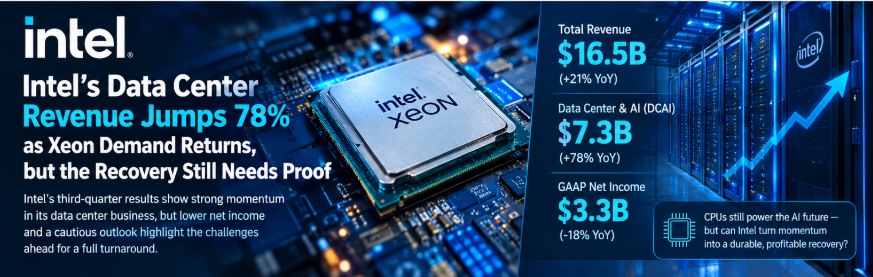
Intel’s data-center business posts its strongest revenue growth in 15 years as demand for server CPUs strengthens, but declining GAAP net income and a softer fourth quarter outlook complicate the turnaround story.
While the artificial intelligence infrastructure boom is frequently characterized as a competition for GPUs, Intel’s recent financial results highlight the critical role of the server CPU. Intel reported third-quarter 2026 revenue of $16.5 billion, a 21% year-over-year increase, with its Data Center and AI (DCAI) segment surging 78% to $7.3 billion. The company noted this as its strongest data-center growth in 15 years, driven by robust demand for its Xeon processor family.
This development is significant for the high-performance computing industry, as AI systems require more than just accelerators. CPUs remain essential for orchestrating workloads, managing operating systems and memory, facilitating data pipelines, and executing general-purpose applications that are not optimized for accelerators.
However, a single quarter of rapid growth does not confirm a durable recovery. Intel’s GAAP net income declined 18% year over year to $3.3 billion, despite improvements in revenue and gross margins. Furthermore, the company's fourth-quarter guidance anticipates lower revenue and margins. For HPC users and system builders, the central question remains whether Intel can transform this spike in server demand into a sustainable supply of competitive processors and whether its manufacturing economics can support long-term profitability.
Data Center and AI becomes the standout segment
Intel's DCAI business generated $7.3 billion in third-quarter revenue, up 78% from the same period a year earlier. The company's Client Computing and Physical AI Group, by contrast, reported $8.1 billion, down 5%.
That divergence is important. It suggests the current strength is not a uniform recovery across Intel's portfolio. Data-center demand is doing much of the heavy lifting while the PC business faces continuing headwinds.
Intel CEO Lip-Bu Tan said demand for Xeon CPUs was robust and identified expanding supply as an immediate priority. The company also highlighted a multiyear collaboration with Oracle intended to expand Xeon-based computing on Oracle Cloud Infrastructure, including planned future offerings powered by its next-generation Diamond Rapids server processor.
For cloud providers, CPUs remain fundamental to the design of heterogeneous systems. A GPU-heavy server still needs host processors to coordinate work, manage input pipelines, handle control-plane functions, and run tasks that are poorly suited to accelerator execution. CPU performance, memory capacity, I/O, and platform-level efficiency can influence the utilization of the more expensive accelerators attached to the same system.
AI inference and agent-based workloads can also involve a diverse mix of operations. Some stages are highly parallel and accelerator-friendly; others involve orchestration, data preparation, retrieval, application logic, or services whose performance depends on CPU and memory behavior.
That makes a strong server CPU market plausible even amid the rise of GPU computing. It does not mean every AI workload is CPU-intensive, or that Intel will capture all of the demand.
The 78% increase is a company-reported segment result. Intel's release does not provide enough detail to attribute all of that growth specifically to AI applications, nor does it fully isolate the contributions of volume, pricing, product mix and individual customer programs.
A broader computing architecture is taking shape
Intel's earnings release highlights several efforts to position its portfolio across AI and enterprise infrastructure.
The company discussed next-generation Xeon processors, its Intel GPU D-series for inference, and platform designs intended for agentic AI and enterprise-scale workloads. It also reported collaboration with AMD on x86 CPU optimizations for PyTorch through oneDNN.
That last point illustrates an important aspect of the HPC ecosystem: software optimization can affect the value of the processor independently of raw hardware specifications. Efficient kernels, vectorization, memory behavior, and library support can influence how effectively CPUs execute machine-learning workloads and cooperate with accelerators.
For many HPC installations, the relevant comparison is not simply CPU versus GPU. It is how a complete architecture performs on a real workload, including data staging, communication, synchronization, memory movement, and energy consumption.
A well-balanced system can prevent accelerators from waiting on input data or control tasks. Conversely, overspending on CPU capacity that the workload does not use can reduce system-level cost efficiency. The appropriate balance depends on the application and its performance requirements.
Intel's reported demand growth suggests that customers are buying more of its data-center products. To judge the longer-term technical significance, HPC buyers will need independently measured workload performance, platform power consumption, memory and I/O capabilities, software support, availability and total cost of ownership.
Better margins, but a mixed earnings picture
Intel reported third-quarter GAAP gross margin of 43.0%, compared with 38.2% a year earlier. Non-GAAP gross margin was 44.1%, up from 40.0%.
GAAP operating margin rose to 15.3%, compared with 5.0% in the year-ago quarter. Non-GAAP operating margin reached 19.6%, up from 11.2%.
These improvements suggest better operating performance and a more favorable financial mix. But the net income picture is more complicated.
GAAP net income attributable to Intel was $3.3 billion, down from $4.1 billion a year earlier. GAAP diluted earnings per share fell to $0.60 from $0.90. Non-GAAP diluted earnings per share, by contrast, increased to $0.52 from $0.23.
The difference between GAAP and non-GAAP results is not a minor detail. Adjusted figures can help isolate certain costs, but they should not replace the full accounting picture when assessing a capital-intensive semiconductor manufacturer.
Intel generated $5.1 billion in cash from operations during the quarter, according to the release. The company also said it completed a $23 billion public equity offering to support future growth opportunities.
The offering is relevant to Intel's financial position because semiconductor manufacturing and advanced packaging require sustained investment. However, additional capital does not by itself prove that new process technologies will meet their performance, yield, cost, or customer-adoption targets.
Foundry growth brings another set of questions
Intel Foundry reported $6.7 billion in third-quarter revenue, up 58% year over year. The company also reported releasing its Intel 14A process design kit 0.9 in October and described work with equipment and packaging partners.
These developments matter because Intel's manufacturing strategy is central to its longer-term competitiveness. A foundry business must attract external customers, deliver predictable yields and performance, maintain manufacturing economics and earn returns on facilities and process development.
However, the foundry revenue figure requires care. Intel's release reports intersegment transactions and eliminations, meaning the foundry business-unit revenue should not simply be added to total consolidated revenue as if all of it represented external sales. Segment growth alone also does not establish how much of the business is externally sourced or whether it is earning an attractive return on the capital committed.
The central questions are practical: Can Intel deliver process technologies on schedule? Can it secure meaningful external customer commitments? Can it produce chips at competitive cost and yield? And can it sustain investment without eroding its financial flexibility?
Those are execution questions, not matters that can be resolved by a single quarterly revenue increase.
The supply constraint cuts both ways
Intel says expanding supply is an immediate priority to meet demand for Xeon processors. That could provide a near-term opportunity if customer demand remains stronger than the available supply.
But shortages can also limit the amount of revenue a company can recognize, delay customer deployments and complicate procurement planning. Increasing supply requires more than a statement of intent: it can involve manufacturing capacity, packaging, test operations, materials, qualified components and customer-platform validation.
The semiconductor supply chain is interdependent. A processor's availability can be constrained by packaging capacity or other components even when wafer production improves. Similarly, customers deploying large server clusters need confidence that parts will arrive in sufficient quantities and on predictable schedules.
Intel's release does not provide enough detail to quantify the precise extent of the Xeon supply constraint or the cost and timing of removing it. Those details will be important in judging how much of the current demand can become recognized revenue.
The fourth-quarter outlook is a reality check
Intel forecasts fourth-quarter 2026 revenue of $15 billion to $16 billion, below the $16.5 billion reported for the third quarter. It expects GAAP gross margin of approximately 37.1% and non-GAAP gross margin of 38.0%, also below the third-quarter figures.
Quarter-to-quarter comparisons can reflect seasonality, product mix, manufacturing costs, and other factors, so the outlook does not necessarily indicate a renewed downturn. Still, it underscores why the latest growth rate should not be extrapolated mechanically into future quarters.
Intel's own release also flags a continuing PC slowdown through at least the first half of next year. The company must balance server demand against pressures elsewhere in its portfolio while investing to expand supply and advance manufacturing technology.
For a company with Intel's manufacturing ambitions, the test is not just whether revenue rises during a period of strong demand. It is whether the company can consistently convert that demand into cash, maintain competitive products, and finance future process development.
What HPC buyers should watch
The quarter gives HPC users several reasons to pay attention to Intel, but not a reason to abandon technical due diligence.
For CPU selection, buyers should look beyond aggregate revenue and compare application-specific performance, memory bandwidth, I/O throughput, power draw, performance per watt, software compatibility, and total cost of ownership. For heterogeneous AI clusters, CPU capability must be evaluated alongside accelerator utilization, host-to-device communication, and the efficiency of the complete software stack.
Cloud customers should also consider supply availability and the continuity of the product roadmap. Intel's announced collaboration with Oracle and plans for future Xeon offerings could be relevant, but planned products are not equivalent to generally available systems with independently validated performance.
For the semiconductor industry, the next checkpoints include whether DCAI growth persists, whether Intel can meet demand without sacrificing margins, and whether its foundry and process-technology plans translate into durable customer relationships and manufacturing returns.
The verdict: a meaningful rebound, not a finished turnaround
Intel's third-quarter results offer compelling evidence of a significant rebound in data-center demand, underscored by a 78% increase in DCAI revenue, improved gross margins, and stronger non-GAAP earnings.
However, the decline in GAAP net income, combined with conservative fourth-quarter revenue guidance and persistent supply constraints, renders a definitive assessment of a long-term turnaround premature. While foundry expansion and upcoming product roadmaps present potential, they do not mitigate the inherent execution risks associated with large-scale semiconductor manufacturing.
For SuperComputingOnline News, the critical narrative remains that the current expansion of AI infrastructure is not exclusively a GPU-driven phenomenon. CPUs continue to serve as fundamental components of contemporary data centers and high-performance computing systems, and the resurgence in demand for Xeon processors warrants careful observation.
Ultimately, the central challenge for Intel is to translate this demand into sustained technical competitiveness and long-term profitability. While a strong quarter signals positive momentum, a durable recovery necessitates consistent performance, reliable supply chain management, competitive manufacturing economics, and products that deliver verifiable value in real-world computing environments.