

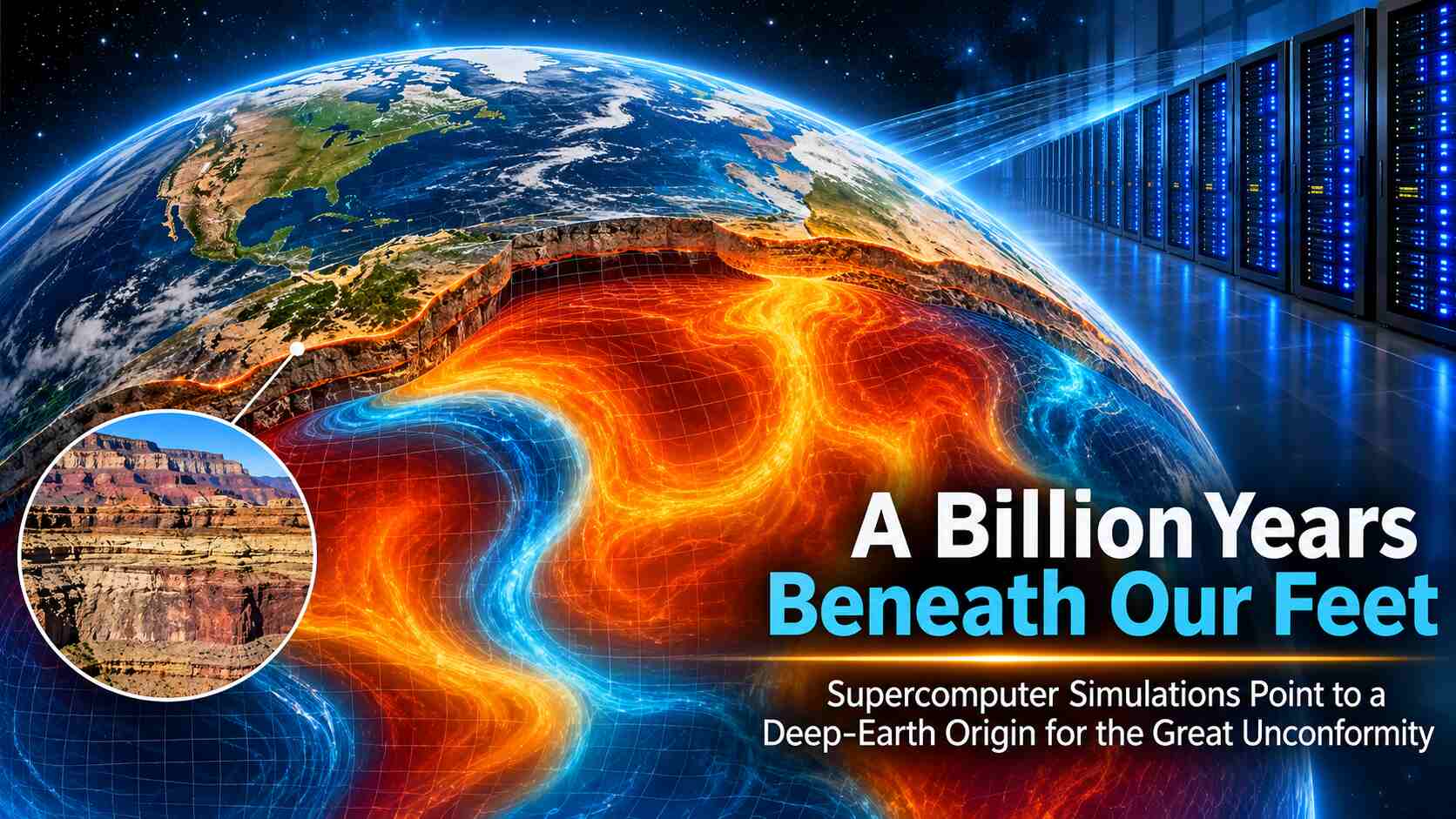
Researchers use 13 million finite-element nodes and billion-year mantle-convection models to investigate one of geology’s most enduring mysteries, but important uncertainties remain.
A geological enigma preserved in rock formations across multiple continents may find its resolution hundreds of kilometers beneath the Earth's surface. In a study published on November 4 in Nature (https://www.nature.com/articles/s41586-026-11156-5), researchers Santosh Dhungana and Nicolas Flament of the University of Wollongong in Australia utilized three-dimensional mantle-convection simulations to investigate the deep-Earth origins of the Great Unconformity, a significant hiatus in the geological record representing at least 200 million years of missing sedimentation or erosion.
The researchers propose that large-scale mantle dynamics drove continental uplift, erosion, and subsequent subsidence, creating the conditions needed to form and preserve this globally significant boundary. For the high-performance computing (HPC) community, this research stands out for reconstructing processes spanning a billion years through computational models that integrate mantle physics, tectonic reconstructions, numerical simulations, and geological observations. Ultimately, this study underscores the utility of HPC in investigating physical systems that operate across spatial and temporal scales inaccessible to direct observation.
Reconstructing a billion years of planetary dynamics
The Great Unconformity is one of the most recognizable discontinuities in Earth's geological record. It separates ancient Precambrian basement rocks from much younger sedimentary formations and is particularly well documented in North America, including the Grand Canyon.
Its formation has been attributed to several possible mechanisms, including extensive glacial erosion during Snowball Earth episodes, continental rifting, volcanic activity, changes in sea level, and mantle-driven vertical movement of continents.
The researchers focused on the last of these possibilities.
Mantle convection is the slow movement of Earth's solid but geologically deformable mantle, driven by internal heat and variations in density. These movements can influence the elevation of continents over geological timescales through a process known as dynamic topography.
In simplified terms, mantle upwelling can contribute to continental uplift, while downwelling and other mantle-flow patterns can contribute to subsidence. Over millions of years, those changes can influence erosion, sediment transport, and the preservation of geological formations.
The challenge is reconstructing how those processes interacted with moving tectonic plates across deep geological time.
To investigate the problem, the researchers used the open-source CitcomS mantle-convection code to simulate Earth's mantle evolution from approximately one billion years ago to the present.
The computational framework used a three-dimensional spherical representation of Earth and approximately 13 million finite-element nodes. The models incorporated reconstructed plate configurations and time-dependent tectonic boundary conditions, with updates at one-million-year intervals.
The simulations also accounted for variations in viscosity associated with temperature, pressure, depth, and composition. These parameters matter because mantle material does not behave as a uniform fluid. Its resistance to deformation changes substantially under different physical conditions.
The resulting calculations allowed the researchers to examine how mantle buoyancy and viscosity variations could have generated long-wavelength dynamic topography across continental regions.
Six models, multiple reconstructions and a geological test
Rather than relying on a single simulation, the researchers evaluated six model configurations, designated M1 through M6, with variations in input parameters and tectonic reconstructions.
Most configurations used a no-net-rotation reference frame for reconstructing plate motion. One model used a palaeomagnetic reference frame, providing a different basis for evaluating the reconstructed tectonic history.
The researchers also compared predicted deep-mantle structures against large low-shear-velocity provinces identified in seismic tomography models. These structures, often called LLSVPs, are major features of the lower mantle inferred from seismic-wave behavior.
The study reports comparisons involving ten tomographic models, as well as reconstructed volcanic provinces. Model M1 was selected as the preferred configuration because its predicted deep-mantle structures and the locations of volcanic provinces showed favorable consistency with those independent geological and geophysical observations.
This validation step is important. A numerical simulation can produce a physically plausible result without necessarily describing Earth's actual history. Comparing model predictions with independent observations provides a way to test whether the reconstructed mantle dynamics are credible.
The researchers then used k-means clustering to classify continental regions according to similarities in their predicted dynamic-topography histories. Their analysis examined the period from approximately 920 million to 420 million years ago for the formation phase, and from 420 million years ago to the present for the preservation phase.
The resulting patterns identified Laurentia, Baltica and North China as important regions where prolonged uplift followed by long-term subsidence could have helped produce and preserve the Great Unconformity.
The simulations suggest that Neoproterozoic uplift, including during the Cryogenian period, could have contributed to extensive erosion. Subsequent subsidence during the Phanerozoic could then have helped preserve the resulting unconformity beneath younger sedimentary deposits.
The findings provide a possible connection between deep-mantle processes and the geological record visible at the surface.
The HPC challenge: modeling physics across geological time
The computational significance of this research lies in the interaction of several demanding numerical problems.
Three-dimensional mantle-convection modeling requires solving coupled equations describing the movement of material, heat transport, density variations, and deformation under gravity. The behavior of the simulated mantle depends on spatially varying physical properties and boundary conditions that evolve as tectonic plates move.
Finite-element methods provide a way to represent these complex physical systems across a discretized computational domain. In this study, the approximately 13 million nodes provide the numerical framework for resolving mantle behavior in three-dimensional spherical geometry.
The challenge is not simply the size of the model. It is maintaining a physically meaningful representation of a system whose boundary conditions, material properties, and geometry change over immense periods of time.
The researchers reconstructed tectonic conditions through a sequence of time-dependent updates and evaluated the resulting mantle-flow behavior across multiple model configurations. They then compared the predicted surface effects with geological and geophysical datasets.
That workflow illustrates an important role for HPC in computational Earth science: connecting numerical models of inaccessible deep-Earth processes with observations collected at the surface.
The research also acknowledges support from Australia's National Computational Infrastructure, a national research computing facility supported by the Australian Government. The authors report that their work used NCI resources, with additional access support from the University of Wollongong.
For the supercomputing community, this is a useful example of HPC infrastructure supporting scientific investigation beyond the more familiar areas of climate modeling, astrophysics, engineering and artificial intelligence.
The important caveat: the model has a known limitation
The findings are compelling, but the researchers acknowledge a significant limitation in their modeling approach.
Their simulations calculate dynamic topography from buoyancy and viscosity variations deeper than 350 kilometers. This approach emphasizes broad, continental-scale effects associated with deep-mantle processes while excluding contributions from shallower sources.
The authors explain that this produces relatively smooth, long-wavelength dynamic topography. However, they also acknowledge that the modeling setup is known to overpredict the amplitude of long-wavelength dynamic topography by approximately a factor of two.
Consequently, they emphasize the trends in the evolution of dynamic topography rather than treating the predicted amplitudes as precise measurements.
That distinction matters.
The simulations may provide a persuasive explanation for the broad sequence of uplift and subsidence, but uncertainty in the magnitude of the modeled vertical movements limits how confidently those results can be translated into exact geological consequences.
The reconstruction of ancient plate positions and subduction zones introduces additional uncertainty. These inputs influence mantle convection and therefore affect the predicted dynamic topography. Reconstructing tectonic configurations deep in Earth's history is inherently difficult, and alternative reconstructions can change the resulting model behavior.
The research therefore supports a plausible mechanism for the Great Unconformity. It does not establish that mantle convection was the sole cause.
Glacial erosion, rifting, sea-level changes and other surface processes may also have contributed. The authors' own discussion points toward further work examining how continental uplift and subsidence affected erosion, sedimentation and seawater chemistry.
Reproducibility and the next generation of computational Earth science
An important aspect of the study is the availability of its computational resources and supporting data.
The researchers identify the CitcomS mantle-convection code used in their work and provide access to study-generated data through Code Ocean and Zenodo. Making the data and scripts available gives other researchers an opportunity to inspect the analysis, reproduce aspects of the workflow, and investigate alternative model configurations.
That is particularly important for research involving deep-time reconstructions, where assumptions about ancient plate motion and mantle structure can have substantial effects on the results.
Future studies could build on this work by testing additional tectonic reconstructions, refining the representation of shallower mantle and lithospheric processes, and integrating more detailed geological constraints.
More comprehensive coupling between mantle dynamics and surface processes could also help quantify how uplift, erosion, sediment transport, and subsidence interact to create the geological record.
Such work will continue to depend on computational resources capable of handling large three-dimensional numerical models, extensive parameter exploration and comparisons against increasingly sophisticated geological and geophysical datasets.
A deeper role for supercomputing in understanding Earth
The Great Unconformity serves as a compelling reminder that several of Earth’s most consequential geological phenomena cannot be fully understood through surface-level evidence alone. The research conducted by Dhungana and Flament provides a computationally intensive methodology to bridge the visible geological record with the gradual, largely inaccessible processes occurring within the deep mantle.
While this study does not definitively resolve the debate surrounding the origins of the Great Unconformity, due to inherent modeling limitations and the uncertainties associated with ancient tectonic reconstructions, it effectively illustrates the utility of large-scale numerical simulation when direct observation is precluded and geological evidence must be synthesized across vast temporal scales. For the high-performance computing community, this work underscores a broader narrative: supercomputing is enabling researchers to reconstruct not only surface-level historical events but also the obscured physical processes that shaped the planet long before the modern geological record emerged.