

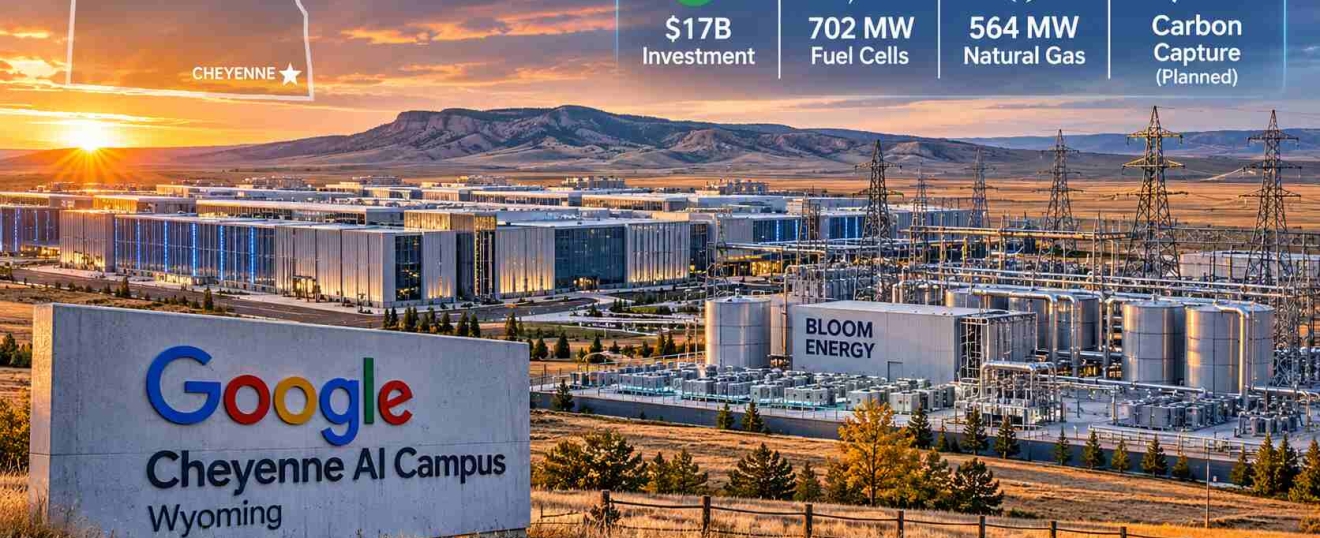
Google is taking control of a massive Wyoming data-center development, assembling a 702-megawatt fuel-cell power system and a broader natural-gas generation network. But the project's true computing capacity, carbon-capture performance, and ultimate infrastructure costs remain unresolved.
Google’s $17 billion investment in a Wyoming-based data center represents a significant evolution in hyperscale infrastructure. This initiative highlights how the burgeoning economics of artificial intelligence are fundamentally altering the relationship between computing facilities, energy generation, and corporate operations.
The project, announced on November 5 in Laramie County, integrates a 702-megawatt fuel-cell installation, additional natural-gas generation, and a private power-resource strategy, alongside proposed carbon capture and storage infrastructure. Google is spearheading this development in collaboration with Tallgrass Energy, Black Hills Energy, American Electric Power (AEP), and Related Digital. Notably, the project’s scope increased following Google's acquisition of the site from AI infrastructure developer Crusoe, a transaction confirmed on November 6 after months of uncertainty.
For the broader supercomputing industry, the implications of this project are significant. As AI workloads require increasingly dense concentrations of processing power and high-speed infrastructure, reliable access to electricity has become a primary constraint on computing capacity. Google’s strategy, developing custom power architecture in tandem with its computing campus rather than relying solely on conventional utility expansion, marks a notable shift. Ultimately, the industry must determine whether this integrated model can deliver the scale, economic viability, and environmental performance the next generation of AI infrastructure requires.
The power infrastructure comes first
At the center of the Cheyenne development is a planned 702 MW fuel-cell power facility being developed through AEP and powered by technology supplied by Bloom Energy.
The project is expected to operate under a 20-year power purchase agreement with Google. AEP plans to invest approximately $4 billion in the facility, with construction expected to begin in 2026 and full operation targeted for the end of 2028.
Unlike conventional natural-gas turbines, solid-oxide fuel cells generate electricity through an electrochemical process rather than combustion. The technology can provide substantial continuous electrical output, making it attractive for large computing facilities that require dependable power around the clock.
But the installation's proposed scale is what makes the development particularly noteworthy.
A 702 MW fuel-cell deployment is an enormous undertaking. It moves the technology beyond the smaller deployments generally associated with fuel-cell applications and into the territory of major power infrastructure.
Google is also sourcing electricity from natural-gas generation operated by Tallgrass Energy and Black Hills Energy.
Black Hills has outlined approximately 564 MW of new natural-gas generation at its Cheyenne Prairie facility, supported by a broader electricity supply arrangement that includes grid-connected service and third-party resources.
Together, the identified new fuel-cell and gas-generation capacity totals approximately 1,266 MW.
That figure should not be confused with the campus's confirmed computing capacity. Google has not publicly disclosed the data center's actual electrical demand or IT load.
Nevertheless, the scale of the power commitments demonstrates the extraordinary infrastructure requirements associated with building AI computing capacity at hyperscale.
The 2.7 GW question: Power capacity is not computing capacity
One of the most important distinctions in the Cheyenne announcement concerns the frequently repeated 2.7 GW figure.
Google has not confirmed that its data center will have 2.7 GW of computing capacity.
Earlier reporting associated the figure with Project Jade, the original development that eventually became Project Tembo. However, the underlying utility documentation describes a broader power-resource arrangement, including grid-connected supply, new generation, third-party microgrid resources, and reserve capacity.
The original project filing described a first phase of approximately 1.8 GW, with the potential to scale significantly further. The 2.7 GW figure appears to have been repeated across subsequent reporting as a description of the campus or its associated power mix.
Those are not interchangeable measurements.
A data center's total power requirements include much more than the electricity consumed directly by processors and accelerators. Cooling, networking, storage, power conversion, lighting, and other facility systems all contribute to the electrical load.
The distinction between utility supply capacity, facility demand and actual IT load is critical when evaluating the computing capabilities of an AI infrastructure development.
Until Google publishes an engineering-level capacity breakdown, the 2.7 GW figure should not be presented as confirmed IT capacity.
For an industry increasingly measuring infrastructure in gigawatts, precision matters.
Google takes control of the former Crusoe project
The Cheyenne campus also has an unusual development history.
Originally announced as Project Jade in July 2025, the project was developed by Crusoe and Tallgrass Energy as a large-scale data center and power-generation campus.
The original proposal described a 1.8 GW first phase with the potential to scale to 10 GW.
Laramie County approved the project in January 2026. However, Crusoe announced in June that development had been paused at the request of its customer, without identifying that customer or explaining the reason.
County records subsequently revealed Google's involvement through its subsidiary, Jupiter Star Holdings LLC. The development was renamed Project Tembo.
On November 6, Crusoe officially confirmed that Google had acquired the southeast Wyoming site, completing Crusoe's pre-development role, which included site selection, government approvals and power strategy.
The transaction is revealing.
Developing a hyperscale AI campus requires coordinating land acquisition, permitting, electricity generation, transmission, cooling, construction and computing infrastructure. These activities must progress together, often years before the first server becomes operational.
Google's acquisition places the project directly under the control of the company expected to consume its computing resources.
It also raises questions about the economics and risks of the original development strategy.
Crusoe did not disclose the acquisition price or provide a reason for the sale. Reports attributing the departure to concerns about cost or construction schedules should therefore be treated as unconfirmed rather than established explanations.
Crusoe remains involved in Google's broader infrastructure plans, including development of its Armstrong County campus outside Amarillo, Texas.
Carbon capture: An ambitious promise with important engineering questions
Google's announcement places considerable emphasis on carbon capture and storage.
The company says the 702 MW fuel-cell installation will capture a large majority of its carbon emissions, with the captured carbon dioxide transported to Tallgrass Energy's Eastern Wyoming Sequestration Hub for permanent geological storage.
The proposed arrangement is important because it attempts to address one of the central contradictions in the AI infrastructure boom.
Companies are demanding enormous amounts of electricity while simultaneously making commitments to reduce the carbon intensity of their operations.
Fuel cells can generate electricity without the combustion process used in conventional gas turbines. However, when natural gas is the fuel, the process still produces carbon dioxide. Fuel-cell technology alone does not eliminate those emissions.
Carbon capture is therefore a critical part of Google's environmental proposition.
There is an important distinction between the existence of carbon-storage infrastructure and the successful operation of a complete carbon-capture system at this scale.
Tallgrass has an established sequestration project, and carbon dioxide from ADM's ethanol operation in Nebraska has been transported through the Trailblazer pipeline to the hub.
That provides a meaningful foundation for the storage component.
However, Google has not disclosed the capture system's vendor, its specific capture percentage, installation cost, or construction schedule.
The company's description of capturing a large majority of emissions is not an engineering performance specification.
The project also includes a front-end engineering and design study examining the possibility of adding carbon capture to Tallgrass's combined-cycle natural-gas turbines.
That remains a study, not a completed installation.
The industry will need actual operating data before it can determine whether this approach delivers the promised emissions reductions at hyperscale.
The water issue is becoming impossible to ignore
Google's decision to use air cooling is another important part of the Cheyenne announcement.
The company says the facility will be air-cooled to minimize pressure on local water resources.
That commitment comes as Cheyenne faces increasing scrutiny over the environmental and infrastructure consequences of rapid data-center development.
The region has experienced controversy surrounding reclaimed wastewater associated with construction activity at Meta's Project Cosmo campus. Local authorities traced the presence of the bacterium Cupriavidus gilardii in the reclaimed-water system to wastewater discharged during construction. Meta has disputed aspects of the local authorities' account and appealed the enforcement action.
Drinking water remained safe, according to local reporting.
The incident nevertheless intensified concerns about how multiple large data-center developments could affect local water systems and infrastructure.
Google's air-cooled approach is therefore significant, but it does not eliminate every environmental consideration.
Air cooling still requires substantial electrical infrastructure, and its performance must be evaluated under actual operating conditions. The campus will also place demands on regional transportation, construction resources, housing, and electricity infrastructure.
Cheyenne is no longer dealing with a single hyperscale development.
Microsoft, Meta, Related Digital and Google are all associated with major projects in the area.
The cumulative impact of these developments is becoming a regional infrastructure issue rather than an isolated corporate construction project.
Google and its partners have announced plans for a Community Council intended to address concerns associated with data-center growth.
The important question is whether that council will have meaningful influence over decisions affecting water, power and local infrastructure, or primarily serve as an advisory and community-engagement mechanism.
Who ultimately pays for the power?
Google says it will pay for 100% of the electricity it consumes and cover infrastructure requirements directly driven by its growth.
That is an important commitment, particularly as communities across the United States increasingly question whether large data-center developments shift infrastructure costs onto residential and commercial electricity customers.
The financial structure of the Cheyenne project deserves closer examination.
Black Hills has explicitly described customer protections intended to prevent the costs of its new generation arrangements from being shifted to other customers. Google also advanced $399 million under the agreement, with repayment provisions.
AEP's approximately $4 billion fuel-cell project is structured through Cheyenne Fuel Cell LLC, an entity majority-owned by AEP and selling its output to Google under a long-term agreement.
However, AEP has not made an equivalent explicit public commitment stating that no costs associated with the project could flow to regulated ratepayers.
That does not establish that ratepayers will subsidize Google's infrastructure.
It does mean the financial arrangements deserve scrutiny.
The pricing of the power purchase agreement is private, and the precise allocation of infrastructure risks, financing costs, and potential overruns has not been fully disclosed.
There is also an important accounting distinction.
Google's $17 billion investment should not simply be added to AEP's approximately $4 billion fuel-cell project and Black Hills' approximately $1.8 billion generation investment to produce a $22.8 billion project total.
Those are separate investment commitments with different ownership and financing structures. Whether any utility investment is included in Google's announced $17 billion has not been disclosed.
The distinction matters when evaluating the actual economic scale of the development.
A new blueprint for AI supercomputing infrastructure?
The Cheyenne project illustrates a growing transformation in the economics of advanced computing.
For years, data-center development was largely organized around access to land, telecommunications, utility connections, and sufficient electrical capacity.
That model is changing.
The largest AI infrastructure projects increasingly require dedicated power-generation strategies, long-term electricity agreements, advanced cooling systems, and coordinated construction schedules.
The computing architecture itself is also evolving.
Large AI systems depend on tightly integrated clusters of accelerators, high-bandwidth memory, high-speed networking, storage infrastructure, and software capable of distributing workloads across thousands of processors.
The performance of those systems ultimately depends on whether the surrounding infrastructure can sustain their electrical and thermal requirements.
A gigawatt-scale power strategy does not automatically translate into a gigawatt-scale AI supercomputer. Actual computing capacity depends on the equipment installed, its power density, utilization, network architecture, cooling efficiency, and operational performance.
Nevertheless, Google's approach demonstrates how energy planning is becoming inseparable from supercomputing strategy.
Rather than waiting for conventional grid expansion to catch up with computing demand, hyperscalers are increasingly willing to participate directly in developing the generation resources needed to support their facilities.
The question is whether this model can be replicated economically and responsibly across multiple regions.
Fuel cells, natural-gas generation, private microgrids and carbon capture may become important elements of the next generation of AI infrastructure. But each introduces engineering, financial and operational dependencies that must be evaluated independently.
The milestones that will determine whether Cheyenne delivers
Several developments will determine whether Google's ambitious infrastructure strategy translates into operational computing capacity.
The first is the planned completion of the 702 MW fuel-cell installation by the end of 2028. Delivering a project of that scale will be an important test of Bloom Energy's technology and AEP's construction and integration capabilities.
The second is the campus construction schedule. The development is expected to proceed in phases, with the complete project targeted for 2031. Earlier first-phase service targets reported in project records will need to be reconciled with the actual availability of power.
The third is carbon capture. Google and Tallgrass will need to provide meaningful engineering specifications, capture performance data, and a credible deployment schedule.
The fourth is electricity cost allocation. Regulators, local officials and customers will have a legitimate interest in understanding whether the project's financial structure protects other electricity consumers.
Finally, the Community Council will need to demonstrate that the benefits and consequences of hyperscale infrastructure development are being addressed transparently.
The bottom line
Google's Cheyenne project represents a pivotal development in the global race for AI infrastructure; however, its significance extends well beyond the $17 billion headline figure. Its true importance lies in the ambition to construct an integrated power and computing ecosystem at a scale commensurate with the demands of next-generation AI workloads. The 702 MW fuel-cell installation, supplemental natural-gas generation, private power arrangements, and proposed carbon-capture systems collectively constitute a highly ambitious infrastructure strategy.
Nevertheless, significant questions remain. Google has not yet disclosed the campus's definitive computing capacity, and the widely cited 2.7 GW figure is not a confirmed IT-load specification. Furthermore, carbon capture remains an engineering challenge rather than a proven operational result at this scale, and the precise financial relationship between the hyperscaler, utility providers, and local infrastructure remains only partially transparent.
There is a broader lesson for the supercomputing industry as well. The next generation of AI systems will not be defined exclusively by faster processors, larger accelerator clusters, or more sophisticated models; their development will increasingly depend on the ability to secure, finance, construct, and operate the power infrastructure necessary to sustain them. Google is betting $17 billion that it can successfully assemble this infrastructure in Wyoming. The more complex challenge, proving that the power, computing capacity, environmental commitments, and economic framework can function cohesively, now remains.