

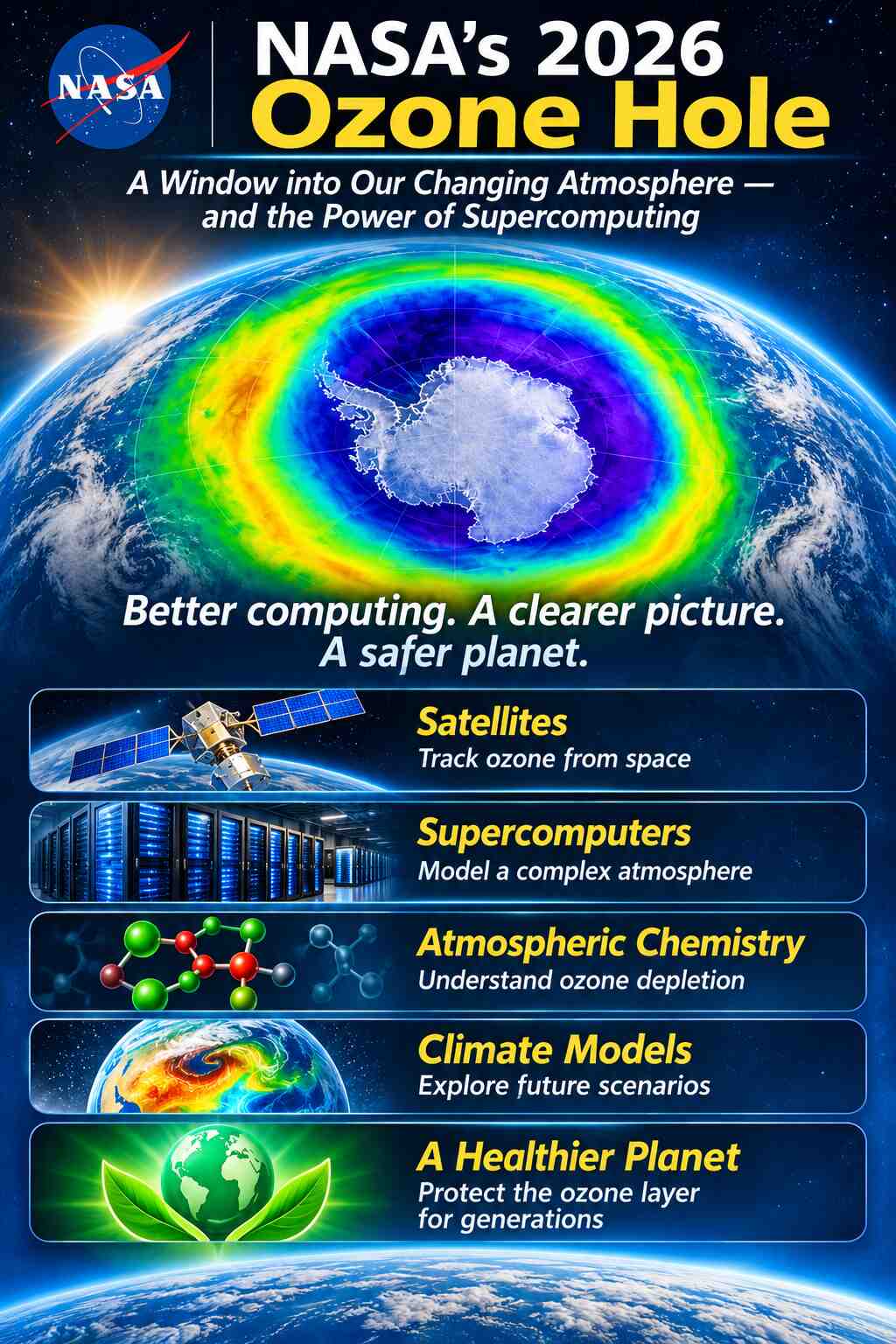
An unusually powerful Antarctic polar vortex helped produce the seventh largest ozone hole in nearly five decades of monitoring. Behind the latest NASA findings lies a much larger scientific challenge: understanding how atmospheric chemistry, climate dynamics, satellite observations, and the computational systems used to model a changing planet interact.
The recent seasonal maximum of the Antarctic ozone hole serves as a poignant reminder of the inherent complexity of Earth's atmospheric systems. According to NASA’s Earth Observatory report titled "Ozone Hole Reaches Its 2026 Maximum," released on November 9, the ozone hole was ranked as the seventh largest by average area within the 48-year monitoring record. This finding is particularly significant, as it demonstrates the intricate interplay between atmospheric circulation, chemical reactions, and persistent human influences in driving year-over-year variability.
During the peak depletion period from September 7 to October 13, the ozone hole spanned an average of approximately 25 million square kilometers, reaching a maximum one-day extent of 27.1 million square kilometers on September 18, an area roughly triple the size of the contiguous United States. However, these figures warrant nuanced interpretation; while the hole was unusually expansive, its depth did not reach the severity observed in previous decades. For atmospheric scientists, this distinction is critical, as the spatial extent of depletion and the absolute concentration of ozone are distinct metrics that necessitate rigorous, sustained observation and sophisticated analytical methods.
A powerful polar vortex changes the equation
The principal factor behind this year's unusually large ozone hole was an exceptionally strong and extensive Antarctic polar vortex.
The polar vortex is a circulation of powerful winds that forms around Antarctica during the Southern Hemisphere winter. It effectively isolates extremely cold air over the continent, helping create the conditions necessary for polar stratospheric clouds to form.
These clouds provide surfaces on which chemical reactions involving chlorine and bromine compounds become especially effective at destroying ozone.
During August and September, atmospheric wave activity that normally helps disrupt the polar vortex was unusually weak. As a result, the vortex remained stronger and extended farther from the South Pole, allowing ozone-depleting conditions to persist over a larger region.
This is a critical distinction in interpreting the 2026 measurements. The unusually large ozone hole was not evidence that international efforts to protect the ozone layer had failed. Rather, atmospheric conditions temporarily amplified the effects of ozone-depleting chemicals that remain in the stratosphere.
NOAA measurements at the South Pole found that ozone concentrations directly overhead reached a seasonal low of 105 Dobson units on October 17. The historical low was 92 Dobson units, recorded in October 2006.
The Dobson unit measures the total amount of ozone in a vertical column of atmosphere. Scientists use 220 Dobson units as the threshold for defining the Antarctic ozone hole.
The word hole, however, is not literal. The atmosphere is not empty of ozone. It describes a region where ozone concentrations have fallen below that established threshold.
The chemistry behind decades of ozone depletion
The origins of the ozone crisis can be traced to chemicals that became widely used during the twentieth century.
Chlorofluorocarbons, or CFCs, were common in refrigeration systems, aerosol products and industrial applications. Their chemical stability allowed them to remain in the atmosphere for decades, eventually reaching the stratosphere.
There, ultraviolet radiation breaks down these compounds, releasing chlorine atoms capable of repeatedly destroying ozone molecules through catalytic chemical reactions.
Bromine-containing compounds also contribute to ozone depletion and can be particularly destructive.
The discovery of the Antarctic ozone hole in the 1980s fundamentally changed scientific understanding of how industrial chemicals could alter the global atmosphere.
The international response produced the 1987 Montreal Protocol, which established a global framework for phasing out the production and consumption of major ozone-depleting substances.
The results have been substantial. NASA and NOAA scientists report that chlorine levels in the Antarctic stratosphere attributable to ozone-depleting substances have declined by approximately one-third from their 1980s levels.
NASA estimates that the Antarctic ozone layer could return to its 1980 condition during the 2070s.
However, the chemicals responsible for ozone depletion have long atmospheric lifetimes. Even after production restrictions, legacy compounds continue circulating through the atmosphere, making recovery a process measured in decades rather than years.
The 2026 measurements demonstrate why scientists cannot simply declare the problem solved.
Ozone depletion and climate change are connected, but they are not the same problem
The relationship between ozone depletion and climate change is frequently misunderstood.
Both involve changes to atmospheric chemistry and circulation, but they are driven by different primary mechanisms.
Ozone depletion is principally associated with chlorine- and bromine-containing chemicals that destroy stratospheric ozone. Climate change is primarily driven by the accumulation of greenhouse gases, including carbon dioxide and methane, which alter Earth's energy balance.
However, the two processes interact.
Increasing greenhouse gas concentrations warm much of the lower atmosphere while generally cooling the stratosphere. Changes in atmospheric temperature and circulation can influence ozone chemistry, the formation of polar stratospheric clouds, and the timing of seasonal ozone depletion.
Ozone itself also influences atmospheric temperatures because it absorbs ultraviolet radiation.
Consequently, understanding the future of the ozone layer requires scientists to consider more than the concentration of ozone-destroying chemicals. They must also examine atmospheric circulation, temperature profiles, seasonal variability and interactions between different layers of the atmosphere.
Importantly, NASA's explanation of the 2026 ozone hole identifies the unusually strong polar vortex and weak atmospheric wave activity as the principal factors behind this year's large extent. It does not establish climate change as the cause of this particular year's result.
That distinction is essential to understanding the science accurately.
The supercomputing challenge: Modeling an atmosphere that never stops moving
Behind the satellite images and atmospheric measurements is a computational challenge that has become increasingly important to modern Earth science.
The atmosphere is a constantly changing three-dimensional system. Temperature, pressure, humidity, chemical concentrations, wind patterns, and solar radiation interact across enormous geographic distances and multiple timescales.
Understanding these interactions requires scientists to combine observations with mathematical models that simulate atmospheric physics and chemistry.
NASA's Earth Modeling Nexus is part of that effort. The initiative brings together Earth-system modeling, scientific computing, and data assimilation capabilities to improve the agency's understanding of interconnected planetary processes.
At the center of its computing infrastructure is NASA's Discover supercomputing cluster at Goddard Space Flight Center.
The system provides:
- 213,288 compute cores.
- Approximately 8.28 petaflops of computing performance.
- 49.5 petabytes of managed data storage.
Discover supports large-scale simulations involving atmospheric, oceanic, land, and ice processes. NASA describes the infrastructure as a means of transforming decades of Earth observations into high-resolution computational representations of planetary systems.
For atmospheric research, this type of infrastructure is particularly valuable.
Scientists must work with enormous observational datasets, reconstruct atmospheric conditions across time and space, and run simulations that account for interactions between physical processes and chemical reactions.
Numerical models can examine how atmospheric conditions evolve, test different assumptions, and investigate how changes in chemical concentrations or circulation patterns influence ozone depletion.
The computational requirements grow as researchers increase spatial resolution, incorporate additional chemical processes, and explore larger ensembles of possible atmospheric conditions.
More detailed simulations can help reveal regional variations that broad global averages may conceal.
It is important to distinguish this broader computational capability from the specific 2026 ozone measurement. NASA has not identified Discover as the system that directly calculated the September 18 ozone-hole map. Satellite instruments and ground-based measurements established the observed conditions. Supercomputing provides the broader modeling and analytical infrastructure used to understand atmospheric behavior and investigate future scenarios.
Satellites provide the evidence; computing provides the context
NASA and NOAA have spent decades developing the observational infrastructure needed to monitor the ozone layer.
The historical record includes measurements from NASA's Total Ozone Mapping Spectrometer instruments, the Ozone Monitoring Instrument aboard the Aura satellite, and the Ozone Mapping and Profiler Suite instruments aboard successive polar-orbiting satellites.
For 2026, the OMPS instrument aboard NOAA-20 contributed to the ozone monitoring record.
These observations are complemented by ground-based instruments and balloon-borne ozonesondes deployed from Antarctic research stations.
The combination is important because satellites provide broad geographic coverage, while ground-based instruments offer independent measurements that help validate and interpret the satellite record.
The resulting datasets allow researchers to compare current conditions against decades of observations.
That historical perspective is indispensable. A single year's ozone-hole measurements cannot establish whether the atmosphere is recovering or deteriorating. Scientists need consistent observations, validated datasets, and computational models capable of separating long-term trends from natural variability.
The same principles apply to climate research, where researchers must distinguish long-term changes from seasonal fluctuations and short-lived atmospheric events.
The next generation of Earth science will depend on computational power
The 2026 ozone hole highlights why high-performance computing is vital for environmental science. As data volume grows, researchers must integrate satellite observations with physics-based simulations to model atmospheric complexity. The future of Earth science relies on combining numerical modeling, advanced data assimilation, and AI, as seen in initiatives like NASA’s Earth Modeling Nexus. Ultimately, accurately monitoring our changing planet requires the computational power to synthesize vast datasets and simulate dynamic atmospheric processes.