

Researchers use large-scale AI-driven molecular modeling to investigate thousands of immune-recognition interactions, offering a promising new computational approach while revealing the limits of current prediction methods.
A longstanding challenge in immunology involves identifying the specific molecular targets recognized by T cells, a pursuit with significant implications for our understanding of immune responses, infectious diseases, and oncology. Predicting these interactions computationally remains complex, as researchers must account for the intricate three-dimensional relationships among T-cell receptors, peptides, and the major histocompatibility complex (MHC) molecules that present them.
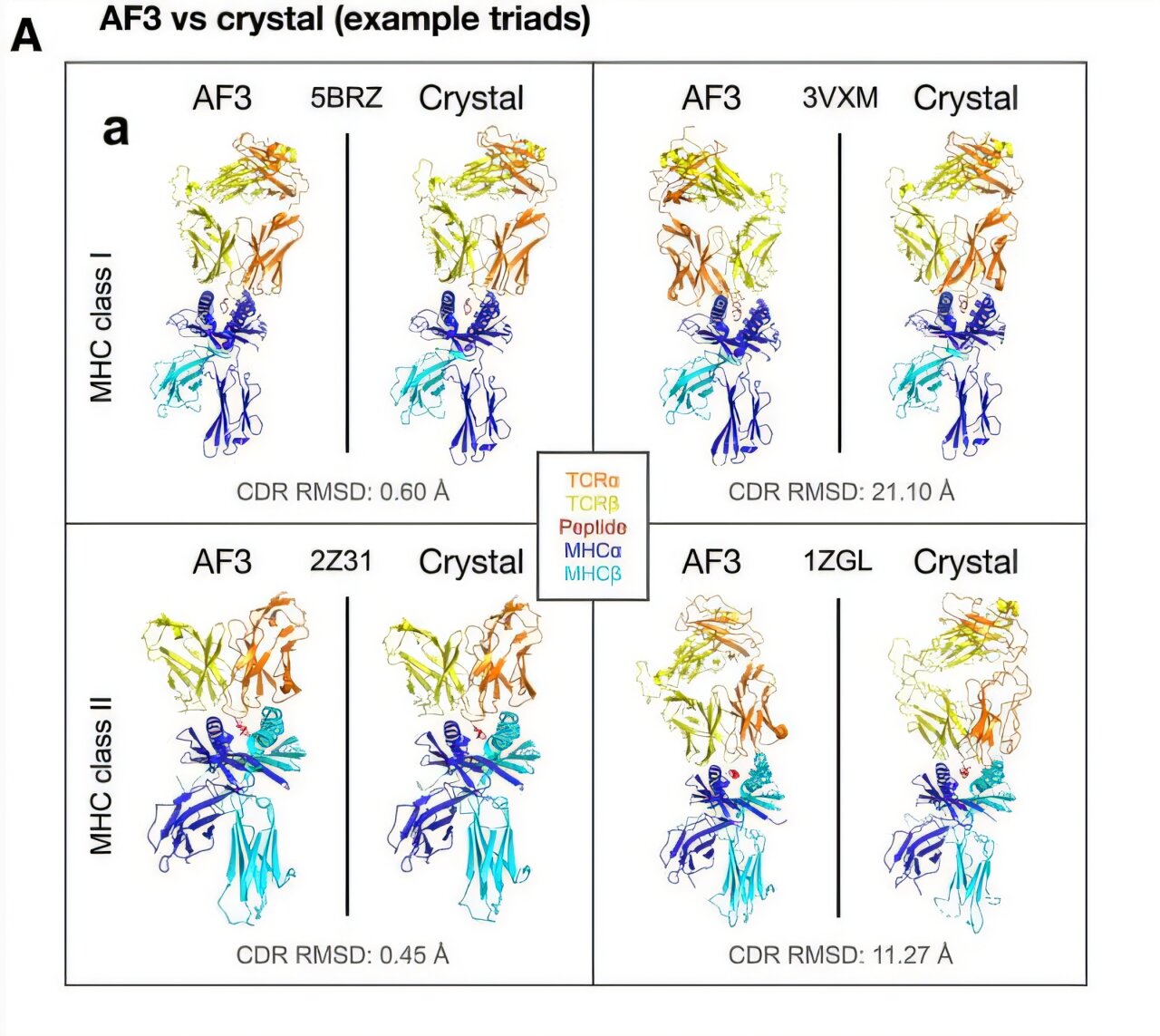
A recent study published in Science Advances https://www.science.org/doi/10.1126/sciadv.aef5674 evaluates the utility of artificial intelligence in addressing this problem. Specifically, the research uses AlphaFold 3 to predict the structures of these molecular complexes, aiming to assess the likelihood of a particular T-cell receptor recognizing a given peptide-MHC target.
Titled “General prediction of T cell receptor antigen specificity from sequence using AlphaFold 3,” this research transcends the conventional application of AI for generating plausible molecular structures. Instead, it investigates whether such structures can provide actionable predictive insights into biological recognition, including interactions involving antigens that lack prior structural characterization. For the supercomputing community, this work serves as a compelling demonstration of how AI-driven molecular modeling is becoming an integral component of the computational infrastructure supporting modern biological research.
Turning molecular structure prediction into a recognition problem
T cells play a central role in adaptive immunity. Their receptors recognize specific molecular targets presented by MHC proteins on cell surfaces. This recognition process is highly selective, but the number of possible receptor-antigen combinations is enormous.
Identifying the targets of individual T-cell receptors experimentally can be labor-intensive. Computational prediction offers a potential way to narrow the search, helping researchers prioritize candidates for further laboratory investigation.
The study examines whether AlphaFold 3 can contribute to that process by modeling the molecular triad formed by the T-cell receptor, peptide, and MHC molecule.
The researchers assembled a substantial collection of known cognate and noncognate interactions. The training data included 7,702 cognate and 157,025 noncognate class I triads, along with 1,625 cognate and 33,628 noncognate class II triads. Together, the dataset contained 9,327 known cognate interactions and 190,653 noncognate examples.
The distinction matters. A model that can generate a plausible structure is not necessarily capable of determining whether two biological components actually interact. The researchers therefore used the predicted structural information to develop a framework for distinguishing recognized targets from nonrecognized combinations.
A substantial computational workload
The methodology also illustrates the computational demands of applying modern structure-prediction systems across large biological datasets.
The researchers ran each molecular triad through AlphaFold 3 using five random seeds, with one diffusion sample per seed and ten recycling steps. Multiple sequence alignments and templates were enabled.
Applying that configuration to the full training dataset implies approximately one million seed-level prediction runs. This is an estimate based on the reported dataset size and five-seed protocol, not a reported count of independent jobs or a measurement of accelerator-hours.
The distinction is important for HPC readers. The paper describes the computational procedure, but does not provide a detailed accounting of the hardware used, GPU configuration, total runtime, memory consumption, energy use, or cluster architecture. It therefore cannot be treated as a benchmark of AlphaFold 3 performance on a particular supercomputer.
Nevertheless, the scale of the experiment demonstrates why high-performance computing, accelerated AI infrastructure and efficient molecular modeling workflows are increasingly important to computational biology. Applying structure-prediction methods to hundreds of thousands of molecular combinations creates a workload involving repeated inference, substantial data handling, and downstream statistical analysis.
As researchers expand these approaches to larger receptor and antigen collections, the ability to manage and execute such workloads efficiently will become an important part of the scientific process.
Promising results, but important limitations
The study reports encouraging results on held-out data, although performance differed between MHC class I and class II predictions.
For class I, the reported median area under the receiver operating characteristic curve (AUC) was 0.92, with results ranging from 0.50 to 1.00. For class II, the median AUC was 0.81, with results ranging from 0.71 to 0.91.
The validation included 14 class I antigens and eight class II antigens. The researchers also examined previously structurally uncharacterized class II antigens, an important test of whether the approach could extend beyond familiar structural examples.
But the headline performance figures do not tell the entire story.
The researchers found that sensitivity could be limited when the model was required to maintain very high specificity. For class II predictions, median sensitivity was 13% at 100% specificity, 26% at 99% specificity, and 52% at 95% specificity.
In practical terms, the model could identify a subset of likely interactions with high confidence, but it could also miss a substantial proportion of genuine targets. That is a significant limitation for applications where failing to identify an important antigen could matter as much as incorrectly predicting one.
Performance also depended strongly on the experimental assay used to establish the underlying interactions. Binding assays produced median AUC values of 0.93 for class I and 0.94 for class II. Other assay categories produced substantially weaker results, with several class II assay types showing median AUC values below 0.6.
That variability underscores a broader challenge in computational biology: AI models are only as reliable as the biological evidence used to train and evaluate them. Different experimental methods measure different aspects of molecular recognition, and those differences can influence the apparent predictive performance of a computational system.
The search space remains enormous
The researchers also acknowledge a major obstacle to applying the approach at unrestricted scale.
Even if a model can distinguish likely interactions among a carefully assembled collection of candidates, searching across billions of possible antigen combinations is another matter entirely. The paper identifies unconstrained mapping across such a vast antigen space as beyond the reach of the current approach.
This is where the HPC implications become particularly relevant.
The challenge is not simply generating more molecular structures. It is determining which combinations are worth modeling, how to prioritize computationally expensive predictions, how to manage uncertainty, and how to integrate structural results with experimental evidence.
Future systems may need more sophisticated screening pipelines that combine sequence-based filtering, structural prediction, statistical ranking, and laboratory validation. Such a workflow could reserve the most computationally expensive modeling for candidates that survive earlier stages of analysis.
That kind of tiered approach is familiar to HPC researchers working with large simulation and scientific AI workloads: use less expensive methods to reduce the search space, then apply more demanding computation to the most promising candidates.
Implications for cancer research and infectious disease
The potential applications are significant, particularly in areas where understanding T-cell recognition could help researchers identify relevant immune targets.
Cancer immunotherapy research, infectious disease studies, and personalized approaches to immune profiling could all benefit from improved methods for predicting which antigens are recognized by particular T-cell receptors.
However, this study does not establish a clinical diagnostic or treatment capability. Its results represent progress in computational prediction, not proof that the approach can independently identify clinically actionable targets across real-world patient repertoires.
The limitations in sensitivity, assay-dependent performance, and the size of the antigen search space remain substantial barriers.
The value of the work is that it provides evidence that AI-generated structural information can contribute to a difficult biological classification problem, while also making clear where the current methodology falls short.
Scientific AI needs more than impressive predictions
This research highlights the growing synergy between AI, molecular simulation, and HPC. While AlphaFold 3 improves how we model biological structures, translating these predictions into scalable, reliable discoveries requires addressing immense search spaces and verifying genuine biological interactions. This study serves as a critical blueprint for managing complex AI-driven workloads in computational biology.