

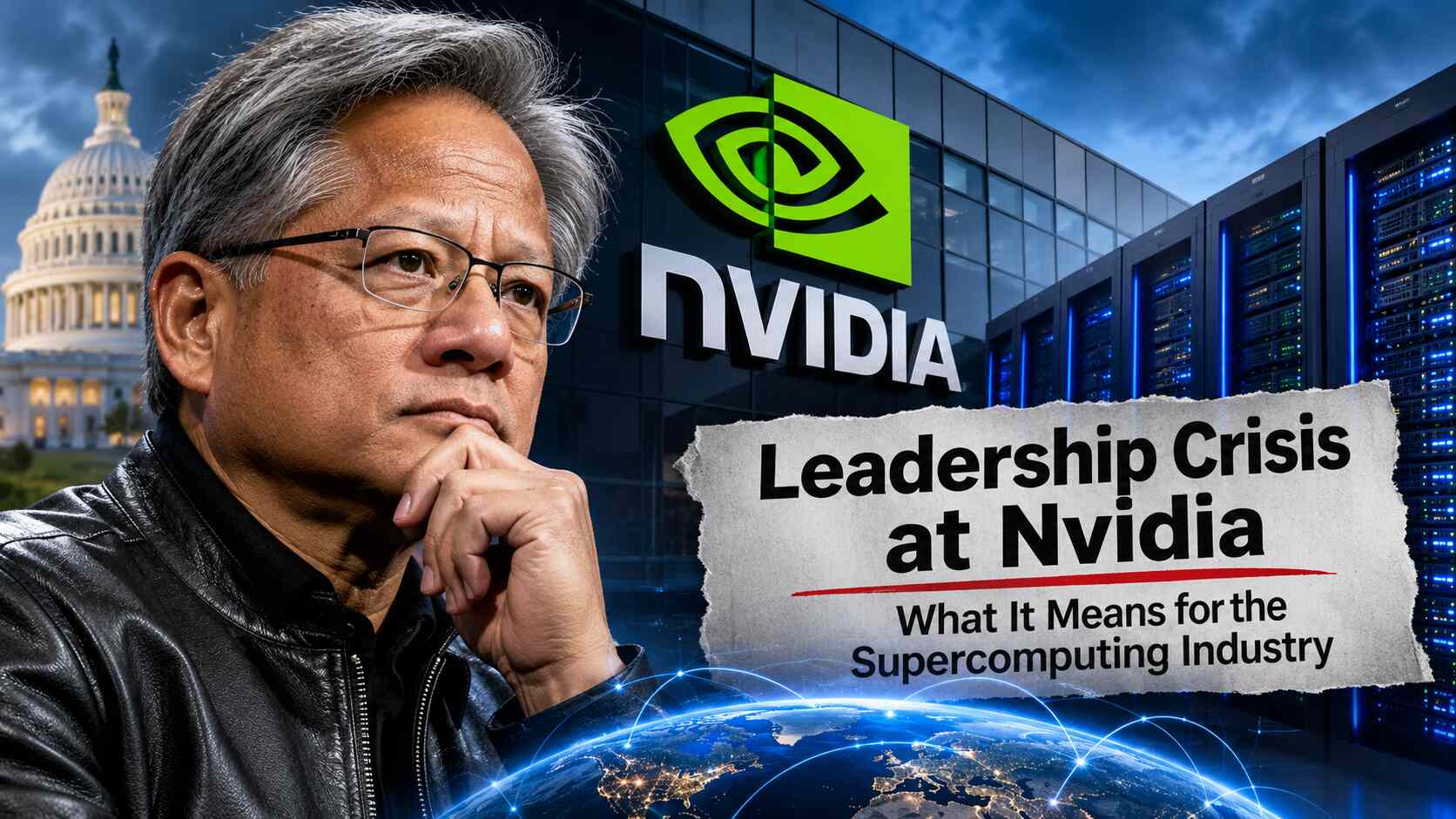
Jensen Huang’s sudden resignation puts the world’s most influential AI chipmaker at a crossroads as congressional scrutiny, export-control concerns, and corporate succession challenges threaten to reshape the high-performance computing landscape.
Jensen Huang's sudden resignation as president and chief executive officer of Nvidia marks a potentially consequential turning point for the global supercomputing industry. After 33 years at the helm of the semiconductor company that helped lay the technological foundation for today’s artificial intelligence revolution, Huang’s departure raises questions that extend far beyond a leadership transition at one corporation.
For an industry increasingly dependent on Nvidia’s graphics processing units (GPUs), accelerated computing platforms, and interconnected AI infrastructure, the implications could be substantial.
Nvidia announced Thursday that Huang had resigned from his positions as president, CEO, and board member, effective immediately. The company’s board has appointed Chief Financial Officer Colette Kress as interim CEO while beginning a search for a permanent successor. Harvey C. Jones has been named the company’s first-ever board chair.
The announcement comes amid mounting scrutiny involving alleged diversions of advanced computing hardware to China, questions surrounding corporate governance, and an ongoing investigation into the company’s business relationships. Huang has also agreed to testify before Congress before Thanksgiving, according to House Foreign Affairs Committee Chairman Brian Mast.
While the circumstances surrounding Huang’s departure remain a matter of significant public interest, the larger concern for the supercomputing community is what this leadership disruption could mean for the stability, direction, and international competitiveness of the AI computing ecosystem.
A leadership change at a critical moment for supercomputing
Nvidia is no longer simply a semiconductor manufacturer. Its hardware and software platforms have become foundational components of modern supercomputing, scientific research, large-scale AI training, national laboratory initiatives, cloud computing, and enterprise data center infrastructure.
The company’s CUDA software ecosystem, GPU architectures, high-speed interconnect technologies, and accelerated computing platforms have helped transform how researchers and businesses approach computationally intensive problems.
From scientific simulations and climate modeling to drug discovery, advanced engineering, and increasingly sophisticated AI systems, Nvidia’s technology occupies a central position in the global computing infrastructure.
That level of influence makes the company’s leadership transition particularly important.
A permanent CEO search could introduce uncertainty at a time when the industry is experiencing extraordinary demand for advanced computing capabilities. Customers, research institutions, hyperscale cloud providers, government agencies, and supercomputing developers all have a substantial interest in knowing whether Nvidia’s product strategy, development priorities, and long-term commitments will remain consistent.
Kress brings considerable financial and operational experience, having served as Nvidia’s CFO since September 2013. Her immediate challenge, however, is considerably larger than maintaining financial continuity. She must reassure customers, employees, investors, technology partners, and government stakeholders that the company can continue executing its strategy during a period of intense scrutiny.
Nvidia’s next quarterly earnings announcement, scheduled for November 17, will provide an early indication of how the leadership transition is affecting the company’s communications and strategic outlook.
Export controls and GPU diversion allegations raise industry-wide concerns
Perhaps the most consequential issue facing Nvidia is the growing scrutiny surrounding the international distribution of advanced computing hardware.
The United States has increasingly treated high-performance AI processors as strategically important technologies, imposing export restrictions intended to limit China’s access to certain advanced computing capabilities.
These restrictions have created a complicated environment for semiconductor manufacturers, cloud providers, international distributors, and organizations operating data centers across multiple countries.
The investigation involving Singapore-based Megaspeed International has intensified those concerns.
Megaspeed has reportedly imported billions of dollars in Nvidia hardware since 2023. Separately, allegations have emerged that restricted processors may have been diverted through intermediary companies to Chinese customers.
One particularly significant report alleged that approximately $7.5 billion in restricted chips may have reached Chinese technology companies through these arrangements. However, Reuters and CNBC have been unable to independently verify that figure.
It is essential to distinguish allegations from established facts. There is currently no publicly established proof that Huang or Nvidia knowingly sold restricted GPUs to China through an unlawful diversion arrangement. No public finding has established Huang’s personal involvement in such activity.
Furthermore, Nvidia’s licensed sales of certain processors, including H20 and H200 products under applicable U.S. regulatory conditions, must not be confused with allegations involving unauthorized diversion.
Nevertheless, the investigation highlights a growing vulnerability within the global supercomputing supply chain: the difficulty of tracking advanced computing hardware once it enters complex international distribution networks.
For the supercomputing industry, this is not a minor regulatory concern.
Advanced GPUs are expensive, strategically important components. Their movement across international borders can have implications for national security, research competitiveness, data center development, and the distribution of global AI computing power.
The industry could face additional compliance requirements, more extensive end-user verification, and increased scrutiny of international hardware distribution arrangements.
The risk of regulatory uncertainty for AI infrastructure
The potential consequences extend well beyond Nvidia.
Supercomputing systems are increasingly assembled through international partnerships involving chip designers, equipment manufacturers, software developers, cloud infrastructure providers, and research organizations.
If export-control enforcement becomes more restrictive or unpredictable, companies throughout this ecosystem may need to reconsider procurement strategies, geographic expansion plans, and long-term infrastructure investments.
Organizations building large-scale AI clusters could face additional uncertainty concerning hardware availability and delivery schedules.
Cloud providers may need to evaluate their international service arrangements more carefully. Supercomputing centers could encounter new procurement challenges, particularly when their computing requirements involve restricted processors or international research collaborations.
The possibility of additional restrictions involving companies such as Megaspeed also raises questions about the role of Southeast Asia as a major distribution and infrastructure region for advanced computing equipment.
The investigation centers on Megaspeed, which is currently the subject of a Department of Justice criminal inquiry following an initial probe by the Department of Commerce. Records indicate that Megaspeed has imported at least $4.6 billion in Nvidia hardware since 2023, including approximately 136,000 GPUs, a significant portion of which are Blackwell-series chips. While customs data and site inspections, which reportedly uncovered large quantities of hardware stored in unopened containers at a Malaysian data center, have fueled concerns, the widely cited figure of $7.5 billion remains unverified. Megaspeed has denied any involvement in the diversion of restricted technology, asserting full cooperation with regulatory inspections and the appointment of U.S. legal counsel to audit its inventory.
Separately, the Department of Justice has brought formal charges against Supermicro co-founder Wally Liaw and two associates in connection with a distinct scheme to divert $2.5 billion in Nvidia-based servers to China. This operation allegedly utilized Thailand-based entities as pass-throughs and employed deceptive tactics, such as serial number swapping, to circumvent compliance audits.
Broader industry trends reveal a systemic pattern of illicit technology transfer. Notable incidents include reports of Moonshot AI reportedly leased 32 Supermicro servers with Blackwell Ultra B300s on the black market at a 350% premium, owned by a Chinese military-linked drone maker. In August, Taiwanese prosecutors indicted nine people, reportedly including a senior Nvidia manager, for falsifying end-user documents; 74 of 130 B300 servers reached Chinese customers. One research estimate (Samaritan Research) puts total smuggled compute at 290,000 to 1.6 million H100-equivalents through end-2025.
The U.S. government must balance two important objectives: protecting national security and preserving the competitiveness of the American semiconductor and supercomputing industries.
Overly permissive enforcement could undermine export-control objectives. However, unclear or inconsistently applied restrictions could create uncertainty for legitimate businesses, slow infrastructure investment, and complicate international research partnerships.
The industry needs regulatory clarity, predictable enforcement, and transparent procedures that distinguish legitimate commercial activity from deliberate violations.
Corporate governance becomes a supercomputing industry issue
Huang’s departure also highlights a governance concern that deserves attention throughout the technology sector.
For more than three decades, Huang’s leadership and personal vision have been closely associated with Nvidia’s evolution. His influence extended across product development, corporate strategy, customer relationships, and the company’s position in the global AI computing market.
Such concentrated leadership can provide strategic consistency and a powerful corporate identity. However, it can also create significant succession challenges.
Nvidia’s own corporate disclosures have acknowledged its dependence on longstanding executive leadership and the potential consequences of inadequate succession planning.
The sudden transition to an interim CEO illustrates why succession planning should be considered a critical component of corporate risk management, particularly for companies whose technologies underpin essential computing infrastructure.
Supercomputing is no longer an isolated technology sector. It supports financial systems, scientific research, national security, healthcare innovation, industrial development, and increasingly important AI applications.
Companies providing foundational technologies to these sectors must demonstrate that their operations can withstand unexpected leadership changes and corporate disruptions.
Investors and customers will be watching closely to determine whether Nvidia can maintain its technological momentum while strengthening its governance structure.
Congress must address the broader technology implications
Huang’s agreement to testify before Congress introduces another important dimension to the developing situation.
The congressional scrutiny involves questions about his interactions with Alice Huang and Nvidia’s security protocols. The allegations surrounding potential chip diversion and the company’s international business relationships have become part of a much broader national debate about advanced semiconductor technology and export enforcement.
The testimony will be important, but it should not be viewed as a substitute for the ongoing independent investigation or any separate law enforcement inquiries.
Congressional oversight must establish what happened, what company officials knew, and whether existing controls are sufficient to protect sensitive computing technologies.
For the supercomputing industry, the outcome could influence future legislation, licensing procedures, international technology partnerships, and the regulatory responsibilities of semiconductor manufacturers.
The industry needs answers, but it also needs a policy environment that supports legitimate innovation.
What this means for the future of high-performance computing
The timing of Nvidia’s leadership crisis could hardly be more significant.
The supercomputing industry is entering an era in which accelerated computing and artificial intelligence are becoming inseparable from traditional high-performance computing.
Organizations are investing enormous resources in GPU-based systems, specialized AI accelerators, high-bandwidth memory, advanced networking, and increasingly sophisticated cooling and power infrastructure.
Nvidia has been one of the primary beneficiaries of this transformation.
Consequently, any sustained disruption to its leadership, corporate strategy, or international distribution network deserves close attention.
There are several important questions the industry must now consider:
- Technology continuity: Will Nvidia maintain its current product development priorities and long-term commitments to supercomputing customers?
- Supply chain security: Will the investigation lead to more stringent tracking and verification requirements for advanced GPUs?
- International competitiveness: Could additional export restrictions create opportunities for competing semiconductor manufacturers and alternative computing architectures?
- Research infrastructure: Could uncertainty surrounding advanced processor availability affect major scientific and government computing projects?
- Corporate governance: Will other major technology companies reconsider their executive succession plans and internal oversight procedures?
- Regulatory clarity: Can policymakers strengthen national security protections without unnecessarily restricting legitimate scientific and commercial innovation?
These questions are particularly important as countries compete to establish leadership in artificial intelligence, scientific computing, and next-generation semiconductor technologies.
A critical test for Nvidia and the supercomputing community
Nvidia’s immediate priority is to demonstrate that its operations can remain effective in the absence of the executive who spearheaded its transformation into a global technological powerhouse.
During this transition, Interim CEO Colette Kress must ensure operational continuity while the board conducts a formal search for a permanent successor. Concurrently, the company must address concerns regarding its international business relationships, cooperate fully with ongoing investigations, and proactively restore confidence among its client base and strategic partners.
For the broader supercomputing industry, this situation serves as a critical reminder of the risks associated with an over-reliance on any single executive, corporation, or technological ecosystem. The long-term vitality of high-performance computing requires a resilient and diversified infrastructure capable of supporting scientific innovation, economic growth, and national security, independent of individual corporate disruptions or unpredictable regulatory shifts.
While Nvidia’s influence remains profound, the sustainable future of the sector depends on fostering competition, transparency, and robust corporate governance. Huang’s resignation does not necessarily signal the end of Nvidia's market leadership, nor does it confirm any personal or corporate involvement in unlawful activities. However, it underscores that the development of the world’s most powerful computing systems is now inextricably linked to issues of corporate accountability, international security, and public policy.
The upcoming weeks, marked by Nvidia’s quarterly earnings report, Huang’s congressional testimony, and the progression of independent investigations, will prove pivotal. These events will clarify whether this transition represents an isolated corporate crisis or the beginning of a fundamental reassessment of global supercomputing operations. For an industry tasked with driving the next generation of scientific breakthroughs, the implications of these developments are too significant to overlook.