

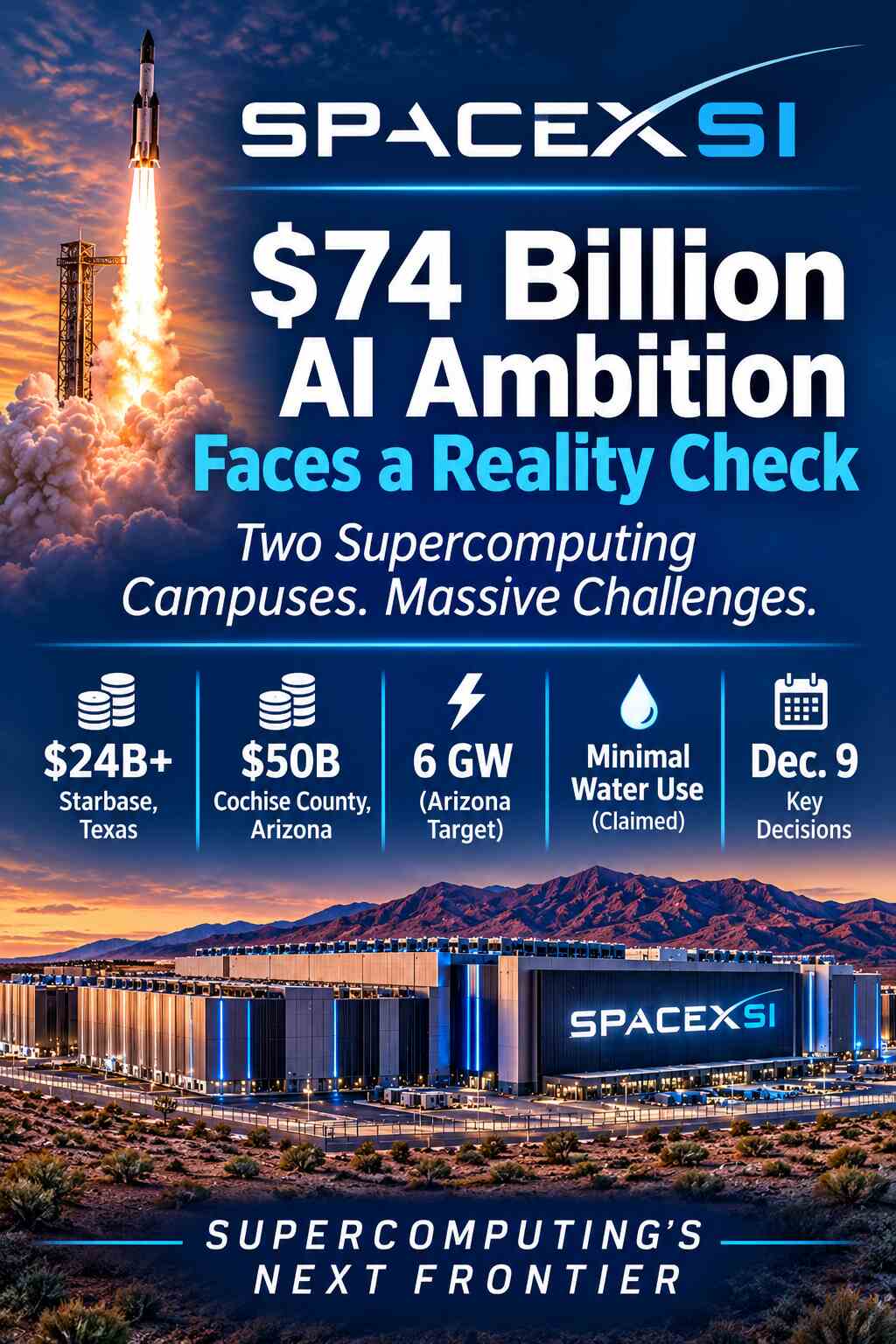
SpaceX is committing unprecedented capital to establish itself as a preeminent global force in artificial intelligence. With a planned $74 billion investment across two massive supercomputing centers in South Texas and southeastern Arizona, the company is significantly escalating its infrastructure ambitions. SpaceX’s "Building the Future" initiative, announced on November 12, represents a massive infrastructure commitment, with over $24 billion earmarked for the Starbase site and approximately $50 billion dedicated to the development in Cochise County.
These projects transcend conventional data center standards, aiming to support frontier AI training, complex scientific research, national security applications, and next-generation space-based computing systems. While the financial scale of this commitment is profound, the underlying engineering and operational hurdles, ranging from energy procurement and environmental compliance to hardware supply-chain logistics and local opposition, present substantial challenges to successful implementation.
A $74 billion commitment changes the scale of the AI infrastructure race
The combined investment puts SpaceX among the most aggressive players in the global race to secure computing capacity for increasingly demanding AI workloads.
The Arizona project alone is designed around an eventual electrical demand of approximately 6 gigawatts, distributed across four development phases. Plans call for as many as nine computing buildings, each approximately 493,000 square feet, supported by extensive electrical infrastructure, battery storage, and cooling systems.
The proposed site encompasses approximately 747 acres.
At full capacity, the Arizona facility would represent a dramatic expansion of SpaceX's existing computing infrastructure. The company's third-quarter 2026 financial results reported approximately 1.7 gigawatts of installed nameplate computing capacity as of September 30.
The proposed Arizona campus would therefore require roughly 3.5 times that existing capacity.
That comparison illustrates the extraordinary scale of the project. It also highlights the engineering and supply-chain requirements associated with bringing such a facility online.
A six-gigawatt computing campus cannot be constructed simply by installing additional GPU racks. It requires coordinated development of electrical substations, transmission infrastructure, high-density server environments, cooling systems, networking, storage, backup power, and the operational systems necessary to maintain enormous computing workloads.
Every layer must work together.
Arizona's 6-Gigawatt supercomputer faces an enormous energy challenge
The Cochise County development may become one of the most ambitious single-site AI computing projects ever proposed.
Its power requirements are particularly significant because the facility is designed around electricity supplied through local utility infrastructure rather than a completely independent generation system.
The development application identifies a substantial transmission and electrical infrastructure expansion involving Sulphur Springs Valley Electric Cooperative and Arizona Electric Power Cooperative.
The estimated cost of associated grid improvements is approximately $3.6 billion.
SpaceX says it will fund these improvements and transfer the infrastructure to AEPCO at no cost.
The company also claims the project could reduce electricity bills for cooperative members by as much as 20 percent. However, the financial mechanism behind that projected reduction has not been independently established.
The distinction between promised infrastructure investment and delivered electrical capacity is important.
A computing campus requiring 6,000 megawatts must have access to dependable power around the clock. Even relatively brief interruptions can affect large-scale AI training operations, potentially interrupting distributed computing jobs involving thousands of accelerators.
The proposed campus includes a 24-gigawatt-hour battery energy storage system. At the full 6-gigawatt load, that represents approximately four hours of theoretical energy storage before accounting for operating losses, reserve requirements, and other system limitations.
Battery storage can help manage fluctuations, provide ride-through capability, and support grid stability. It does not independently solve the challenge of supplying a continuous 6-gigawatt electrical load.
For SpaceX, the availability, reliability and cost of electricity will be just as important as the computing hardware itself.
Dry cooling reduces water consumption, but raises other engineering questions
SpaceX is proposing a dry-cooling architecture for the Arizona campus, a decision that addresses one of the most contentious issues surrounding large data center developments in water-constrained regions.
The application estimates annual direct water consumption of approximately 7 to 10 acre-feet at full build-out, with most of that demand associated with personnel and domestic operations rather than industrial cooling.
The company says it does not plan to use groundwater for industrial purposes.
Dry cooling avoids the substantial evaporative water requirements associated with conventional cooling towers. Instead, heat is rejected into the surrounding air through heat exchangers and large fan systems.
However, dry cooling introduces another engineering consideration: electricity consumption.
As outside temperatures increase, dry-cooling systems can require additional fan power and may face reduced heat-rejection efficiency. In a facility operating thousands of high-density GPU systems, thermal management becomes a major infrastructure concern.
There is also an important distinction between direct and indirect water consumption.
The Arizona campus may use relatively little water within its property boundaries, but the power generation required to supply its enormous electrical demand can create additional water requirements elsewhere.
Without a published breakdown of the project's electricity supply mix, its broader water footprint cannot yet be independently calculated.
The proposed cooling strategy is therefore a meaningful engineering decision, but it does not eliminate the need to evaluate the full environmental footprint of the computing operation.
Starbase takes a different approach: Build the power plant alongside the supercomputer
The Texas development represents a different approach to solving the AI trade's electricity problem.
Rather than depending entirely on public grid connections, SpaceX proposes an independently powered computing campus at Starbase, supported by a natural-gas-fired generating facility.
The project covers approximately 444 acres and carries an announced investment exceeding $24 billion.
SpaceX's initial power-generation proposal identifies 35 temporary turbines with combined generating capacity of approximately 748 megawatts. The filing also describes a later configuration involving eight larger GE Vernova 7E turbines totaling approximately 708 megawatts.
These are alternative configurations, not additional generating capacity.
The strategy reflects a growing trend among major computing developers: securing dedicated power generation to avoid dependence on increasingly constrained utility infrastructure.
But generating electricity independently does not eliminate regulatory responsibilities.
SpaceX's registration with the Texas Commission on Environmental Quality remained pending as of November 12. The application also identifies a proposed annual nitrogen oxide emissions cap of 248.86 tons, just 1.14 tons below the 250-ton federal major-source threshold relevant to the applicable regulatory framework.
The proposed emissions limit and the treatment of turbine startup and shutdown events have become important points of scrutiny.
The situation is particularly notable because SpaceX has already faced regulatory problems involving temporary turbines at its Southaven, Mississippi, facility. Under an agreement with Mississippi regulators, the company must remove 69 temporary turbines from that site by July 2027.
For Starbase, the question is whether its proposed generation infrastructure can satisfy environmental requirements while delivering the dependable electricity necessary for large-scale computing.
An off-grid supercomputer is still subject to environmental regulation.
The hardware question: Where will millions of GPUs come from?
Even if SpaceX successfully resolves its electricity and permitting challenges, another enormous question remains: computing hardware.
The company has not identified a specific chip supplier, accelerator architecture, or delivery schedule for either of the newly announced campuses.
SpaceX has, however, disclosed a separate financing arrangement that provides an indication of the scale of its broader hardware procurement strategy.
In October, the company disclosed a roughly $40 billion master finance lease involving an Apollo-managed entity that will acquire NVIDIA Vera Rubin GPUs and related equipment for lease back to SpaceX.
The agreement represents a substantial commitment to next-generation accelerated computing hardware, with lease arrangements expected to begin as equipment arrives during the first half of 2027.
But there is an important distinction.
The financing arrangement covers SpaceX's broader terrestrial computing expansion. It does not specifically allocate GPUs to either the Starbase or Cochise County campus.
Consequently, the $40 billion agreement should not be interpreted as a confirmed hardware procurement commitment for these two particular developments.
The distinction matters because the AI hardware market remains highly competitive. Securing millions of advanced accelerators requires much more than purchasing processors.
Large-scale systems depend on high-bandwidth memory, advanced packaging, high-speed networking, optical interconnects, storage infrastructure, power distribution, and sophisticated thermal management.
At this scale, even small delays in component availability can affect entire construction and deployment schedules.
SpaceX will need to coordinate its hardware deliveries with the construction of electrical infrastructure and the commissioning of individual computing buildings.
A completed building without its intended accelerators is not an operational supercomputer.
SpaceX's financial numbers reveal the magnitude of the bet
The company's financial results provide important context for evaluating the $74 billion announcement.
SpaceX reported approximately $48.1 billion in capital expenditures during the first nine months of 2026. Approximately $40 billion of that spending was attributed to its Super Intelligence segment.
The proposed two-campus investment is therefore equivalent to approximately 1.5 times the company's entire capital expenditure during those nine months.
SpaceX also guided toward fourth-quarter capital expenditures of approximately $35 billion to $40 billion.
Its third-quarter revenue reached approximately $14.6 billion, with the Super Intelligence segment contributing approximately $7.56 billion, or slightly more than half.
Those figures demonstrate that AI computing has become a central component of the company's financial strategy rather than simply an extension of its aerospace and satellite businesses.
However, the distinction between financial capacity and infrastructure execution remains critical.
SpaceX may have the financial resources to pursue these projects, but capital availability does not automatically produce transmission capacity, regulatory approvals, manufacturing availability, or operational computing infrastructure.
The company must convert financial commitments into physical systems capable of delivering useful computing performance.
That is a much harder test.
A new ambition: Computing beyond Earth
Perhaps the most intriguing aspect of SpaceX's announcement is its reference to developing and testing future space-based computing systems.
The company says the two campuses will support research and development associated with future computing infrastructure in space.
The concept introduces a potentially significant new direction for the relationship between artificial intelligence, high-performance computing and aerospace engineering.
SpaceX has capabilities that could make it uniquely positioned to investigate the possibility of orbital computing infrastructure, including launch vehicles, satellite communications, and experience operating large distributed space systems.
But the technical challenges are considerable.
Space-based computing would need to address radiation exposure, thermal management in a vacuum, power generation, hardware reliability, maintenance limitations, and the enormous difficulty of transporting and replacing computing equipment in orbit.
High-performance AI accelerators also generate substantial heat. Unlike terrestrial facilities, orbital systems cannot depend on conventional air-based cooling. They must reject heat through radiators and other thermal-management technologies.
Communications introduce another major challenge.
Moving large quantities of training data between orbital computing platforms and ground-based systems would require substantial communications capacity, sophisticated networking architectures and careful management of latency.
SpaceX has not disclosed a technical architecture, hardware configuration, launch schedule, or deployment timeline for this concept.
For now, space-based computing should be viewed as a stated development objective rather than an established infrastructure program.
Nevertheless, it is an important indication that the company's longer-term computing ambitions may extend well beyond conventional terrestrial data centers.
December 9 becomes an important test for both projects
Both developments face important local decisions on December 9.
In Arizona, the Cochise County Planning and Zoning Commission is scheduled to hold a public hearing on the proposed supercomputing campus. The application faces local opposition, including a petition reportedly carrying approximately 2,400 signatures.
In Texas, the Starbase City Commission is scheduled to consider a property tax abatement and development agreement associated with the proposed campus.
Neither project has received all the necessary approvals.
The Arizona hearing will be an important milestone in determining whether the proposed development can advance through the county's approval process. The Starbase meeting concerns local tax and development arrangements, not the separate state-level air registration.
The distinction is important. Neither meeting should be interpreted as final authorization for every aspect of construction and operation.
For the broader supercomputing industry, the outcome will provide another indication of how local communities and regulators are responding to the enormous infrastructure demands created by AI.
The real test is delivering computing capacity, not announcing it
SpaceX's $74 billion announcement illustrates the extraordinary scale of investment now being directed toward artificial intelligence infrastructure.
The two proposed campuses represent different approaches to a common problem: securing enough dependable electricity, cooling capacity, and advanced computing hardware to support increasingly demanding AI workloads.
Arizona proposes a massive utility-supported computing development with dry cooling and extensive battery storage. Texas proposes a more independent power-generation strategy built around a natural-gas-fired plant.
Both approaches involve substantial engineering complexity.
Both also face questions that cannot be answered by financial announcements alone.
The industry has become increasingly focused on accelerator performance, model capabilities, and the economics of AI training. Yet the physical infrastructure required to operate these systems is becoming just as important as the processors themselves.
Transmission infrastructure, power generation, cooling efficiency, networking, storage, and hardware availability will determine how quickly ambitious AI projects can become operational.
For SpaceX, the challenge is particularly significant. The company is attempting to scale its computing infrastructure at a pace that would place enormous demands on the global semiconductor supply chain and the energy systems serving its proposed campuses.
The $74 billion figure is impressive. The 6-gigawatt Arizona proposal is extraordinary. The possibility of extending computing infrastructure into space is even more ambitious.
But none of those numbers represents delivered computing performance.
The real measure of success will be how much reliable, useful supercomputing capacity SpaceX can actually bring online, how efficiently it can operate that infrastructure, and whether the company can do so while meeting the financial, environmental, and regulatory obligations surrounding both developments.
The next chapter of the AI supercomputing race may not be decided by who can announce the biggest investment. It may be decided by who can actually build the power plants, secure the chips, cool the machines, and keep millions of computing components running.
For SpaceX, the $74 billion gamble is only the beginning.