

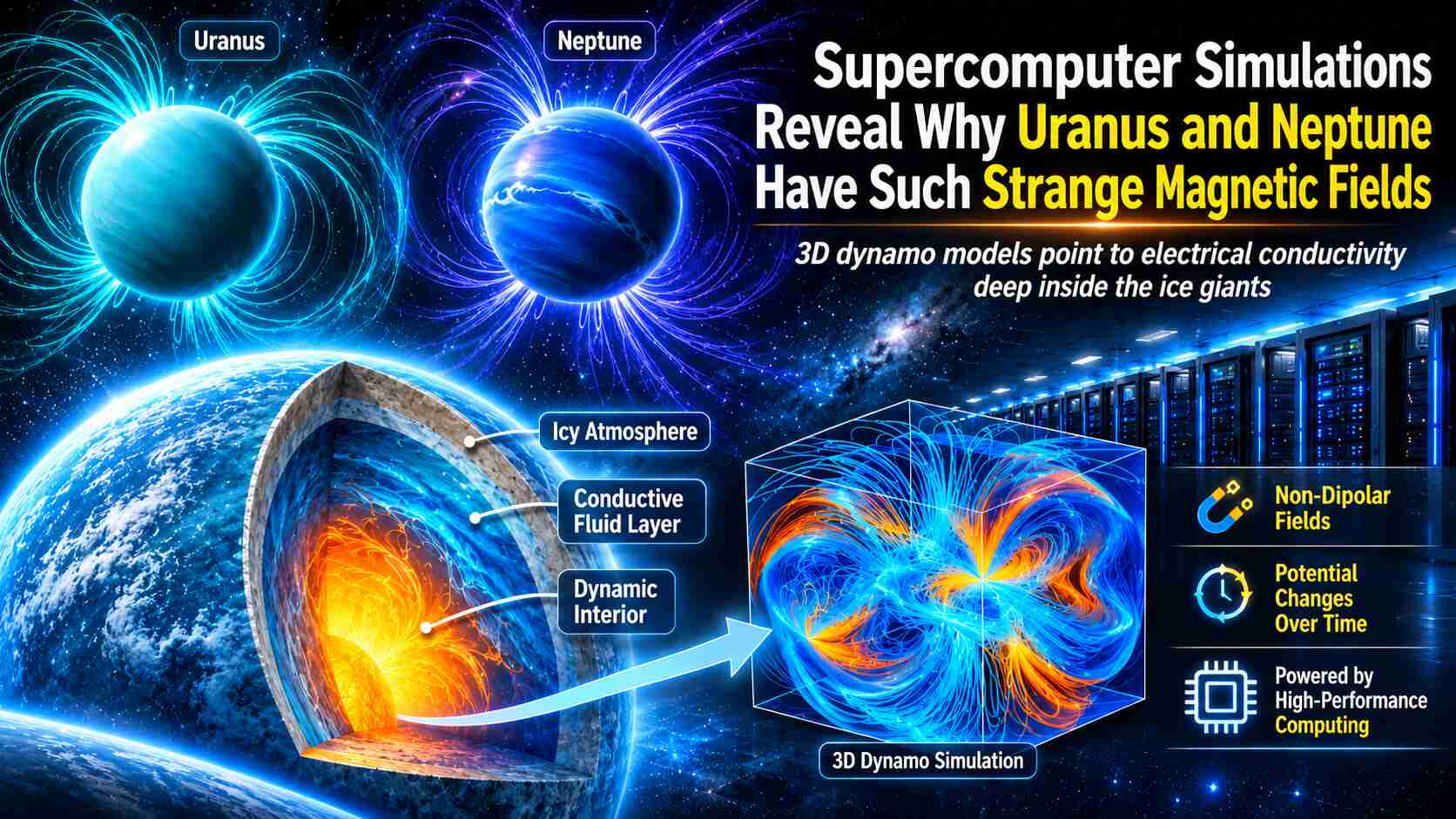
New 3D dynamo models point to electrical conductivity deep inside the ice giants as a key to their unusual magnetic fields, while raising questions about how much those fields may have changed since Voyager 2.
For decades, the magnetic fields of Uranus and Neptune have challenged planetary scientists. Unlike the dominant north-south dipoles observed in Earth, Jupiter, and Saturn, these ice giants exhibit unusually complex, tilted, and asymmetric magnetic structures characterized by multiple components.
A recent study, published on November 3 in Communications Physics (https://www.nature.com/articles/s42005-026-02841-y) and titled "Electrical conductivity structure drives anomalous and potentially time-varying magnetic fields at Uranus and Neptune," offers a compelling explanation for this phenomenon. Led by Chi Yan and Krista M. Soderlund at The University of Texas at Austin, in collaboration with researchers from UCLA, Imperial College London, and Northumbria University, the study utilizes three-dimensional numerical dynamo simulations to demonstrate that the depth-dependent variation of electrical conductivity within these planets is a primary factor in shaping their magnetic fields. Furthermore, these findings suggest that such fields may evolve considerably over relatively short astronomical timescales. By bridging complex planetary science challenges with advanced computational modeling of fluid dynamics, electromagnetism, and extreme material conditions, this research provides a vital framework for understanding the internal processes of these distant worlds.
A magnetic-field problem that has resisted explanation
NASA's Voyager 2 spacecraft revealed the unusual magnetic environments of Uranus and Neptune during its flybys in 1986 and 1989. Rather than the relatively orderly magnetic configurations seen at other planets, both ice giants displayed highly non-dipolar and non-axisymmetric fields.
The axial dipole accounts for only about 12 percent of the total observed surface magnetic energy at Uranus and Neptune. At other planets, the corresponding dipole contribution is substantially larger, reaching approximately 74 to 98 percent in the planetary examples the researchers examined.
Their magnetic power spectra also contain a pronounced feature known as the M1 peak, representing an unusually strong non-axisymmetric component. This characteristic has become an important constraint for scientists attempting to reproduce the magnetic fields through numerical simulations.
The challenge is that the magnetic fields are generated deep beneath the visible atmospheres, where direct measurements remain extremely limited. Voyager 2 provided only one in-situ measurement at each planet, leaving researchers with incomplete information about the processes operating inside these distant worlds.
Modeling the hidden planetary dynamo
Magnetic fields inside planets are generated through dynamo action, a process in which electrically conducting fluids move and produce magnetic fields through electromagnetic induction.
The new research focuses on an important property that earlier ice-giant dynamo models had not fully incorporated: electrical conductivity does not necessarily remain constant throughout a planet's interior.
As pressure and temperature increase with depth, water-rich material can undergo molecular-to-ionic transitions, allowing it to conduct electricity more effectively. The researchers investigated how these changing conductivity conditions influence the movement of conducting fluids and the resulting magnetic-field structure.
The team used the open-source MagIC numerical dynamo code to solve three-dimensional magnetohydrodynamic equations in a rotating spherical-shell geometry. The simulations modeled the evolving velocity, magnetic-field, and temperature distributions inside idealized planetary interiors.
The computational experiments examined different radial electrical-conductivity profiles and convective-shell geometries. Fifteen dynamo models were evaluated, including configurations with constant conductivity and several different conductivity gradients.
The numerical framework employed a pseudospectral approach, using 65 Chebyshev polynomials in the radial direction and spherical harmonics with a maximum degree of 170 to resolve the fields across the modeled spherical surfaces.
These calculations allowed the researchers to examine how changes in interior conductivity affect the balance among magnetic forces, rotation, convection, and fluid inertia.
The simulations were conducted using the Stampede3 system at the Texas Advanced Computing Center through an allocation provided by the National Science Foundation-supported ACCESS program.
This is a useful example of high-performance scientific computing being applied to a problem that cannot be investigated directly through conventional observation. The researchers could systematically vary interior conditions, follow the evolution of complex magnetic structures, and compare thousands of simulated snapshots against the limited magnetic-field information obtained from Voyager 2.
Conductivity gradients produce more realistic magnetic structures
One of the study's central findings is that models assuming constant electrical conductivity consistently produce magnetic fields dominated by an axial dipole. Those configurations fail to reproduce important characteristics of the fields observed at Uranus and Neptune.
The results change when electrical conductivity increases with depth.
Under those conditions, the simulations produce multipolar and non-axisymmetric magnetic structures, including the pronounced M1 feature found in the observed magnetic-field spectra.
The conductivity gradient also changes the internal force balance. Reduced conductivity toward the outer boundary weakens magnetic forces relative to other processes, allowing inertia and buoyancy to play a stronger role in shaping convection.
The resulting fluid motions can generate smaller-scale magnetic structures and more complex field configurations.
The researchers found that thinner convective dynamo shells generally produced ice-giant-like magnetic structures more frequently. Models with variable conductivity and shell geometries in the tested range of 0.5 to 0.6 were among the most successful at reproducing the observed characteristics.
Importantly, the results do not establish one definitive interior configuration for either planet. Different combinations of conductivity profiles and shell geometries can produce similar magnetic characteristics, and the researchers found that model rankings could depend on which published reconstruction of the Voyager-era magnetic field was used for comparison.
Nevertheless, the simulations identify radial electrical conductivity as a major physical ingredient in explaining the unusual magnetic environments of the ice giants.
Magnetic fields could change over decades
Perhaps the most intriguing finding concerns the potential evolution of the magnetic fields.
The simulations indicate that non-dipolar dynamo configurations can undergo substantial temporal variation. In some modeled intervals, the orientation and structure of the magnetic field change considerably over periods measured in decades. Other intervals exhibit much slower evolution.
In one comparison, the researchers examined modeled magnetic-field configurations separated by 32 years. The initially close resemblance to the Voyager-era observations deteriorated substantially as the simulated dynamos evolved.
Some Neptune-like model intervals exhibited projected dipole-tilt changes of approximately 26 to 56 degrees over 40 years. Other modeled intervals showed considerably smaller changes.
These are simulation results, not measured changes in the magnetic fields of Uranus or Neptune.
The distinction is important. Neither planet has been visited by another spacecraft since Voyager 2, and no subsequent in-situ measurements have established how much its internal magnetic field has changed.
There are observational clues worth investigating. The study discusses auroral emissions and their apparent positions, including a reported latitudinal shift of roughly 30 degrees in Neptune's southern auroral emission between 1989 and 2023. However, the researchers caution that this does not establish magnetic-field variation conclusively.
The simulations therefore provide a physically plausible mechanism for changes that future observations could test, rather than proof that the planets' magnetic fields have already undergone the modeled shifts.
Why the computational limitations matter
The research also illustrates a persistent challenge in computational planetary science: reproducing the physical conditions of a planet's interior is extraordinarily difficult.
Global dynamo simulations cannot currently reach the extremely low Ekman numbers expected inside actual planetary interiors. The Ekman number describes the relationship between viscous forces and rotational forces, and it is an important parameter governing fluid behavior in rapidly rotating systems.
The researchers used parameter scaling to reproduce important dynamical diagnostics and force balances within the computationally accessible range. They also tested a lower Ekman number configuration to examine whether important magnetic characteristics persisted.
The M1 feature remained present in that additional test, supporting the robustness of the result within the parameter range that could be simulated.
But the limitations remain significant. The actual temperature, composition, density distribution, electrical conductivity, and internal layering of Uranus and Neptune are not sufficiently constrained to establish precisely where their dynamos operate or how efficiently they generate magnetic fields.
The study also identifies other interior properties that deserve additional computational investigation, including thermal conductivity, density structure and possible stable layers associated with superionic materials.
For HPC researchers, this is an important reminder that increasing numerical resolution alone does not eliminate uncertainty in a scientific model. The physical assumptions, boundary conditions, parameter ranges, and ability to reproduce the relevant dynamical regime are equally important.
JWST and future missions could provide the next test
The findings have implications beyond explaining the magnetic fields themselves.
Changes in magnetic-field strength and orientation could influence the interaction between the planets and the solar wind, magnetic reconnection, radiation-belt particle behavior and auroral activity.
They could also complicate interpretations of atmospheric and magnetospheric observations that rely on magnetic-field models derived from Voyager 2.
The James Webb Space Telescope and other observatories offer opportunities to improve the available constraints through observations of auroral emissions and atmospheric signatures. However, a new spacecraft mission capable of directly measuring the magnetic environments of Uranus or Neptune would provide much stronger evidence.
The research also gives planetary scientists a framework for evaluating future observations. If magnetic-field configurations have evolved since Voyager 2, models that assume the 1980s measurements still describe the planets accurately may need to be reconsidered.
A compelling example of HPC-driven discovery
The significance of this research extends beyond these two distant planets. It demonstrates how high-performance computing enables the investigation of physical systems that are otherwise inaccessible to direct experimentation. By combining three-dimensional magnetohydrodynamic simulations, spherical-harmonic analysis, and systematic testing of interior conductivity profiles, the researchers have identified a plausible mechanism connecting the internal material properties of the ice giants to their anomalous magnetic fields.
The utilization of an established open-source dynamo code, alongside publicly accessible simulation data and analysis scripts, provides a robust foundation for independent inquiry and future model development. The subsequent challenge lies in evolving beyond current assumptions regarding planetary interiors, integrating additional physical processes, and comparing these simulations against more precise observations. While this study does not resolve every mystery surrounding Uranus and Neptune, it offers a computationally testable explanation for their unique magnetic configurations and highlights specific observations that may determine whether these fields remain in a state of flux.
More than three decades after the Voyager 2 flybys, advanced scientific computing is allowing researchers to reexamine one of the mission’s most unexpected discoveries, illustrating the vast amount of activity still hidden beneath the atmospheres of these remote worlds.