

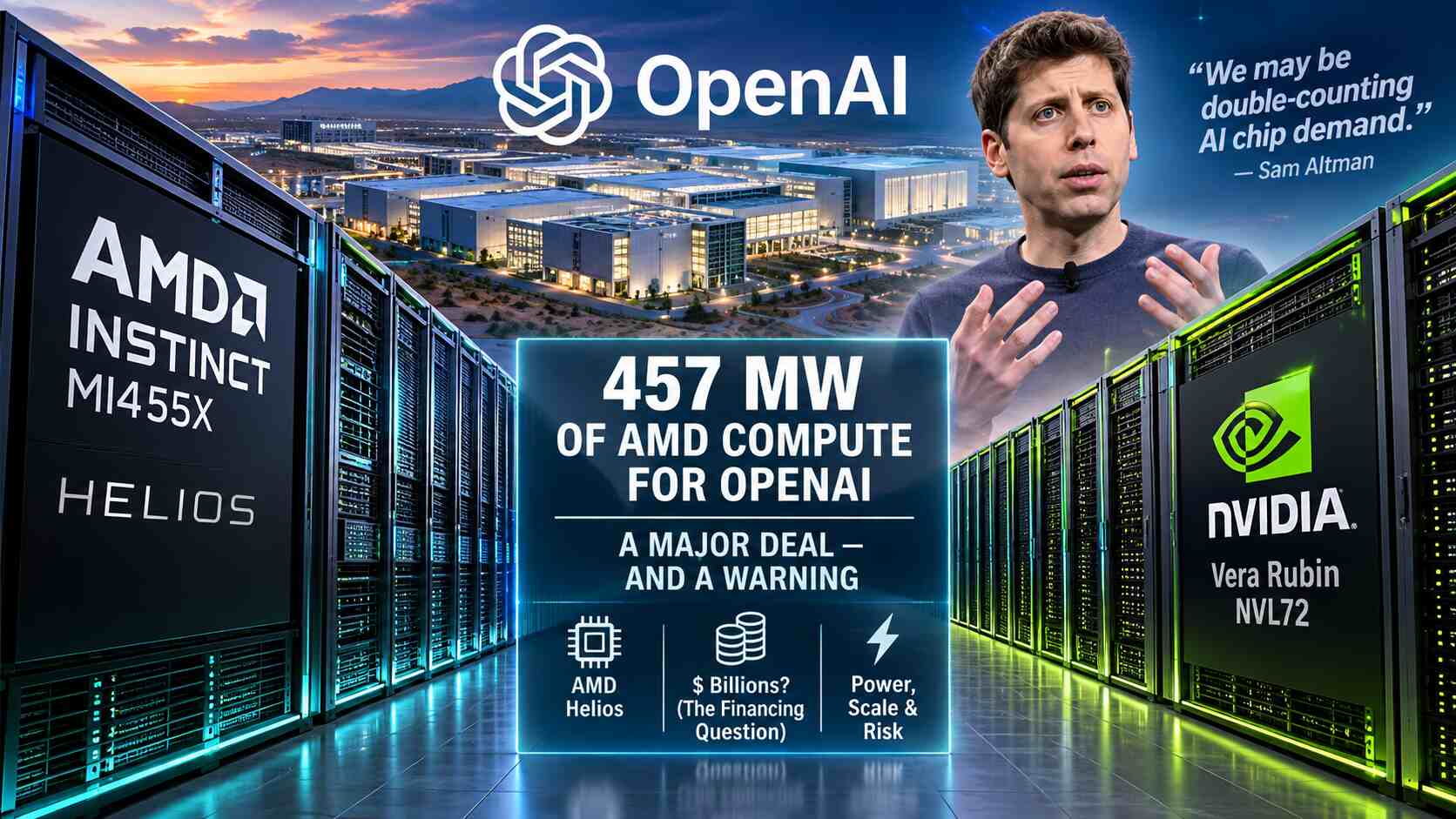
The six-year agreement puts AMD’s Helios rack-scale architecture into a major OpenAI infrastructure deployment, but the deal also exposes the financial risks behind the industry’s rapidly expanding neocloud economy.
The competition for dominance in the global artificial intelligence computing infrastructure market is entering a pivotal new phase. AMD has secured a substantial opportunity to challenge Nvidia’s market position, following OpenAI’s commitment to a six-year, 457-megawatt agreement with TensorWave, which will utilize AMD Instinct MI455X accelerators.
This partnership serves as a significant indicator that AMD is evolving beyond its role as a secondary accelerator supplier, now positioning itself to compete directly at the scale of integrated, rack-level AI supercomputing systems.
Under the terms of the agreement, TensorWave is tasked with delivering dedicated, single-tenant infrastructure across multiple U.S. data centers. The deployment will leverage AMD’s Helios rack-scale architecture, with preliminary capacity slated for the first half of 2027 and full operational deployment anticipated by early 2028.
While this announcement marks a strategic milestone for AMD, its broader implications transcend the semiconductor industry. It serves as a rigorous test of AMD’s capacity to provide a cohesive computing platform capable of supporting frontier AI workloads. At the same time, it raises a critical financial question: whether the entities building this next-generation infrastructure can sustain the enormous capital requirements needed to fulfill such ambitious commitments. This inquiry becomes increasingly pertinent in light of recent warnings from OpenAI CEO Sam Altman regarding the industry-wide risk of overestimating and double-counting future demand for AI hardware and memory.
AMD’s Helios architecture moves into the spotlight
At the center of the agreement is AMD’s Helios platform, a rack-scale computing architecture designed to bring accelerators, server processors, memory and high-speed networking together into a tightly integrated system.
Each Helios rack is designed around 72 AMD Instinct MI455X GPUs, supported by 18 sixth-generation AMD EPYC Venice CPUs and Pensando Vulcano networking components.
The architecture combines high-bandwidth accelerator memory with UALink scale-up connectivity and Ultra Ethernet scale-out networking. The objective is to provide the communication bandwidth and system-level integration necessary to distribute demanding AI training and inference workloads across large collections of accelerators.
AMD specifies up to 432 GB of HBM4 memory per MI455X GPU, with approximately 23.3 TB/s of memory bandwidth per accelerator. Across a 72-GPU rack, that represents approximately 31 TB of HBM4 capacity.
AMD also advertises peak theoretical performance of up to 2.9 exaFLOPS for FP4 operations and 1.4 exaFLOPS for FP8 operations per rack.
These figures are important because modern AI systems increasingly depend on more than raw arithmetic throughput. Memory capacity, memory bandwidth, interconnect performance, communication overhead, and the efficiency of distributed software determine how effectively thousands of accelerators can operate together.
A system capable of delivering impressive theoretical performance on individual accelerators can still encounter substantial limitations when scaled across multiple racks. Data movement, synchronization, communication latency, and collective operations can become major bottlenecks during large-scale model training.
AMD’s Helios architecture is designed to address those challenges through rack-scale integration and high-bandwidth connectivity.
For OpenAI, the agreement provides access to another large source of computing capacity without relying exclusively on Nvidia’s hardware ecosystem.
A direct challenge to Nvidia’s integrated AI platform
AMD’s competitive opportunity is substantial, but the company faces a formidable opponent.
Nvidia’s advantage has never been limited to its GPUs. Its competitive position is built around an integrated ecosystem that includes accelerator hardware, networking, rack-scale systems, CUDA software, optimized libraries, and an extensive developer environment.
That combination makes switching infrastructure more complicated than comparing accelerator specifications.
AMD’s strategy is to compete across the entire computing stack rather than relying exclusively on the performance of individual GPUs.
Helios is central to that effort.
AMD claims that its Helios configuration offers up to 15 percent greater peak FP4 performance, 50 percent more HBM capacity, 6 percent more HBM bandwidth, and 50 percent more scale-out bandwidth than the published specifications of Nvidia’s Vera Rubin NVL72 platform. AMD also claims up to 30 percent more tokens per dollar.
These comparisons deserve attention, but they should not be mistaken for independently verified performance results.
Peak theoretical throughput does not establish real-world application performance. The actual economics of an AI supercomputer depend on sustained utilization, software optimization, model architecture, precision requirements, power consumption, networking efficiency, and the cost of operating the complete facility.
The most meaningful comparison will be how much useful model training and inference each platform delivers for every dollar and megawatt consumed.
AMD must demonstrate that its ROCm software ecosystem, networking architecture and accelerator platform can operate reliably at frontier-model scale.
OpenAI’s willingness to reserve 457 MW of AMD-powered infrastructure is an important commercial endorsement. However, the deployment has not yet demonstrated its full production capabilities.
For Nvidia, the development introduces another competitive challenge. The company’s dominance remains substantial, but large AI customers increasingly have incentives to diversify their computing suppliers, reduce dependence on a single hardware ecosystem, and negotiate more favorable infrastructure economics.
AMD does not need to replace Nvidia entirely to change the market. It needs to become a credible alternative for sufficiently large portions of the AI computing workload.
TensorWave: A startup taking on a multibillion-dollar infrastructure challenge
Perhaps the most consequential part of this announcement is not the hardware itself, but the company responsible for delivering it.
Founded in December 2023, TensorWave has built its cloud infrastructure around AMD Instinct accelerators and the ROCm software environment.
The company has expanded rapidly, reporting 8,192 AMD MI325X GPUs online in June 2026 and securing substantial investment to expand its infrastructure footprint.
Its financing history includes a $43 million SAFE financing round, a $100 million Series A, and a $350 million Series B completed in June 2026. The Series B valued the company at approximately $1.55 billion.
That is a substantial financing achievement for a relatively young infrastructure provider.
However, the new OpenAI agreement represents a different category of responsibility.
Providing 457 MW of dedicated IT capacity requires far more than purchasing GPUs and installing them in existing data centers. It involves coordinating accelerator procurement, server manufacturing, rack integration, electrical infrastructure, cooling systems, high-speed networking, facility availability, and long-term operations.
The project also requires substantial financial commitments before the infrastructure begins generating revenue.
TensorWave says it has secured more than 2 GW of long-term data-center capacity. That figure is encouraging, but secured capacity should not automatically be interpreted as completed facilities, energized power, or operational computing infrastructure.
The distinction matters.
A company can have agreements for future data-center capacity without having the financing, equipment, electrical connections or completed facilities necessary to deliver that capacity.
The company’s financial disclosures leave important questions unanswered.
Neither TensorWave nor OpenAI disclosed the value of the six-year agreement, the locations of the facilities, the ownership structure of the accelerators or the financing arrangements supporting the deployment.
There is also an important development involving TensorWave’s previously announced relationship with Fermi America’s Project Matador in Texas. That 222 MW lease was terminated in November, and the associated AMD credit support ended with it. The newly announced OpenAI deployment must not be assumed to be located at that project.
The timing makes the financing question particularly important.
TensorWave has raised hundreds of millions of dollars in equity, but the new agreement represents an infrastructure commitment whose total capital requirements could be considerably larger than its disclosed equity financing.
The company may have access to project financing, equipment leasing, customer prepayments, infrastructure partners, or other funding mechanisms. However, none of those arrangements has been established publicly for this particular deployment.
A six-year customer agreement is not the same thing as a fully financed data-center construction program.
That distinction deserves considerably more attention than the headline capacity figure.
Altman’s warning creates an uncomfortable contradiction
The TensorWave announcement arrived against an increasingly complicated backdrop for the AI infrastructure industry.
On November 16, Altman addressed concerns about comments he had made during an earlier meeting with Samsung executives. His remarks, reported through accounts of the Semafor event and its recording, highlighted the possibility that semiconductor manufacturers and infrastructure providers are double-counting anticipated AI demand.
The underlying problem is relatively straightforward.
Multiple accelerator suppliers may be planning production around the assumption that they will capture substantial portions of the same future orders from OpenAI, Anthropic, and other major AI developers.
If several manufacturers independently forecast that they will win the same customers, the combined industry demand projections can become significantly larger than the actual purchasing requirements of those customers.
The problem extends beyond GPUs.
Memory manufacturers face similar uncertainty as they attempt to anticipate demand for high-bandwidth memory and other components required by increasingly sophisticated AI accelerators.
Altman emphasized that long-term AI demand remains strong, but the timing and distribution of purchases are difficult to predict.
This is not necessarily a prediction of an AI infrastructure collapse. It is a warning about the possibility of mismatched supply and demand.
The distinction is important.
AI computing demand can continue growing rapidly while individual infrastructure providers experience financial difficulties because they built capacity too early, purchased expensive equipment without sufficient customer commitments, or borrowed against revenue projections that fail to materialize.
The TensorWave agreement illustrates both sides of that equation.
OpenAI is clearly seeking additional computing capacity. AMD has an opportunity to expand its position in the market. TensorWave has secured a major customer.
But the industry still needs to establish whether the financing, equipment supply and physical infrastructure can support these commitments at sustainable economics.
The financial model behind the AI supercomputer boom
The rapid expansion of neocloud providers has created a new category of infrastructure companies positioned between semiconductor manufacturers, data-center operators and major AI customers.
These companies purchase or lease accelerator systems, arrange power and data-center capacity, and sell access to computing resources through long-term contracts.
The model can work when utilization remains high, and customers make reliable payments.
However, it can become financially dangerous when companies borrow heavily to acquire equipment whose economic value depends on continued growth in AI demand.
CoreWeave has already demonstrated how capital-intensive this business can become. Large infrastructure backlogs can represent substantial future contracted revenue, but they are not cash, and they do not eliminate debt servicing obligations.
The same caution applies to TensorWave.
The company’s Series B valuation and fundraising success are not substitutes for project-level financing. Investors need to understand who owns the hardware, who bears the construction risk, who guarantees the debt, and what happens if the deployment schedule slips.
There is also a broader question concerning the financial relationships between accelerator suppliers and the companies purchasing their hardware.
AMD Ventures has invested in TensorWave, and AMD previously provided credit support connected to the company’s terminated Fermi lease. That relationship does not establish that AMD is financing the new OpenAI deployment. It does, however, make transparency around future financing arrangements particularly important.
The industry must distinguish genuine end-user demand from financing structures that encourage suppliers, infrastructure operators and customers to reinforce one another’s growth expectations.
When the same ecosystem provides capital, equipment, guarantees and customer commitments, the resulting infrastructure expansion deserves careful examination.
Power, cooling and networking remain the physical constraints
Even with sufficient financing, delivering 457 MW of IT capacity presents a significant engineering challenge.
The announced figure represents computing equipment power, not the total electricity required by the facilities.
Data centers must also power cooling infrastructure, power conversion systems, networking equipment, and other supporting operations. Consequently, the electrical infrastructure required at the utility connection will be greater than the stated IT load.
Cooling presents another major consideration.
High-density accelerator racks concentrate substantial heat within relatively small physical footprints. Helios systems will require carefully engineered thermal management, power distribution, and facility-level cooling strategies to maintain reliable operation.
The networking architecture is equally important.
Large AI models distribute computation across accelerators and racks. Moving model parameters, gradients, activations, and other data efficiently becomes increasingly difficult as the system expands.
AMD’s use of UALink for scale-up connectivity and Ultra Ethernet for scale-out networking reflects the importance of those communication requirements.
The effectiveness of the complete system will depend on how well these technologies work together under sustained production workloads.
A 457 MW deployment is therefore not simply a procurement agreement. It is a complex infrastructure engineering program requiring coordination across semiconductor manufacturing, electrical utilities, cooling providers, networking suppliers, and data-center operators.
The industry has learned that announcing gigawatts of planned AI capacity is considerably easier than delivering operational computing infrastructure.
What this means for the future of Nvidia
AMD’s agreement with OpenAI is a meaningful competitive development, but Nvidia should not be written off.
Nvidia continues to benefit from its established software ecosystem, broad customer relationships, mature systems integration, and experience deploying large accelerator clusters.
AMD’s opportunity is to demonstrate that customers can achieve competitive performance and better infrastructure economics without depending exclusively on Nvidia.
For major AI developers, supplier diversification also provides negotiating leverage and helps reduce exposure to hardware shortages, pricing pressures, and platform-specific limitations.
If AMD can demonstrate strong real-world performance across large Helios deployments, it could become a much more important supplier in the global AI computing market.
That would have consequences beyond the semiconductor industry. Competition could influence accelerator pricing, networking standards, software development, memory demand, and the economics of operating large-scale AI supercomputers.
But the next phase of competition will be decided by operational performance and financial sustainability, not announcement-day specifications.
The real test begins in 2027
The TensorWave agreement is an important step toward a more competitive AI infrastructure market.
OpenAI gains another source of dedicated computing capacity. AMD gains an opportunity to establish its Helios architecture in a major frontier AI environment. TensorWave receives a landmark customer contract that could transform its position in the industry.
However, the unanswered questions are substantial.
Where will the 457 MW be deployed? Who owns and finances the accelerators? What guarantees the delivery schedule? How much of the capacity is already backed by completed power and data-center agreements? And what happens if OpenAI’s computing requirements or the industry’s demand forecasts change?
SuperComputing News will be watching several developments closely:
- Financing: Whether TensorWave discloses project-level debt, equipment leasing, customer prepayments, or financial support from AMD and other infrastructure partners.
- Deployment locations: Which data-center campuses will host the 457 MW and whether the associated electrical capacity is secured and deliverable.
- Hardware performance: Independent benchmarks comparing MI455X and Helios systems against Nvidia’s competing rack-scale platforms under realistic AI training and inference workloads.
- Software maturity: ROCm stability, distributed training performance, workload portability, and the operational reliability of large multi-rack deployments.
- Power efficiency: Actual tokens per kilowatt-hour and useful computational throughput per megawatt, rather than theoretical accelerator performance alone.
- Commercial execution: Whether the first capacity arrives in the first half of 2027 and whether the complete deployment reaches operational status by early 2028.
The primary concern has shifted from whether AMD can develop a faster or more cost-effective AI accelerator to whether the company and its infrastructure partners can deliver a competitive, financially viable supercomputing platform at the scale required by leading AI developers.
Nvidia has effectively established the industry benchmark, providing AMD with a significant opportunity to challenge that dominance. However, in the next generation of AI supercomputing, success will not be defined solely by the volume of computing commitments announced. Instead, victory will belong to the entities that demonstrate the capability to finance, construct, power, cool, and operate these complex systems profitably.