

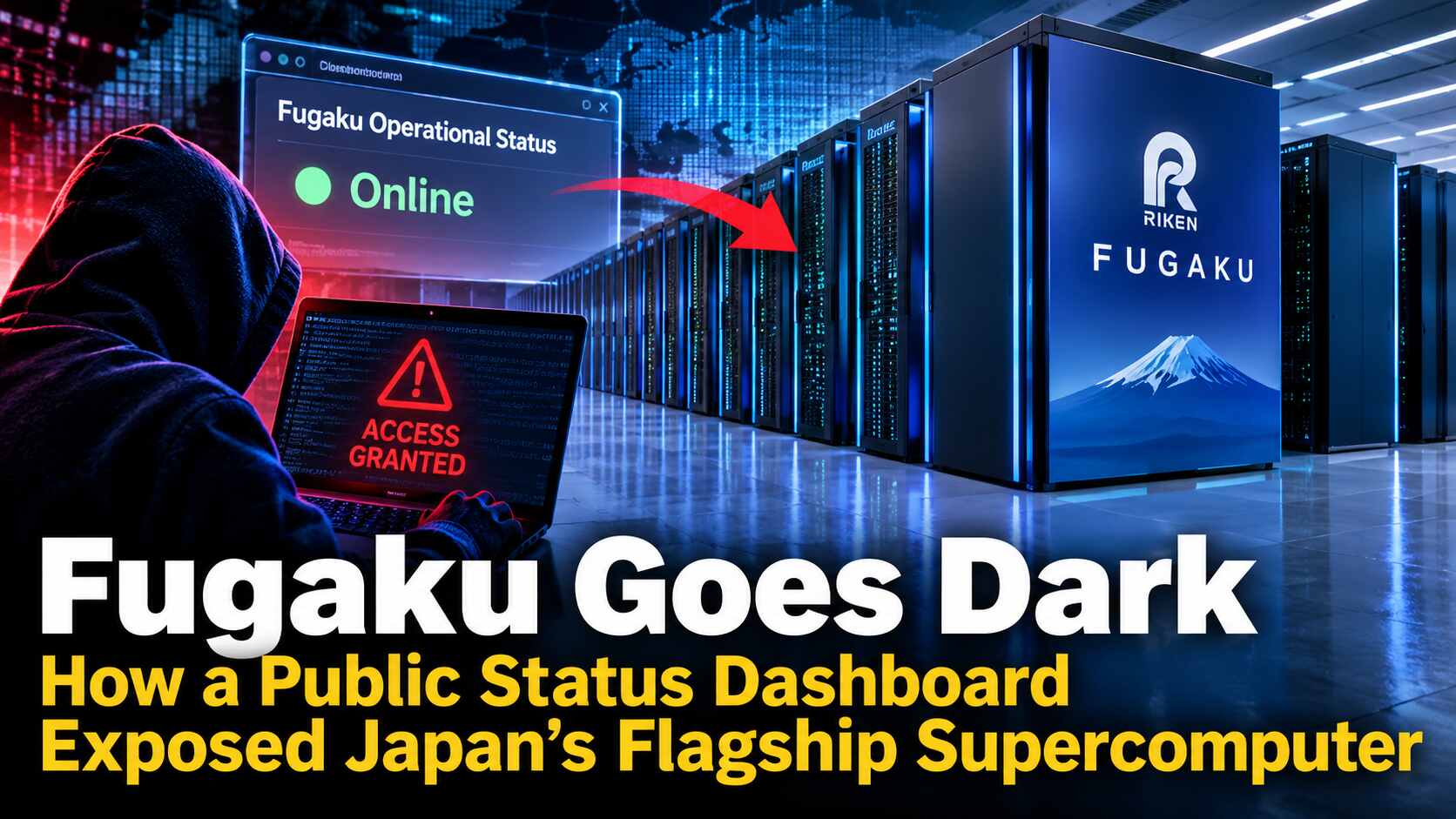
A breach of RIKEN’s operational network has forced the shutdown of one of the world’s most powerful scientific computers, potentially exposing the credentials of 4,597 researchers and raising uncomfortable questions about the security architecture protecting national supercomputing infrastructure.
The recent cybersecurity breach involving Japan's flagship supercomputer, Fugaku, has forced a complete shutdown, highlighting critical vulnerabilities in the security architecture of high-performance computing infrastructure. Between November 10 and November 13, 2026, unauthorized actors exploited a publicly accessible status dashboard to gain entry into RIKEN’s internal operational network.
According to the RIKEN Center for Computational Science (R-CCS), this intrusion led to the compromise of multiple internal servers and the potential exposure of sensitive data belonging to 4,597 researchers, including user identification, research files, and SSH private keys. Given that these credentials may facilitate unauthorized access to external systems, the implications extend far beyond the immediate facility. RIKEN has suspended all Fugaku operations indefinitely while the investigation continues. This incident serves as a significant concern for the global scientific community, prompting urgent questions regarding the security protocols and network segmentation currently employed to protect essential national computing assets.
A public dashboard became an internal security problem
The most disturbing element of the incident is the reported entry point.
RIKEN says the attacker used a publicly accessible webpage displaying Fugaku’s operational status to gain access to the internal operational network. The exact vulnerability and technical method used to cross that boundary have not yet been disclosed.
That distinction matters.
A public status dashboard is not inherently a security weakness. Supercomputing facilities routinely provide operational information to researchers and administrators through web interfaces. The security problem arises when a publicly accessible service has a pathway into systems that should remain isolated from external access.
A properly segmented HPC environment should prevent a compromise of a public-facing service from automatically becoming a compromise of the underlying operational infrastructure.
That means separating public information services from management interfaces, administrative systems, authentication infrastructure, and the networks responsible for controlling the computing environment. Access between those zones should be restricted, monitored, and independently authenticated.
RIKEN’s disclosure suggests that the security boundary protecting Fugaku’s operational network did not prevent an attacker from progressing beyond the public-facing dashboard.
The investigation has not established whether the failure involved an unpatched software vulnerability, inadequate network segmentation, compromised administrative credentials, or another weakness. It would be premature to assign a specific technical cause.
However, the fundamental question is unavoidable: why could an internet-accessible status service provide a foothold into the internal operational network of a national supercomputing facility?
That question deserves a detailed public answer.
The credential exposure could reach far beyond Japan
The potential exposure of SSH private keys and other authentication credentials may be the most consequential part of the breach.
Researchers working on national supercomputers frequently interact with multiple computing environments. Their workflows can involve university clusters, national laboratories, research institutions, external storage systems, cloud resources, and international collaborations.
SSH, or Secure Shell, provides encrypted access to remote computing systems. Key-based authentication allows a researcher to access a remote machine using a cryptographic key pair rather than relying exclusively on passwords.
The public key is registered with the destination service, while the corresponding private key remains with the authorized user.
If an attacker obtains a usable copy of that private key, the attacker may be able to impersonate the researcher on other systems where the matching public key remains authorized.
This is why the Fugaku incident is potentially more serious than a conventional compromise of a single computing facility.
A credential stored on one supercomputer may provide access to another institution’s infrastructure. The connection does not require those institutions to share a network or operate the same hardware. It requires only that the compromised credential remains trusted elsewhere.
RIKEN has confirmed that some of the credentials obtained during the intrusion were used in attempts to connect to other systems. The institute is investigating whether those attempts caused secondary damage.
The potential reach of this exposure is therefore still unknown.
RIKEN has instructed affected users to revoke the corresponding public keys at external services, generate replacement key pairs, and invalidate other credentials stored on Fugaku through the services that issued them.
That response is essential. Disabling Fugaku’s own login credentials does not automatically invalidate private keys or access tokens that other institutions continue to recognize.
For HPC administrators elsewhere, the incident is a reminder that credential management must extend beyond the boundaries of an individual supercomputer.
A national scientific asset is now offline
Fugaku is not a legacy installation or an aging research cluster approaching retirement.
Located at RIKEN’s Center for Computational Science in Kobe, the system was developed by RIKEN and Fujitsu as the successor to Japan’s K computer. It entered shared public operation in March 2021 and became one of the defining supercomputing platforms of its generation.
In the November 2026 TOP500 rankings, Fugaku occupies ninth place, delivering approximately 442 petaflops on the High Performance LINPACK benchmark.
The system contains approximately 7.63 million processing cores built around Fujitsu’s Arm-based A64FX processors and its Tofu interconnect architecture.
Its scientific importance extends beyond conventional peak-performance rankings. Fugaku also holds third place on the HPCG benchmark, which is designed to provide a different perspective on performance for workloads more representative of practical scientific computing.
That distinction matters because scientific applications do not operate exclusively on the dense mathematical calculations measured by LINPACK.
Memory access, communication between processors, synchronization, and data movement can significantly influence real-world application performance. HPCG attempts to capture some of those characteristics.
Fugaku has supported research involving climate modeling, disaster simulation, materials science, computational chemistry, drug discovery, and other computationally demanding disciplines.
Its shutdown therefore represents more than an interruption to an institutional IT service. It removes a major national research resource from active use.
Every running and queued job was halted on November 15. Researchers must now wait for RIKEN to complete its investigation, rebuild compromised systems, and establish that the operational environment can safely return to service.
RIKYU adds another dimension to the incident
The breach also touches RIKEN’s newer RIKYU supercomputer, although an important distinction must be maintained.
RIKYU is an AI-for-Science computing platform developed to support research combining artificial intelligence and high-performance computing.
Its architecture includes 400 nodes equipped with NVIDIA GB200 NVL4 systems, representing 1,600 Blackwell GPUs. The platform delivers approximately 64.16 petaflops of FP64 performance and 15.539 exaflops of FP8 performance.
RIKYU entered production operation in October 2026.
RIKEN’s disclosure identifies RIKYU users among those potentially affected because their information was registered in the authentication system involved in the incident.
However, the reported intrusion was into Fugaku’s operational network. RIKEN has not reported a separate intrusion into RIKYU’s computing infrastructure.
That distinction is important. Exposure of user records does not establish that RIKYU’s GPU infrastructure or computing workloads were independently compromised.
Nevertheless, the incident raises questions about shared authentication services and the security boundaries between multiple national computing platforms.
As research institutions increasingly operate traditional HPC systems alongside GPU-intensive AI infrastructure, identity management becomes an increasingly important component of the overall security architecture.
A weakness in a shared authentication environment can have consequences across multiple platforms, even when their computing hardware and operational networks remain separate.
The response raises questions about operational oversight
RIKEN detected suspicious network traffic on November 12 and confirmed unauthorized access on November 13 at 4:33 p.m.
The institute isolated the compromised system that evening and suspended Fugaku operations at 4:30 a.m. on November 14.
However, the timeline also raises questions about incident notification and operational decision-making.
RIKEN did not email affected users or halt all running and queued jobs until November 15 at 4:18 p.m., approximately 48 hours after confirming the unauthorized access.
The institute has not fully explained the reasoning behind that interval.
There may have been technical considerations involved in containing the intrusion without destroying forensic evidence or disrupting the investigation. Those considerations deserve recognition.
But researchers whose credentials may have been exposed needed timely information to protect their external accounts and research environments.
The institute also disclosed that the affected operational system was maintained and managed by an external service provider.
RIKEN has indicated that it will review the division of responsibilities between its personnel and the outside provider to improve emergency response.
That review should examine more than contractual responsibilities.
It should establish who was responsible for securing the public-facing dashboard, monitoring its connections to internal systems, applying software updates, reviewing access permissions, and responding to suspicious activity.
Outsourcing maintenance does not outsource institutional accountability for the security of national research infrastructure.
The identity of the service provider and the precise scope of its responsibilities have not been disclosed.
The 2020 attacks on academic supercomputers offer a warning
The Fugaku breach also recalls the coordinated attacks against academic supercomputing environments in May 2020.
That campaign affected more than a dozen research computing systems across Europe, including the UK’s ARCHER service, clusters operated by German universities and research institutions, and systems at the Swiss National Supercomputing Centre.
In those incidents, attackers used stolen SSH credentials to gain access to computing environments, exploited vulnerabilities to escalate privileges, and installed cryptocurrency-mining software and other malicious tools.
The ARCHER system was taken offline while administrators reset credentials and rebuilt the affected environment.
The similarities are significant, particularly the role of credentials in enabling access beyond an initial point of compromise.
However, the available evidence does not establish that the Fugaku intrusion involved the same attackers, motivations, or techniques.
RIKEN has not identified an attacker, disclosed a motive, or reported a ransomware demand.
The lesson is not that every HPC intrusion follows the same playbook. It is that research computing environments remain attractive targets because they combine valuable intellectual property, extensive computing resources, trusted institutional identities and connections to other research infrastructure.
The modern supercomputer is not simply a collection of processors. It is an interconnected ecosystem of software, storage, management services, authentication systems and external dependencies.
Every one of those components belongs in the security model.
Rebuilding Fugaku will require more than patching a dashboard
RIKEN says Fugaku will return to operation only after addressing vulnerabilities in the exploited software, rebuilding compromised servers, reviewing network configurations and implementing additional security measures, including measures utilizing artificial intelligence.
The institute has not provided a timetable.
That is understandable given the complexity of the investigation, but the recovery process should be measured by the integrity of the rebuilt environment rather than the speed with which the machine returns to production.
Rebuilding compromised servers is only one part of the challenge. Administrators must establish which systems were accessed, determine whether persistence mechanisms remain, validate administrative credentials, review network access controls, and ensure that compromised authentication material cannot be reused.
The institution also needs to demonstrate that its public-facing services are properly isolated from critical operational infrastructure.
RIKEN’s reference to AI-assisted security measures is noteworthy, particularly as AI becomes increasingly integrated into scientific computing operations.
Machine-learning-based monitoring may help identify unusual network activity, suspicious access patterns, and deviations from established system behavior. However, AI security tools cannot compensate for inadequate network segmentation, excessive privileges or poorly managed credentials.
The fundamentals of secure infrastructure remain essential.
For a machine of Fugaku’s scale, restoring confidence in the operational environment may be considerably more important than restoring computing capacity quickly.
The larger warning for the global HPC community
The Fugaku breach highlights the urgent need for HPC operators to audit security architectures, strictly isolate public-facing dashboards from internal networks, and harden credential management.
Organizations must implement robust segmentation, enforce stringent controls on shared authentication, and clearly define security responsibilities with third-party vendors to protect national research infrastructure against evolving threats.