

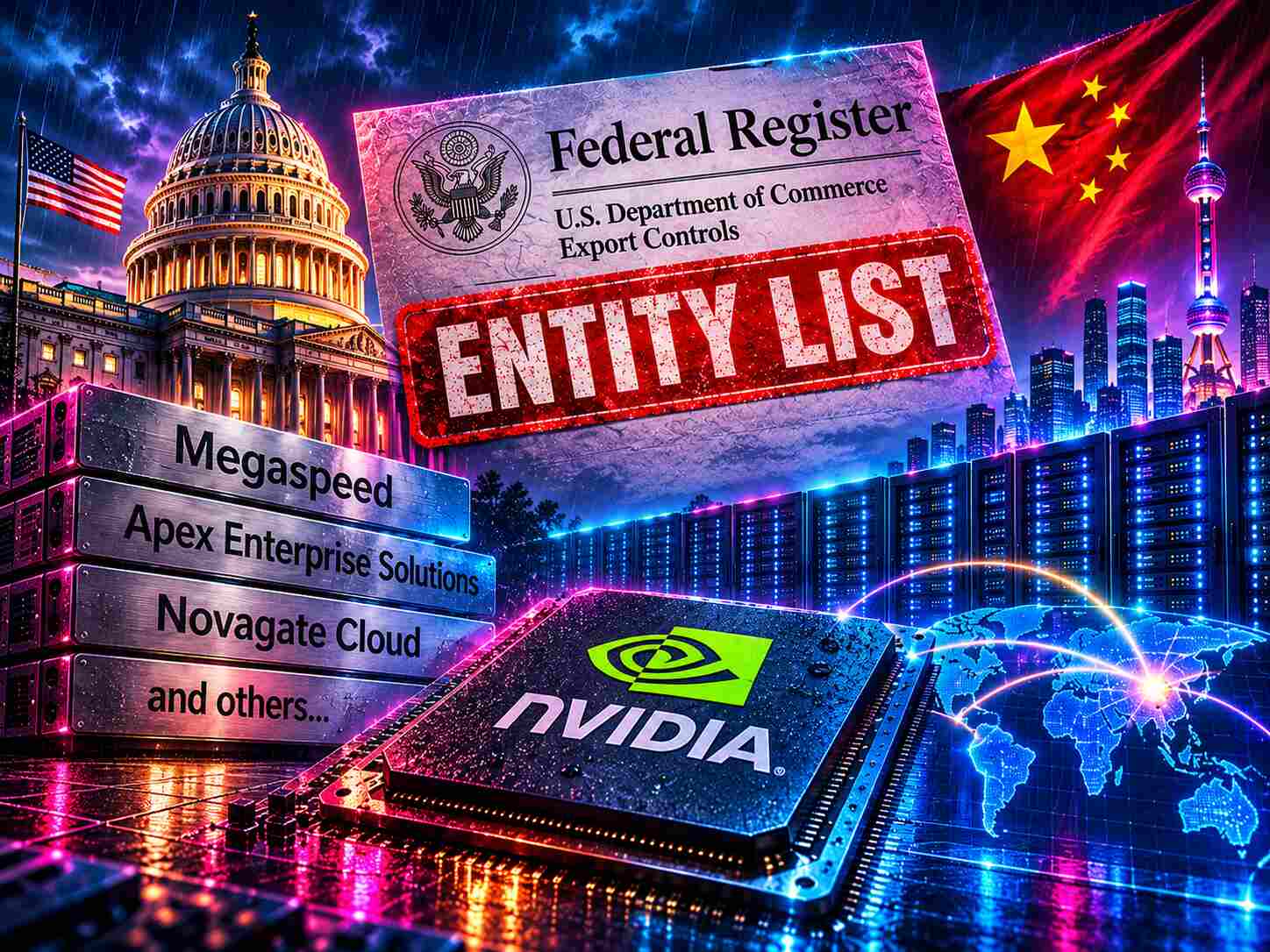
Commerce Department's action against seven entities exposes a growing challenge for U.S. export controls: Regulating advanced AI computing hardware, overseas data centers and the financial networks connecting them.
The U.S. government’s decision to place Megaspeed International and its six affiliates on the Commerce Department’s Entity List signifies a major effort to curb the proliferation of advanced computing technology. However, this action has prompted significant debate within the global semiconductor industry regarding the efficacy of these measures in preventing the flow of Nvidia AI accelerators through international supply chains.
The November 23 mandate, which targets entities across Singapore, Malaysia, and Thailand, follows an extensive investigation into the diversion of restricted hardware to Chinese customers. While this represents a clear escalation in Washington's export control strategy, the specific regulatory framework has sparked contention between officials and industry experts. Central to this debate is the application of provisions governing foreign-produced technology, specifically whether the current listing sufficiently restricts Nvidia processors manufactured outside the United States.
For the supercomputing industry, these developments highlight a broader shift in the landscape of export controls. As the industry evolves, managing advanced AI hardware has moved beyond monitoring physical shipments to encompass the complex infrastructure, financing, and corporate networks that enable access to high-performance computing capacity.
Seven entities added to the Entity List
The Commerce Department's action covers seven organizations with connections spanning Singapore, Malaysia and Thailand. The entities include Megaspeed International, Swiftdata, Apex Enterprise Solutions, MSFusion, PT Megaspeed International, Speedmatrix and Megaspeed (Thailand).
Under the new restrictions, exports, reexports and transfers of items subject to the U.S. Export Administration Regulations generally require a license, with applications subject to a presumption of denial.
The restrictions cover applicable U.S.-origin goods, software and technology. The rule also provides a 30-day savings provision for qualifying shipments already in transit when the restrictions took effect.
The Commerce Department cited a significant risk that the listed organizations could become involved in the diversion of advanced computing commodities.
That distinction matters. The Entity List designation is a risk-based regulatory action, not a judicial determination that the companies committed export-control violations or successfully diverted specific Nvidia processors.
The action follows an investigation that began in late 2024. Nvidia reportedly placed Megaspeed on its internal no-sale list in June 2025 after U.S. authorities requested sales information and conducted an end-use check in Singapore.
The subsequent investigation has drawn attention to the increasingly complicated international business arrangements supporting large-scale AI computing operations.
The Nvidia problem: A dispute over foreign-produced chips
The most consequential question surrounding the listing concerns the foreign direct product rule, or FDPR.
The provision is designed to extend certain U.S. export restrictions to products manufactured outside the United States when those products are produced using specified American technology, software, or manufacturing equipment.
It is particularly important to the semiconductor industry because Nvidia's advanced processors are manufactured in Taiwan by TSMC rather than fabricated in the United States.
Former National Security Council official Chris McGuire, now a senior fellow at the Council on Foreign Relations, argues that the Megaspeed listing omitted an entity-specific FDPR provision that would normally help extend restrictions to foreign-manufactured AI processors.
McGuire criticized the omission, arguing that the listing, by itself, does not prohibit shipments of Taiwan-manufactured Nvidia chips to the designated entities.
He described the action as having potentially "zero effect" on the availability of those processors.
The Commerce Department rejected that interpretation.
Bureau of Industry and Security spokesperson Thomas Wackman said it is unlawful to export advanced superintelligence chips to Megaspeed even when the processors are manufactured outside the United States. Commerce officials maintain that existing advanced-computing export regulations already provide the necessary extraterritorial authority.
The disagreement is significant because the two interpretations concern different aspects of the export-control framework.
The absence of an entity-specific FDPR footnote does not automatically eliminate other applicable restrictions. Separate advanced-computing rules may still impose licensing requirements depending on the product, destination, and end use.
Consequently, the central question is not whether U.S. export controls can ever reach foreign-produced processors. It is whether this particular Entity List action independently accomplishes what Commerce says it does.
Until the department provides additional clarification, the practical reach of the listing remains an important regulatory question.
Alibaba's $4.2 billion connection raises the stakes
One of the most consequential developments is the inclusion of Apex Enterprise Solutions, a Singapore-based subsidiary of Alibaba Group.
According to reporting cited in the vetting investigation, Apex made approximately $4.2 billion in prepayments for computing capacity in Southeast Asia through arrangements involving Megaspeed and other companies.
The arrangement illustrates how the economics of AI infrastructure can complicate traditional export-control enforcement.
Large-scale computing operations require more than processors. They depend on data-center construction, electrical infrastructure, cooling systems, networking equipment, financing, and long-term agreements for access to computing capacity.
A company purchasing computing services does not necessarily own the underlying processors or operate the facilities where they are installed. Financial relationships can therefore create connections between technology providers, infrastructure operators and customers that are difficult to evaluate through conventional hardware-export controls.
The $4.2 billion figure must be interpreted carefully. It represents reported prepayments for rented computing capacity across several companies, not a confirmed $4.2 billion purchase of Nvidia processors or proof that the entire amount reached Megaspeed.
Alibaba has strongly objected to the designation.
The company called the inclusion of Apex erroneous, stating that the subsidiary had never diverted advanced computing chips subject to U.S. export restrictions. Alibaba said it would pursue all available legal avenues to protect its rights and reputation.
The dispute introduces another important dimension to the case: how far U.S. authorities can extend export-control restrictions through financial and commercial relationships when direct evidence of prohibited hardware transfers has not been established.
The successor-company challenge
Perhaps the most troubling issue for export-control enforcement is the possibility that restricting one corporate network may not eliminate the underlying computing operation.
The vetting investigation identifies Novagate Cloud as a newer venture established in 2025 and reportedly associated with individuals previously connected to Megaspeed.
Novagate describes itself as an Nvidia cloud partner and reportedly operates data centers equipped with Blackwell processors.
A Wall Street Journal investigation, as summarized in the available reporting, identified at least $300 million in Nvidia-containing hardware received by a Novagate entity in Malaysia between January and May 2026.
The same reporting described nearly $12 billion in Nvidia chip orders arranged by Megaspeed for Chinese companies between March 2024 and June 2025. Those figures concern orders arranged, not confirmed deliveries.
Novagate is not among the seven entities named in the latest Commerce Department action.
That distinction raises a difficult enforcement question. If an organization is restricted but associated infrastructure operators, financing relationships, or successor businesses remain outside the designation, how effectively can authorities prevent computing capacity from moving through the broader network?
There is no evidence that Novagate has violated export controls. However, it demonstrates why corporate identity and ownership structures deserve as much attention as individual hardware shipments.
Singapore and Malaysia move from investigation to enforcement
The consequences of Washington's decision are now extending across Southeast Asia, where the countries hosting important parts of the regional AI infrastructure ecosystem are being forced to address the practical implications of U.S. export restrictions.
On November 24, Singapore Prime Minister Lawrence Wong confirmed that his government is working with Washington to establish an information-sharing and enforcement mechanism addressing semiconductor exports. Singapore wants to prevent its position as a major international trading hub from being exploited as a route for circumventing American export controls.
Wong acknowledged that Singapore still needs additional information from U.S. authorities to establish the ultimate destinations of chips purchased by Megaspeed and verify relevant transaction documents. Singapore is continuing its own investigation into possible violations of domestic law.
The distinction between American and Singaporean enforcement authority is important. Singapore does not enforce U.S. export restrictions, but it can investigate whether companies operating through its jurisdiction have violated local laws.
Malaysia is taking a more direct approach to the data-center infrastructure involved. Its Ministry of Investment, Trade and Industry announced that the country's investment agency would notify data-center operators not to host, lease space to, or provide services to the seven entities named in the U.S. designation.
Malaysia also clarified that PT Megaspeed International does not appear in its records as a Malaysian entity, data-center operator or data-center tenant, despite its inclusion in the American listing.
Meanwhile, Alibaba has formally rejected the designation of its Singapore subsidiary, Apex Enterprise Solutions, calling the decision erroneous and denying any diversion of restricted advanced computing chips. The company says it will pursue all available legal avenues.
These developments demonstrate that the Megaspeed case is becoming an international enforcement challenge rather than simply an American trade restriction.
The practical effectiveness of the designation will depend on whether governments, data-center operators, cloud providers and semiconductor suppliers can coordinate restrictions across the entire computing infrastructure chain.
The larger problem: Controlling access to AI computing
The Megaspeed case highlights a structural challenge confronting the United States as AI computing becomes an increasingly important strategic resource.
Advanced accelerators are only one component of the modern AI infrastructure stack. Their value is realized through interconnected systems of high-speed networking, memory, storage, power delivery, liquid cooling, and large-scale data-center operations.
A processor can be manufactured in Taiwan, installed in a Malaysian data center, financed through a Singapore-based commercial arrangement and accessed remotely by customers operating elsewhere.
That model complicates the traditional concept of controlling technology through physical export restrictions.
For HPC engineers and infrastructure operators, the distinction between owning hardware and accessing computing capacity is becoming increasingly important. A customer does not necessarily need to import or possess a restricted accelerator to benefit from the computational resources it provides.
Cloud-based AI infrastructure makes that distinction particularly consequential. Access to clusters of advanced accelerators can provide enormous computational capability without transferring ownership of the underlying equipment.
This creates a difficult regulatory problem: controlling the physical movement of processors is not necessarily equivalent to controlling who can use them.
The United States has already begun expanding its attention beyond conventional hardware shipments, including restrictions addressing remote access to advanced semiconductor computing resources. The Megaspeed controversy demonstrates why those policies will need to operate consistently across international supply chains and cloud infrastructure arrangements.
What happens next?
Several developments will determine whether the latest action becomes an effective enforcement measure or primarily a symbolic designation.
First, Commerce may need to clarify its interpretation of the foreign-produced product restrictions and explain precisely how the existing advanced-computing rules apply to Taiwan-manufactured Nvidia processors destined for the listed organizations.
Second, Alibaba's threatened legal challenge could test how far the government can extend Entity List designations to commercial and financing relationships.
Third, authorities will need to determine whether Novagate Cloud or other related organizations warrant additional scrutiny.
Finally, the broader question of remote access to advanced AI computing capacity will remain central to U.S. technology policy.
For Nvidia, the case adds another layer of regulatory uncertainty to an already complicated international business environment. For data-center operators and cloud providers, it reinforces the importance of understanding not only where computing hardware is installed but also who ultimately receives access to its capabilities.
The next significant test may not involve a container of processors crossing a border. It could involve a customer accessing a powerful AI cluster thousands of miles away through a commercial cloud agreement.
The bottom line
Adding Megaspeed and its affiliates to the Entity List highlights the difficulties of regulating international AI infrastructure. The debate over foreign-produced Nvidia chips, Alibaba's financial ties, and potential successor ventures exposes major challenges in modern export control enforcement.
The United States can restrict the sale of advanced computing hardware. Preventing access to the computing power that hardware delivers is a considerably more complicated challenge.
For the supercomputing industry, that may become one of the defining technology-policy battles of the AI era.