“Our goal is to increase patient safety, reduce errors and improve the quality of care by using simulation models and simulated clinical settings – which offer a more cost-effective, hands-on, yet non-invasive alternative to Halstedian techniques – to train a wide array of health care professionals,” commented Pamela Boyers, Ph.D., Senior Advisor to the Chancellor for the Advancement of Interprofessional Education and Executive Director of the Center. “Barco's I-Space and CADWalls are essential to creating a highly effective teaching model. The realism and versatility they bring to the medical education experience is absolutely phenomenal.”
The UT-IISC will ultimately deliver a unique and comprehensive range of simulation experiences under one roof according to a “Tri-Center” concept. The integrated centers will include a progressive anatomy and surgical skills center; an advanced clinical simulation center; and a virtual immersive reality center, encompassing a broad spectrum of sophisticated clinical simulation and 3D technologies. The purpose is to provide a virtual, interactive environment to depict real-life medical scenarios, conditions and procedures – from disaster medical readiness to childbearing – for advanced learning, teaching, skill development and clinical practice. The Center is currently in the prototype phase located in a temporary pilot facility, which is already accommodating more than 800 learners a month. A new $36 million, 60,000 square foot Tri-Center – funded in partnership with ProMedica Health System – is under development.
“We are embarking on a revolutionary new model for the education of medical professionals, one that takes not only an interdisciplinary, but also an interprofessional, approach to health care delivery,” commented Jeffrey P. Gold, M.D., Chancellor and Executive Vice President for Biosciences and Health Affairs, Dean of the College of Medicine. “Barco's virtual reality solutions will help us in developing improved techniques that not only improve patient outcomes in terms of shorter hospital stays, reduced complications, and enhanced treatment protocols, but also make healthcare more patient-centric on a daily basis.”
Barco's I-Space is a multi-sided, cubic immersive environment that completely surrounds a user with virtual imagery, creating a complete sense of presence in the virtual environment with the use of rear-projection technology and flawless image continuity. Barco created the world's first active/passive six-sided I-Space, utilizing 12 state-of-the-art projectors equipped with motorized polarizing systems. The system enables users to switch from active to passive stereo at the touch of a button.
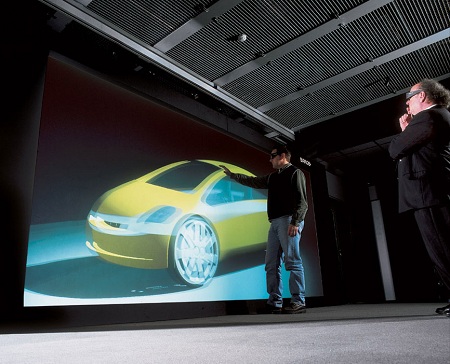
The CADWall is a multi-channel, ultra high-resolution 3D stereoscopic display wall featuring multiple edge-blended projection systems. From projectors to screens, it is a fully integrated Barco solution, ensuring maximum synergy between components. The brightness, high resolution and color depth of the display portray highly realistic imagery, ideal for interactive, larger-than-life depictions. Multiple sources can be visualized simultaneously in any combination of mono and 3D stereo with uncompromised image quality, regardless of source type. All local and networked image sources can be controlled with mouse and keyboard. The end result is a collaborative visual workspace that enables researchers to work with each other in real-time, both locally and remotely from other locations.
“We applaud the University of Toledo's vision and commitment to cutting-edge medical education, and are honored that they've chosen to invest in Barco's simulation solutions to further their mission,” commented Hans Dekeyser, VP Sales Control Rooms and Simulation for Barco North America. “Based on our mutual spirit of innovation, we look forward to a long partnership based on supporting the University's pursuit of quality medical education focused on enhancing healthcare outcomes.”