How to track sharks using machine learning

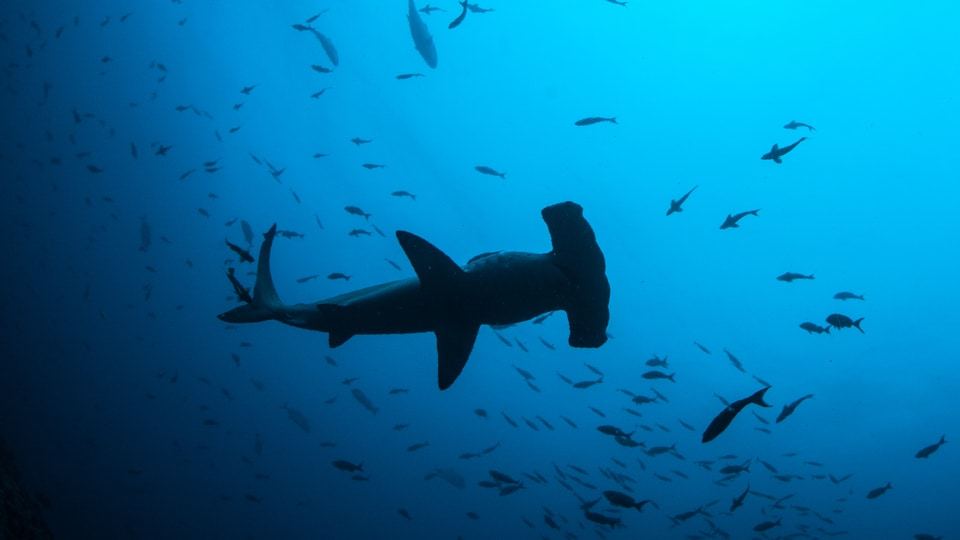
New research led by UMass Amherst reveals where, why, and how sharks and game fish overlap; information can help anglers land a trophy fish Webp.net resizeimage 2022 04 05T213356.067 d0b8d

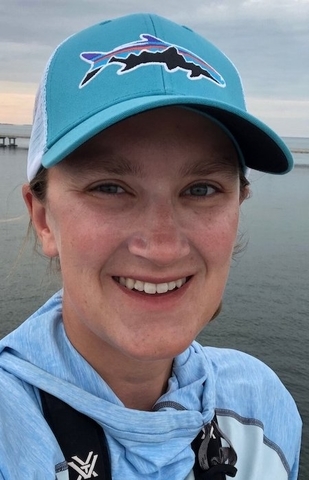
An international team of researchers, led by the University of Massachusetts Amherst, has compiled a massive dataset that overlays years’ worth of information on the position, migration, and interaction of sharks and game fish. This research has immediate relevance for anglers, who have been reporting increased contact with sharks over the years. The research, recently published in Ecological Applications and which relies on innovative use of acoustic telemetry and machine learning, gives us the clearest window yet into complex ecological relationships and promises to be a useful tool in ongoing conservation efforts.UMass Amherst  postdoctoral researcher Lucas Griffin

“It’s so rare to observe multi-species interaction in the ocean,” says Lucas Griffin, the paper’s co-lead author and a postdoctoral researcher in environmental conservation at UMass Amherst. That’s because species such as the ones the researchers focused on – great hammerhead and bull sharks, permit and Atlantic tarpon – can range over hundreds of square miles of open ocean. There has long been anecdotal evidence from the game-fishing community that instances of depredation – when a shark eats a fish that has been hooked – are on the rise, but to date, there’s been no hard data to support whether or not such encounters are indeed increasing and, if so, why. 

For this study, the researchers focused on the coastal regions of the Florida Keys. Over three years, the collaborative team deployed nearly 300 acoustic receivers and tagged 257 fish (including 73 sharks) with transmitters. Every time one of the tagged sharks or fish swam within range of the receiver, its presence was recorded and tagged with the date and time. This approach, called acoustic telemetry, gave the team unprecedented access to the migratory, reproductive, and feeding patterns of sharks and gamefish. The team then ran their raw data through a cutting-edge machine-learning algorithm to model the incredibly complex interplay of environmental factors, such as time of year, lunar cycle, and water depth and temperature.

“Combining acoustic telemetry and machine learning helped us to answer a host of questions about predators and prey,” says Grace Casselberry, the paper’s other co-lead author and a graduate student in the program in marine sciences and technology at UMass Amherst’s Department of Environmental Conservation. It turns out that tarpon and permit are returning to the same spawning grounds, at the same times of the year, every year. Sharks know this: “they seem to remember where and when the tarpon and permit aggregate,” says Casselberry. So do anglers who, through years of word-of-mouth reporting on when the fish are biting where wind up trying to hook the same fish that sharks feed on. Knowing this, fisheries managers can tailor their management strategies to best protect the interests of sharks, game fish, and anglers.

Finally, the team’s research is innovative not just for its methods, but for its cooperation. A wide range of institutions shared data from tagged fish, including research institutions, like the University of Miami and the Bimini Biological Field Station in The Bahamas, to state agencies, like the Florida Fish and Wildlife Conservation Commission, and the nonprofit environmental groups, Bonefish & Tarpon Trust. “We also worked extensively with the local fishing-guide community to help tag game fish and sharks, and figure out where to place the receivers,” says Griffin. “Our lab very much embraces a collaborative and cooperative spirit,” says Andy Danylchuk, professor of fish conservation at UMass Amherst and one of the paper’s senior authors. “We are grateful for our research partners and hope our science will help to hone conservation and management strategies for both game fish and sharks.” UMass Amherst graduate student Grace Casselberry

UR Medicine suggests the brain processes smell both like a painting, a symphony

What happens when we smell a rose? How does our brain process the essence of its fragrance? Is it like a painting – a snapshot of the flickering activity of cells – captured in a moment in time? Or like a symphony, an evolving ensemble of different cells working together to capture the scent? New research suggests that our brain does both. 

“These findings reveal a core principle of the nervous system, flexibility in the kinds of calculations the brain makes to represent aspects of the sensory world,” said Krishnan Padmanabhan, Ph.D., an associate professor of Neuroscience and senior author of the study recently published in Cell Reports. “Our work provides scientists with new tools to quantify and interpret the patterns of activity of the brain.” Krishnan Padmanabhan, Ph.D.

Researchers developed a model to simulate the workings of the early olfactory system – the network the brain relies on for smelling. Employing supercomputer simulations, they found a specific set of connections, called centrifugal fibers, which carry impulses from other parts of the central nervous system to the early sensory regions of the brain, played a critical role. These centrifugal fibers act as a switch, toggling between different strategies to efficiently represent smells. When the centrifugal fibers were in one state, the cells in the piriform cortex – where the perception of an odor forms – relied on the pattern of activity within a given instant in time. When the centrifugal fibers were in the other state, the cells in the piriform cortex improved both the accuracy and the speed with which cells detected and classified the smell by relying on the patterns of brain activity across time.

These processes suggest the brain has multiple responses to representing a smell. In one strategy, the brain uses a snapshot, like a painting or a photograph, at a given moment to capture the essential features of the odor. In the other strategy, the brain keeps track of the evolving patterns. It is attuned to which cells turn on and off and when – like a symphony.

The mathematical models the researchers developed highlight the critical feature of the nervous system – not only diversity in terms of the components that make up the brain but also how these components work together to help the brain experience the world of smell. “These mathematical models reveal critical aspects of how the olfactory system in the brain might work and could help build brain-inspired artificial computing systems,” Padmanabhan said. “Computational approaches inspired by the circuits of the brain such as this have the potential to improve the safety of self-driving cars, or help computer vision algorithms more accurately identify and classify objects in an image.”

All antennas at the VLA ready to stream massive data for technosignature research at COSMIC

Once the digital backend comes online, SETI observations will be possible 24/7 at the VLA

COSMIC SETI (the Commensal Open-Source Multimode Interferometer Cluster Search for Extraterrestrial Intelligence) took a big step toward using the National Science Foundation’s Karl G. Jansky Very Large Array (VLA) for 24/7 SETI observations. Fiber optic amplifiers and splitters are now installed for all 27 VLA antennas, giving COSMIC access to a complete and independent copy of the data streams from the entire VLA. In addition, the COSMIC system has used these links to successfully acquire VLA data, and the primary focus now is on developing the high-performance GPU (Graphical Processing Unit) code for analyzing data for the possible presence of technosignatures. SETI Institute Post-Doctoral Researchers, Dr Savin Varghese and Dr Chenoa Tremblay, in front of one of the 82-foot diameter dishes that makes up the Very Large Array.

COSMIC is a collaboration between the SETI Institute and the National Radio Astronomy Observatory (NRAO), which operates the VLA, to bring a state-of-the-art search for extraterrestrial intelligence to the VLA for the first time. As the VLA conducts observations, COSMIC will enable SETI Institute scientists to access that data to analyze for evidence of technosignatures, signs of technology not caused by natural phenomena.

“Having all the VLA digital signals available to the COSMIC system is a major milestone, involving close collaboration with the NRAO VLA engineering team to ensure that the addition of the COSMIC hardware doesn’t in any way adversely affect existing VLA infrastructure,” said Jack Hickish, Digital Instrumentation Lead for COSMIC at the SETI Institute. “It is fantastic to have overcome the challenges of prototyping, testing, procurement, and installation – all conducted during both a global pandemic and semiconductor shortage – and we are excited to be able to move on to the next task of processing the many Tb/s of data to which we now have access.”

There are several advantages to conducting SETI research with the VLA:

  • The size of the VLA: Each of the VLA's 27 antennas is 25 meters in diameter, spread over 22 miles
  • The VLA has a combined collecting area equivalent to a single-dish antenna of 130 meters across
  • Each VLA antenna has 8 cryogenically cooled receivers covering the radio spectrum continuously from 1 to 50 GHz
  • Some receivers can operate below 1 GHz down to 54 MHz, a band used on Earth for television broadcasting

Once up and running, it is estimated that COSMIC SETI will observe about 40 million galactic star systems in two years. It will be the most comprehensive SETI observing program undertaken in the Northern Hemisphere, with high sensitivity and a huge target list.

“I am excited by the ability of COSMIC to conduct the most comprehensive technosignature search ever in the Northern Hemisphere,” said Cherry Ng, SETI Institute COSMIC Project Scientist. “We will be able to monitor millions of stars with a sensitivity high enough to detect an Arecibo-like transmitter out to a distance of 25 parsecs (81 light-years), covering an observing frequency range from 230 MHz to 50 GHz, which includes many parts of the spectrum that have not yet been explored for ETI signals.”

The system should be fully operational by early 2023 and will conduct its first major observational campaign in parallel with the ongoing VLA Sky Survey (VLASS).

“We look forward to partnering with the SETI Institute on this exciting initiative and are pleased to see this important milestone in the technical work that will make this new science possible,” said NRAO Director Tony Beasley.