

SUPERCOMPUTING NEWS SUPERCOMPUTING NEWS
    • MEDIA KIT
    • MOST READ
    • RSS FEED
    • ACADEMIA
    • AEROSPACE
    • APPLICATIONS
    • ASTRONOMY
    • AUTOMOTIVE
    • BIG DATA
    • BIOLOGY
    • CHEMISTRY
    • CLIENTS
    • CLOUD
    • DEFENSE
    • DEVELOPER TOOLS
    • EARTH SCIENCES
    • ECONOMICS
    • ENGINEERING
    • ENTERTAINMENT
    • GAMING
    • GOVERNMENT
    • HEALTH
    • OIL & GAS
    • INDUSTRY
    • INTERCONNECTS
    • MANUFACTURING
    • MIDDLEWARE
    • MOVIES
    • NETWORKS
    • PHYSICS
    • PROCESSORS
    • RETAIL
    • SCIENCE
    • STORAGE
    • SYSTEMS
    • VISUALIZATION
    • AcyMailing subscription form

    • ADD YOUR VIDEOS
    • MANAGE VIDEOS
    • CONVERSATION INBOX
    • SOCIAL ADVERTISER
    • SOCIAL NETWORK VIDEOS
    • SURVEYS
    • GROUPS
    • PAGES
    • MARKETPLACE LISTINGS
    • APPLICATIONS BROWSER
    • PRIVACY CONFIRM REQUEST
    • PRIVACY CREATE REQUEST
    • LEADERBOARD
    • POINTS LISTING
      • BADGES
    • TRADE SHOWS
Sign In
Tyler O'Neal, Staff Editor APPLICATIONS July 29, 2019, 6:55 pm

Japanese scientists start travelling towards a quantum internet at light speed

Specialists successfully transferred and verified the angular momentum basis of quantum information from laser light to an electron trapped on a quantum dot. This work is a major step towards realizing hacker-proof interconnected quantum supercomputers

A research team led by Osaka University demonstrated how information encoded in the circular polarization of a laser beam can be translated into the spin state of an electron in a quantum dot, each being a quantum bit and a quantum computer candidate. The achievement represents a major step towards a "quantum internet," in which future computers can rapidly and securely send and receive quantum information.

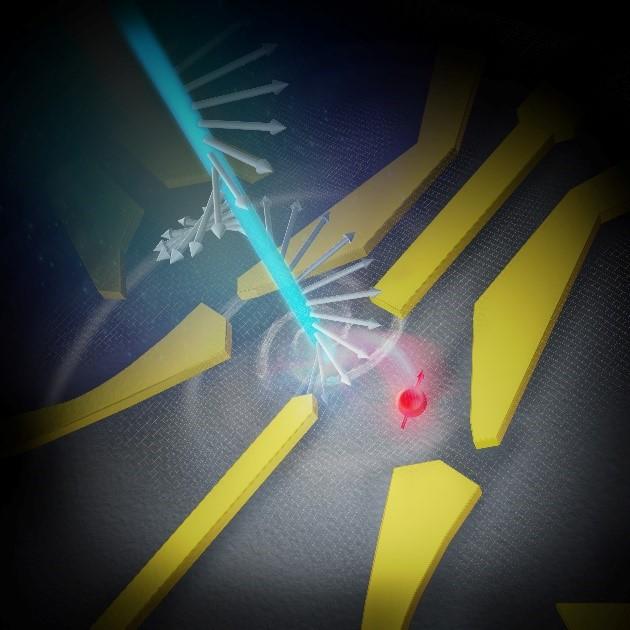
Quantum supercomputers have the potential to vastly outperform current systems because they work in a fundamentally different way. Instead of processing discrete ones and zeros, quantum information, whether stored in electron spins or transmitted by laser photons, can be in a superposition of multiple states simultaneously. Moreover, the states of two or more objects can become entangled, so that the status of one cannot be completely described without this other. Handling entangled states allow quantum supercomputers to evaluate many possibilities simultaneously, as well as transmit information from place to place immune from eavesdropping. This is a schematic image of the spin detection of a circularly polarized photon exciting an electron spin. The yellow nano-fabricated metal electrodes form the pockets required to trap the electrons, move them, and sense them.{module In-article}
However, these entangled states can be very fragile, lasting only microseconds before losing coherence. To realize the goal of a quantum internet, over which coherent light signals can relay quantum information, these signals must be able to interact with electron spins inside distant computers.

Researchers led by Osaka University used laser light to send quantum information to a quantum dot by altering the spin state of a single electron trapped there. While electrons don't spin in the usual sense, they do have angular momentum, which can be flipped when absorbing circularly polarized laser light.

"Importantly, this action allowed us to read the state of the electron after applying the laser light to confirm that it was in the correct spin state," says first author Takafumi Fujita. "Our readout method used the Pauli exclusion principle, which prohibits two electrons from occupying the exact same state. On the tiny quantum dot, there is only enough space for the electron to pass the so-called Pauli spin blockade if it has the correct spin."

Quantum information transfer has already been used for cryptographic purposes. "The transfer of superposition states or entangled states allows for completely secure quantum key distribution," senior author Akira Oiwa says. "This is because any attempt to intercept the signal automatically destroys the superposition, making it impossible to listen in without being detected."

The rapid optical manipulation of individual spins is a promising method for producing a quantum nano-scale general supercomputing platform. An exciting possibility is that future supercomputers may be able to leverage this method for many other applications, including optimization and chemical simulations.
Stanford physicists count sound particles with quantum microphone

Tyler O'Neal, Staff Editor APPLICATIONS July 26, 2019, 7:41 pm

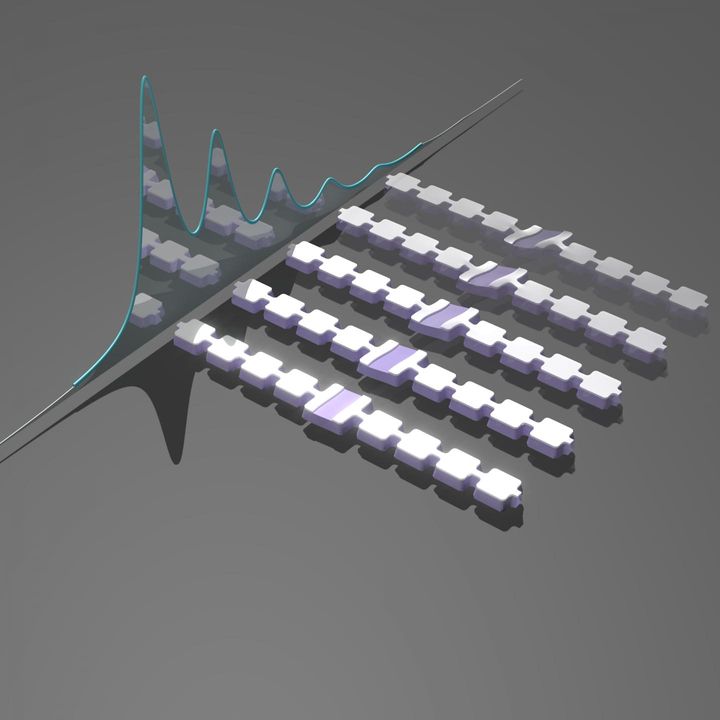
CAPTION Artist's impression of an array of nanomechanical resonators designed to generate and trap sound particles, or phonons. The mechanical motions of the trapped phonons are sensed by a qubit detector, which shifts its frequency depending on the number of phonons in a resonator. Different phonon numbers are visible as distinct peaks in the qubit spectrum, which are shown schematically behind the resonators. CREDIT Wentao Jiang

Stanford physicists have developed a "quantum microphone" so sensitive that it can measure individual particles of sound, called phonons.

The device, which is detailed July 24 in the journal Nature, could eventually lead to smaller, more efficient quantum supercomputers that operate by manipulating sound rather than light. {module In-article}

"We expect this device to allow new types of quantum sensors, transducers and storage devices for future quantum machines," said study leader Amir Safavi-Naeini, an assistant professor of applied physics at Stanford's School of Humanities and Sciences.

Quantum of motion

First proposed by Albert Einstein in 1907, phonons are packets of vibrational energy emitted by jittery atoms. These indivisible packets, or quanta, of motion manifest as sound or heat, depending on their frequencies.

Like photons, which are the quantum carriers of light, phonons are quantized, meaning their vibrational energies are restricted to discrete values - similar to how a staircase is composed of distinct steps.

"Sound has this granularity that we don't normally experience," Safavi-Naeini said. "Sound, at the quantum level, crackles."

The energy of a mechanical system can be represented as different "Fock" states - 0, 1, 2, and so on - based on the number of phonons it generates. For example, a "1 Fock state" consist of one phonon of a particular energy, a "2 Fock state" consists of two phonons with the same energy, and so on. Higher phonon states correspond to louder sounds.

Until now, scientists have been unable to measure phonon states in engineered structures directly because the energy differences between states - in the staircase analogy, the spacing between steps - is vanishingly small. "One phonon corresponds to an energy ten trillion trillion times smaller than the energy required to keep a lightbulb on for one second," said graduate student Patricio Arrangoiz-Arriola, a co-first author of the study.

To address this issue, the Stanford team engineered the world's most sensitive microphone - one that exploits quantum principles to eavesdrop on the whispers of atoms.

In an ordinary microphone, incoming sound waves jiggle an internal membrane, and this physical displacement is converted into a measurable voltage. This approach doesn't work for detecting individual phonons because, according to the Heisenberg uncertainty principle, a quantum object's position can't be precisely known without changing it.

"If you tried to measure the number of phonons with a regular microphone, the act of measurement injects energy into the system that masks the very energy that you're trying to measure," Safavi-Naeini said.

Instead, the physicists devised a way to measure Fock states - and thus, the number of phonons - in sound waves directly. "Quantum mechanics tells us that position and momentum can't be known precisely - but it says no such thing about energy," Safavi-Naeini said. "Energy can be known with infinite precision."

Singing qubits

The quantum microphone the group developed consists of a series of supercooled nanomechanical resonators, so small that they are visible only through an electron microscope. The resonators are coupled to a superconducting circuit that contains electron pairs that move around without resistance. The circuit forms a quantum bit, or qubit, that can exist in two states at once and has a natural frequency, which can be read electronically. When the mechanical resonators vibrate like a drumhead, they generate phonons in different states.

"The resonators are formed from periodic structures that act like mirrors for sound. By introducing a defect into these artificial lattices, we can trap the phonons in the middle of the structures," Arrangoiz-Arriola said.

Like unruly inmates, the trapped phonons rattle the walls of their prisons, and these mechanical motions are conveyed to the qubit by ultra-thin wires. "The qubit's sensitivity to displacement is especially strong when the frequencies of the qubit and the resonators are nearly the same," said joint first-author Alex Wollack, also a graduate student at Stanford.

However, by detuning the system so that the qubit and the resonators vibrate at very different frequencies, the researchers weakened this mechanical connection and triggered a type of quantum interaction, known as a dispersive interaction, that directly links the qubit to the phonons.

This bond causes the frequency of the qubit to shift in proportion to the number of phonons in the resonators. By measuring the qubit's changes in tune, the researchers could determine the quantized energy levels of the vibrating resonators - effectively resolving the phonons themselves.

"Different phonon energy levels appear as distinct peaks in the qubit spectrum," Safavi-Naeini said. "These peaks correspond to Fock states of 0, 1, 2 and so on. These multiple peaks had never been seen before."

Mechanical quantum mechanical

Mastering the ability to precisely generate and detect phonons could help pave the way for new kinds of quantum devices that are able to store and retrieve information encoded as particles of sound or that can convert seamlessly between optical and mechanical signals.

Such devices could conceivably be made more compact and efficient than quantum machines that use photons, since phonons are easier to manipulate and have wavelengths that are thousands of times smaller than light particles.

"Right now, people are using photons to encode these states. We want to use phonons, which brings with it a lot of advantages," Safavi-Naeini said. Their device is an important step toward making a ”mechanical quantum mechanical“ supercomputer.

Page 66 of 66

  • 57
  • 58
  • 59
  • 60
  • 61
  • 62
  • 63
  • 64
  • 65
  • 66
POPULAR RIGHT NOW
  • Supercomputers uncover a new class of cosmic explosions hidden in plain sight
    Supercomputers uncover a new class of cosmic explosions hidden in plain sight
  • AI supercharges the hunt for stronger magnets: Iowa State researchers launch a new era of intelligent materials discovery
    AI supercharges the hunt for stronger magnets: Iowa State researchers launch a new era of intelligent materials discovery
  • IBM's Historic stock collapse raises questions for the future of enterprise supercomputing
    IBM's Historic stock collapse raises questions for the future of enterprise supercomputing
  • Could a novel dark matter theory simultaneously resolve multiple cosmic enigmas? Supercomputer simulations provide a compelling, albeit currently unverified, potential solution
    Could a novel dark matter theory simultaneously resolve multiple cosmic enigmas? Supercomputer simulations provide a compelling, albeit currently unverified, potential solution
  • Melting icebergs may be reshaping Earth’s greatest ocean current
    Melting icebergs may be reshaping Earth’s greatest ocean current
  • Supercomputers replace ‘bathtub’ flood maps with physics-based digital twins of Britain’s coastline
    Supercomputers replace ‘bathtub’ flood maps with physics-based digital twins of Britain’s coastline
  • Supercomputers push neural quantum simulation beyond previous limits
    Supercomputers push neural quantum simulation beyond previous limits
  • Intel’s AI supercomputing revival: Q2 financial surge signals new era for CPU-powered HPC infrastructure
    Intel’s AI supercomputing revival: Q2 financial surge signals new era for CPU-powered HPC infrastructure
  • AI infrastructure financing fears shake semiconductor sector
    AI infrastructure financing fears shake semiconductor sector
  • AWS supercomputing investment reaches historic scale as Amazon’s AI strategy powers record financial results
    AWS supercomputing investment reaches historic scale as Amazon’s AI strategy powers record financial results
THIS YEAR'S MOST READ
  • Wall Street wants to trade supercomputing power like oil
    Wall Street wants to trade supercomputing power like oil
  • Cosmic ambition at scale: UK’s supercomputer unlocks a 2.5 petabytes universe
    Cosmic ambition at scale: UK’s supercomputer unlocks a 2.5 petabytes universe
  • Hidden order, revealed at scale: Supercomputing, electron ptychography uncover the inner workings of relaxor ferroelectrics
    Hidden order, revealed at scale: Supercomputing, electron ptychography uncover the inner workings of relaxor ferroelectrics
  • Beamforming the future: BeammWave's 6G push signals the rise of orbital-terrestrial wireless networks
    Joakim Axmon
    Joakim Axmon
  • Intel's Q1 results signal supercomputing surge driving Xeon momentum
    Intel's Q1 results signal supercomputing surge driving Xeon momentum
  • When stars fall apart: Supercomputing reveals the hidden physics of black holes
    When stars fall apart: Supercomputing reveals the hidden physics of black holes
  • Multi-layer simulations reveal the hidden supply chain of solar prominences
    Multi-layer simulations reveal the hidden supply chain of solar prominences
  • Japanese scientists decode dolphin speed with supercomputing: Turbulence, vortices, and the hidden physics of propulsion
    Japanese scientists decode dolphin speed with supercomputing: Turbulence, vortices, and the hidden physics of propulsion
  • Cosmic feedback at scale: Supercomputing reveals how quasars regulate the early Universe
    Cosmic feedback at scale: Supercomputing reveals how quasars regulate the early Universe
  • Modeling life at the microscopic scale: A computational breakthrough in oxygen transport
    Modeling life at the microscopic scale: A computational breakthrough in oxygen transport
MOST READ OF ALL-TIME
  • Largest Computational Biology Simulation Mimics The Ribosome
    Details
    112107
    The amino acid (green) slithers into the chemical reaction center, moving through an evolutionarily ancient corridor of the ribosome (purple). The amino acid is delivered to the reaction core by the transfer RNA molecule (yellow).
    The amino acid (green) slithers into the chemical reaction center, moving through an evolutionarily ancient corridor of the ribosome (purple). The amino acid is delivered to the reaction core by the transfer RNA molecule (yellow).
  • Silicon 'neurons' may add a new dimension to chips
    Details
    80990
    Silicon 'neurons' may add a new dimension to chips
  • Linux Networx Accelerators Expected to Drive up to 4x Price/Performance
    Details
    75537
  • Complex Concepts That Really Add Up
    Details
    73635
    Complex Concepts That Really Add Up
  • Blue Sky Studios Donates Animation SuperComputer to Wesleyan
    Details
    68140
    Each rack holds 52 Angstrom Microsystem-brand “blades,” with a memory footprint of 12 or 24 gigabytes each. (Photos by Olivia Bartlett Drake)
    Each rack holds 52 Angstrom Microsystem-brand “blades,” with a memory footprint of 12 or 24 gigabytes each. (Photos by Olivia Bartlett Drake)
  • Humanities, HPC connect at NERSC
    Details
    57945
  • TeraGrid ’09 'Call for Participation'
    Details
    54951
  • Turbulence responsible for black holes' balancing act
    Details
    52310
  • Cray Wins $52 Million SuperComputer Contract
    Details
    50139
  • SDSC Researchers Accurately Predict Protein Docking
    Details
    46078
  • FRONTPAGE
  • LATEST
  • POPULAR
  • REGISTER
  • SOCIAL
  • VIDEO
  • SUBSCRIPTION
  • RSS
  • GUIDELINES
  • PRIVACY
  • TOS
  • ABOUT
  • +1 (816) 799-4488
  • editorial@supercomputingonline.com
© 2001 - 2026 SuperComputingOnline.com, LLC. All rights reserved. This material may not be published, broadcast, rewritten or redistributed without permission.
Sign In
  • FRONT PAGE
  • LATEST
    • MEDIA KIT
    • MOST READ
    • RSS FEED
    • ACADEMIA
    • AEROSPACE
    • APPLICATIONS
    • ASTRONOMY
    • AUTOMOTIVE
    • BIG DATA
    • BIOLOGY
    • CHEMISTRY
    • CLIENTS
    • CLOUD
    • DEFENSE
    • DEVELOPER TOOLS
    • EARTH SCIENCES
    • ECONOMICS
    • ENGINEERING
    • ENTERTAINMENT
    • HEALTH
    • INDUSTRY
    • INTERCONNECTS
    • GAMING
    • GOVERNMENT
    • MANUFACTURING
    • MIDDLEWARE
    • MOVIES
    • NETWORKS
    • OIL & GAS
    • PHYSICS
    • PROCESSORS
    • RETAIL
    • SCIENCE
    • STORAGE
    • SYSTEMS
    • VISUALIZATION
  • VIDEOS
    • ADD YOUR VIDEOS
    • MANAGE VIDEOS
  • COMMUNITY
    • TRADE SHOWS
    • SOCIAL NETWORK VIDEOS
    • SURVEYS
    • APPLICATIONS BROWSER
    • CONVERSATION INBOX
    • SOCIAL ADVERTISER
    • GROUPS
    • MARKETPLACE LISTINGS
    • PAGES
    • LEADERBOARD
    • POINTS LISTING
      • BADGES
    • PRIVACY CONFIRM REQUEST
    • PRIVACY CREATE REQUEST

Hey there! We noticed you’re using an ad blocker.