

From 7 October 2020, hundreds of ECMWF forecast charts will become free and accessible to all.
Medium-range, extended-range, and long-range forecast charts of temperature, wind, precipitation, clouds, and ocean waves are just some of the products that are becoming available. With ECMWF’s focus on ensemble prediction, charts also cover probability-based information, which provides a guide to forecasting confidence. The likelihood of extreme conditions, as well as tropical and extratropical cyclone activity, are also included.
Up to now, full access to these forecast charts was restricted to national meteorological and hydrological services of ECMWF’s Member and Co-operating States, World Meteorological Organisation (WMO) members, and commercial customers. Access was subject to a range of bespoke licenses and often incurred charges for customers. Only a few charts were freely available.
Making these hundreds of charts free and open means that, not only is there no charge for the information, but users can also share, redistribute and adapt the information as they require, even for commercial applications, as long as they acknowledge the source as ECMWF. The charts are available under the Creative Commons license (CC-BY 4.0).
The changes also mean a move to an open data policy for historical information in ECMWF’s huge data repository – the Meteorological Archival and Retrieval System, or MARS. MARS contains hundreds of petabytes of data including recent and past forecasts, analyses, climatological data, and research experiments; it represents the largest archive of such data in the world. Making these MARS data open will simplify and expand their use and, importantly, allow their re-use, thus stimulating further research and the development of applications related to weather and beyond. 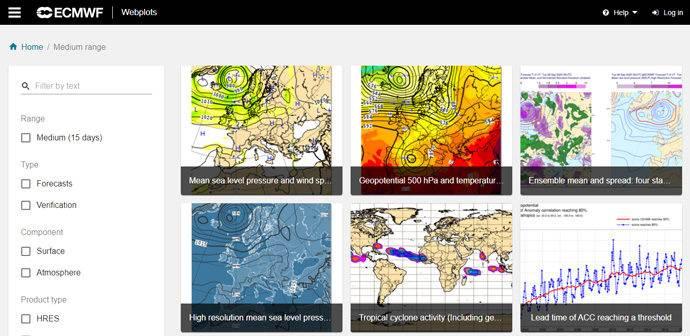 {module INSIDE STORY}
These changes are part of broader developments across Europe to encourage the wider use of public sector data – for the benefit of all.
Rolf Brennerfelt, Chair of ECMWF Policy Advisory Committee, commented: “The ECMWF Member States have been keen for the Centre’s data to be open and free for a while. The societal benefits associated with free and open data are big. We are aware that the move comes with its financial challenges, but the benefits outweigh those challenges. We are in a period of transition, and this first batch of data being made freely available is a very good start and illustrates well our commitment to this principle.”
This phased move towards free and open data aims to support creativity and innovation in the field of scientific research as well as weather applications. Whilst today’s announcement only represents the first step, it has the potential to already increase accountability and transparency, and enable more necessary and critical scientific, social, and economic advances.
The EU Copernicus Earth observation program, several elements of which are implemented by ECMWF, has operated a policy of free, open data since its inception. With many thousands of users, the program offers a host of examples of the benefits that open data can bring.
Adrian Tompkins, a research scientist at the International Centre for Theoretical Physics (ICTP), commented: "ICTP has a long history of working with scientists in both academia and government agencies in developing countries and one issue repeatedly raised is the lack of easy access to leading global forecasting systems and climate information. This move by ECMWF to open their catalog of graphical products, combined with the continued development of the excellent Copernicus climate data store, has the potential to supercharge research efforts in developing countries, particularly in the continent of Africa, where weather and climate information has utmost societal importance."
At the start of the COVID-19 pandemic, a group of Italian epidemiologists used atmospheric pollution data from the EU Copernicus Atmospheric Monitoring Service (CAMS) to investigate links between the level of pollution in a given area, and the rate and seriousness of COVID infection. The open data policy meant that the group was able to quickly and easily access the data they needed. The Copernicus Climate Change Service (C3S) has developed an application that allows health authorities and epidemiology centers to explore whether temperature and humidity affect the spread of the coronavirus.
Climate reanalyses provide a globally complete, consistent picture of the climate system stretching back in time, being derived from a blend of observations and model data. They are one of the most used datasets provided by C3S and represent a cornerstone of the development of climate services across Europe. Reanalyses provide vital information for monitoring how the climate is changing and for understanding impacts across a whole range of sectors such as transport, utilities, finance, and agriculture. Wind, solar radiation, and ocean wave data from reanalyses are being used, for example, to help plan and safeguard renewable energy developments.
Data from all past ECMWF forecasts stretching back to the early 1980s are just some of the billions of fields within ECMWF’s vast MARS data repository. The epitome of the term ‘big data’, MARS offers immense opportunities for machine learning, where a supercomputer uses observations or other data, to ‘learn’ relationships between different variables. If there are sufficient data for training, machine learning can be used to develop numerical tools that can mimic complex systems. In fact, researchers are using machine learning to investigate the development of a ‘digital twin’ of the Earth system. Reanalyses and simulated satellite data from the MARS repository have been key to this work.
MARS data coupled with non-meteorological ‘big data’ offers the potential for almost limitless applications through machine learning - from weather effects on financial markets or consumer behavior to phenomena in the natural world such as bird migration.
As part of its formal agreement with the WMO, ECMWF is designated as a World Meteorological Centre (WMC). The change in policy at ECMWF will mean simplified access to ECMWF forecasts for the national meteorological and hydrological services (NMHSs) of WMO Members. NMHS forecasters rely on WMCs for the information they need to carry out their operational activities and in particular to warn citizens of severe weather events.
These are only a few examples, but they show how much is already being achieved through free and open data, and offer a glimpse of how much more could be possible.
Andy Morse, Professor of Climate Impacts at the University of Liverpool, commented: "The potential uses and benefits these products bring for a range of users and sectors are vast and particularly key in less economically developed countries. Now that remote internet access is widespread through modern mobile phone networks; the availability of this information is likely to be a game-changer for many small enterprises. In my experience, people in these most remote parts of the world are hungry for such information."
Why is ECMWF moving more towards open data?
The EU and ECMWF Member and the Co-operating States are themselves moving towards an open data policy.
In the EU, a Directive on open data and the re-use of public sector information, also known as the 'Open Data Directive'entered into force on 16 July 2019. It focuses on the economic aspects of the re-use of information and it encourages the EU Member States to make as much information available for re-use as possible. The Directive also introduces the concept of high-value datasets (which includes weather data), the re-use of which is associated with particularly important benefits for society and the economy.
 {module INSIDE STORY}
 {module INSIDE STORY}