Spread of mosquito-borne viral diseases linked to climate change

European project of the University of Bayreuth studies the influence of biodiversity

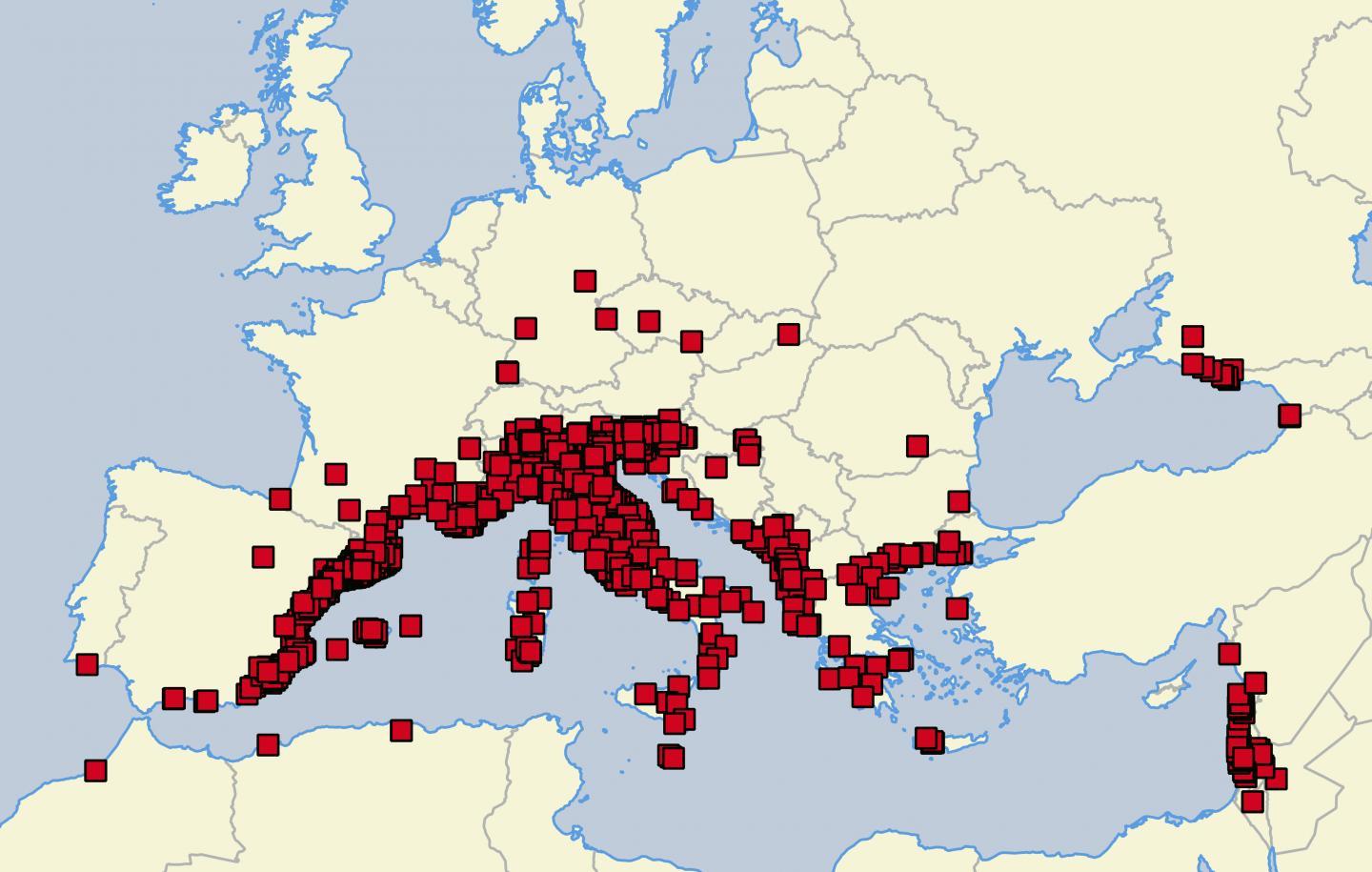
As a result of climate change, mosquito-borne viral diseases are penetrating ever further into Europe. A joint project coordinated by the University of Bayreuth is investigating for the first time how this trend is influenced and even controlled by biological diversity within the respective chains of infection. Consequently, the research work focuses on the biodiversity of viruses, vectors, and infected organisms. The European research network "BiodivERsA" will be funding the project to the tune of almost € 1 million over the next three years. CAPTION Spread of the Asian Tiger Mosquito (Aedes albopictus) in Europe.  CREDIT Graphic: Nils Tjaden.{module INSIDE STORY}
In addition to the University of Bayreuth, four other institutions are involved in the new research project entitled "DiMoC - Diversity components in mosquito-borne diseases in the face of climate change": the Bernhard Nocht Institute for Tropical Medicine in Hamburg, the Institute for Tropical Medicine in Antwerp, the Institute for Development Research in Montpellier, and the National Autonomous University of Mexico. On 6 March 2020, the first meeting of the project partners took place in the Iwalewahaus of the University of Bayreuth.

In public debate, but also in the scientific community itself, the term "biodiversity" is usually applied to the relative wealth of species in the animal and plant world. The ecological and economic benefits of this diversity, which is threatened by climate change, have been clearly proven by scientific research. However, very little is known about the impact of biodiversity, for example in the area of diseases caused by arboviruses. These are viruses that are transmitted in particular by mosquitoes, ticks, fleas, or midges. These vectors, also comprise a large number of species, which may help determine the routes of transmission and the probability of infection.

"So, in our research project, we want to get to the bottom of the question of how chains of infection - from arboviruses to diseased organisms - develop under the influence of biological diversity. In this way, we will gain more precise insights into the causes and pathways by which some of the viral diseases transmitted by mosquitoes spread from the tropics to Europe. On the basis of these research results, well-founded recommendations for action can be developed, for example for health, environmental, and development policy," explains Prof. Dr. Carl Beierkuhnlein, who is the Chair of Biodiversity at the University of Bayreuth and coordinates the DiMoC project.

The aim is to produce a broadly based and scientifically sound report. It will be addressed to all those who can help to prevent or contain infectious diseases transmitted by mosquitoes. These include not least the diseases caused by the West Nile virus and the Chikungunya virus. The vector of the Chikungunya virus is the Asian tiger mosquito, which thanks to international trade has reached southern Europe. In Germany, too, it is finding increasingly favourable living conditions. The planned guide will therefore take into account both current climatic conditions and projections of future climate change.

A central aim of the research project is to develop reliable risk assessments through empirical studies and model calculations. To this end, supercomputer simulations will be used to develop and compare different future scenarios. These calculations will take into account not only the identified impact of biodiversity on chains of infection, but also, for example, that of landscape diversity and prevailing socio-economic conditions. "It is precisely this point that illustrates how important the close interdisciplinary cooperation in our project is. The participating partner institutions contribute very different expertise to the research work - that from medicine, the natural, environmental and geosciences, but also from the social sciences," says Dr. Stephanie Thomas, who coordinates the elite study programme "Global Change Ecology" at the University of Bayreuth and is involved in the DiMoC project from a biogeographic angle.

Supercomputing shows safety zone saves giant moons from fatal plunge

Numerical simulations have shown that the temperature gradient in the disk of gas around a young gas giant planet could play a critical role in the development of a satellite system dominated by a single large moon, similar to Titan around Saturn. Researchers found that dust in the circumplanetary disk can create a "safety zone," which keeps the moon from falling into the planet as the system evolves.

Astronomers believe that many of the moons we see in the Solar System, especially large moons, formed along with the parent planet. In this scenario, moons form from the gas and dust spinning around the still-forming planet. But previous simulations have resulted in either all large moons falling into the planet and being swallowed-up or in multiple large moons remaining. The situation we observe around Saturn, with many small moons but only one large moon, does not fit in either of these models.

Yuri Fujii, a Designated Assistant Professor at Nagoya University, and Masahiro Ogihara, a Project Assistant Professor at the National Astronomical Observatory of Japan (NAOJ), created a new model of circumplanetary disks with a more realistic temperature distribution by considering multiple sources of opacities including dust and ice. Then, they simulated the orbital migration of moons considering pressure from disk gas and the gravity of other satellites. An artist's impression of a satellite forming around a giant gas planet which is itself still forming around a star.{module INSIDE STORY}

Their simulations show that there is a "safety zone" where a moon is pushed away from the planet. In this area, warmer gas inside the orbit pushes the satellite outward and prevents it from falling into the planet. 

"We demonstrated for the first time that a system with only one large moon around a giant planet can form," says Fujii. "This is an important milestone to understand the origin of Titan."

But Ogihara cautions, "It would be difficult to examine whether Titan actually experienced this process. Our scenario could be verified through research of satellites around extrasolar planets. If many single-exomoon systems are found, the formation mechanisms of such systems will become a red-hot issue."

These results were published as Fujii and Ogihara "Formation of single-moon systems around gas giants" in Astronomy and Astrophysics Letters in March 2020. The simulations in this research used the PC cluster operated by NAOJ.

Many Lyme disease cases go unreported; a new model could help change that

Researchers have drawn on 17 years of data to develop a model that identifies areas in which the tick-borne illness is likely to emerge

The Centers for Disease Control and Prevention receives reports of about 30,000 cases of Lyme disease each year. The real number, according to the agency, is closer to 300,000.

Underreporting affects the ability of public health authorities to assess risk, allocate resources and devise prevention strategies. It also makes early detection very difficult, hampering efforts to treat the condition quickly and effectively.

A new report, published on March 3, 2020, in the Journal of the American Medical Association, describes a data model developed by researchers from Columbia University and RTI International, a nonprofit research institute, that helps identify areas of the United States where Lyme disease cases may go unreported. A data model developed by Columbia researchers showed about 162 U.S. counties may have Lyme disease cases not yet been reported to the CDC.{module INSIDE STORY}

"We believe our analysis can help predict the trajectory of where Lyme disease will spread," said Maria Pilar Fernandez, a post-doctoral researcher at Columbia and lead author of the study. "Identifying high-risk areas can lead to surveillance in counties and areas where infections are likely to emerge. It also allows authorities to alert physicians and the public, which can lead to early treatment when it is most effective."

To develop their model, the researchers analyzed publicly available data, tracking the geographic spread of Lyme disease over nearly two decades. They studied an estimated 500,000 cases of the illness reported to CDC from different counties across the United States between 2000 and 2017.

Lyme disease is difficult to diagnose, and accurate case assessment depends on many variables, the researchers said, from provider awareness and testing methods to reporting practices, state budgets, and personnel.

"We were able to show that about 162 U.S. counties may already have Lyme disease, but they have not yet been reported to the CDC," said Maria Diuk-Wasser, associate professor in the Department of Ecology, Evolution and Environmental Biology at Columbia and a co-author on the study.

The CDC collects Lyme disease data from state and local health departments, which base the number of cases on notifications from clinicians, hospitals and laboratories.

Lyme disease is difficult to diagnose, and accurate case assessment depends on many variables, the researchers said, from provider awareness and testing methods to reporting practices, state budgets, and personnel.

Although Lyme disease has been diagnosed in almost every state, most cases reported to the CDC are in the Northeast and upper Midwest.

If diagnosed early--a rash commonly appears around the site of the tick bite--the condition can be effectively treated with antibiotics. Longer-term infections can produce more serious symptoms, including joint stiffness, brain inflammation, and nerve pain.

Models have been created in the past to identify high-risk areas in a few states or regions in the United States, but the new one expands the geographic scope to all areas in the U.S. where the disease is most likely to occur.

"In the future, the model can be expanded," Fernandez said. "We hope to continue to keep track of the spread and inform authorities about areas where Lyme disease is likely to emerge."