

USask researchers use sophisticated supercomputer modeling technology to reconstruct volcanic eruptions to predict climate risks

University of Saskatchewan (USask) researcher Dr. Matthew Toohey (Ph.D.) and University of Bern researcher Dr. Michael Sigl (Ph.D.) were part of the research team that developed an updated, more accurate reconstruction of volcanic eruptions that can help scientists understand future climate risks. Satellite image (Copernicus Sentinel-2) of the Aniakchak Caldera on the Alaska Peninsula, one out of over 850 eruptions reconstructed to understand their lasting impacts on climate. (Credit: Copernicus Sentinel data 2021, created by Helga Weber, University of Bern)
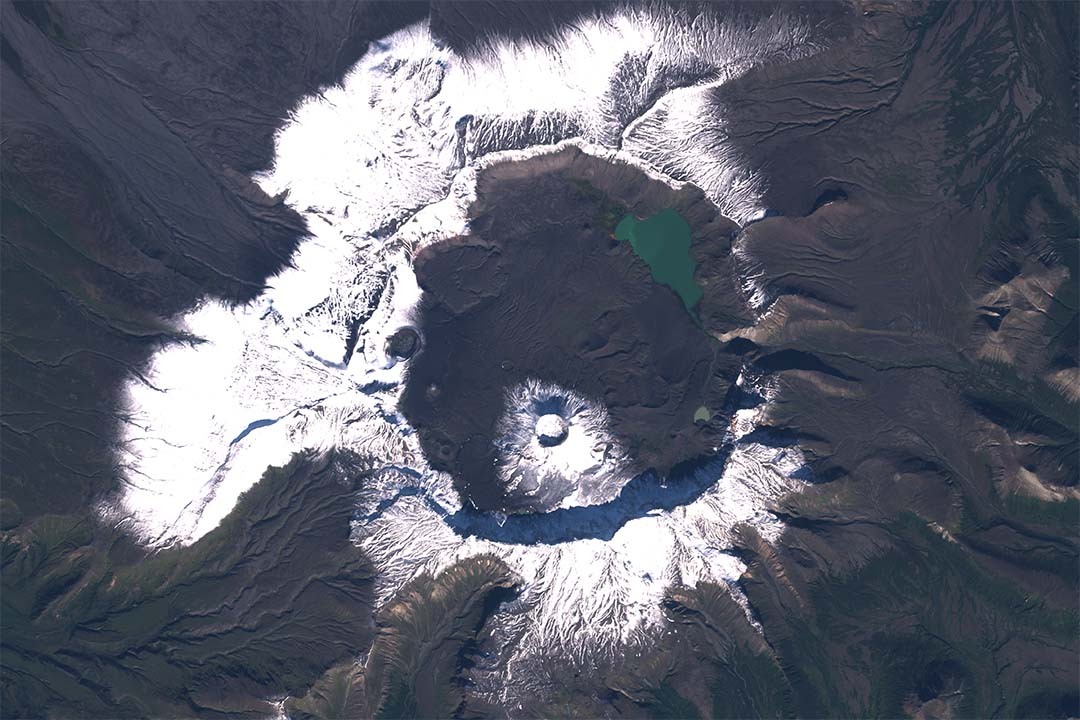
When volcanoes erupt, they release much more than an impressive, photogenic spray of lava into the air. Gases such as sulfur and carbon released from volcanoes into the atmosphere can impact the global climate. An international research team has used modern technologies to better understand historical volcanic eruptions and how they have contributed to climate alterations and radiation transmission in the atmosphere.

Determining how volcanic eruptions have contributed to climate change over time has traditionally relied on geochemical records extracted from the polar ice sheet of Greenland, and because of its coarse resolution and limited scope, this data can be inconsistent or inaccurate. This work was able to improve understanding of volcanic activity by synchronizing ice core records from Greenland with new, high-resolution records from Antarctica. The resulting record spans the past 11,500 years, a period of relatively warm and stable climate called the Holocene which began after the last ice age.

“This new data set will allow scientists to address the fundamental questions of climate science, including how sensitive the climate system is to external forcing agents like volcanoes,” said Toohey, an assistant professor of physics and engineering physics at USask’s College of Arts and Science and a member of USask’s Institute of Space and Atmospheric Studies. “Understanding of past climate changes and their sources helps to improve climate models and projections of future climate change.”

The researchers used sophisticated supercomputer modeling technology to reconstruct a series of volcanic eruptions from the past 11,500 years. The work included estimating – for the first time – the precise ages and amounts of atmospheric sulfur injections for over 850 historical volcanic eruptions by measuring the contents of sulfur in ice cores.

“A total of 26 eruptions during the past 11,500 years released more sulfur into the stratosphere than the colossal eruption of Tambora in 1815, suggesting eruptions of this size occur more than twice as often globally as previously thought,” said Sigl, who led the research project.

Sigl also said the research found a link between melting glaciers and an increase in volcanic activity – a finding that helps scientists predict the potential impacts on the climate from continued global warming. Results were recently published in the journal Earth System Science Data.

Toohey was responsible for taking estimates of the amount of sulfate present in ice and estimating how stratospheric aerosols from past eruptions have impacted the transmission of radiation through the atmosphere. The tools developed by Toohey and his group will allow ice core information to be used in climate model simulations of the Holocene, as well as provide rapid estimates of the impact of potential future eruptions.

“This work greatly improves our ability to estimate the probability of large, climate-relevant eruptions in the future, and their radiative impact, providing a valuable resource for climate risk assessment,” said Toohey.

Nevada's Ren, Hanan build models predicting future wildfire frequency, size, intensity

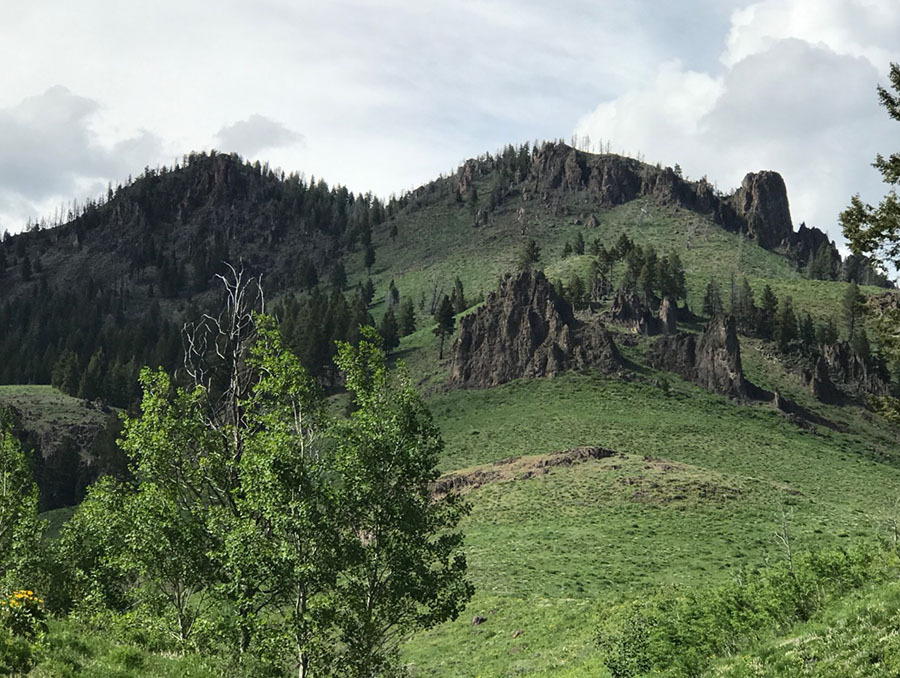
Researchers attempting to help predict how the wildfire hazard will change due to various factors over the next several decades have some good news, and some bad news. The good news is, that wildfire occurrence and intensity will likely decrease in several locations in the future. The bad news: decreases may not occur for another 50 years, and wildfire hazard will likely get worse before it gets better. A photo taken of the Big Wood River Basin adjacent to the study site. Photo by Erin Hanan.

“There are so many factors that we need to consider and better understand if we want to predict how the frequency, size, and intensity of wildfires will change over time,” said Erin Hanan, a University of Nevada, Reno researcher with the University’s Experiment Station and an assistant professor in the College of Agriculture, Biotechnology & Natural Resources. “Our two studies looked at how changes in temperature, rainfall, and atmospheric carbon dioxide may interact with and influence plant growth, turnover, and decomposition, and how those processes, in turn, affect fuel loading and fuel moisture in different plant communities, which are two key factors driving wildfire regimes in the West.”

Making the case for more detailed research needed on plant decomposition

Hanan is the coauthor of the two related journal articles about the research. She is the lead author of the first article, in the Journal of Advances in Modeling Earth Systems, that focuses on how plants may decompose, or break down (think composting), under different climate scenarios, thus affecting the fuel load or amount of litter on the ground that can burn.

“Many of the decomposition algorithms in models that have come from small experiments and specific locations just aren’t going to be accurate all the time,” Hanan said. “Accumulation of fine fuels and the rate at which those fuels or plant parts break down is highly sensitive to several factors, such as temperature and rainfall. That’s what this research verified. So, unless we get better at estimating fuel load, or accumulation, and decomposition of fine fuels under different climate scenarios, it is going to be very difficult to build accurate models predicting future wildfire regimes.”

A case study for semi-arid watersheds in central Idaho leads to the good news-bad news forecast


Armed with this information, Jianning Ren, a postdoctoral scholar in Hanan’s lab group, set out to examine different future climate scenarios for semi-arid watersheds that more accurately account for the various ways that higher temperatures, changes in moisture, and increasing atmospheric CO2 can influence fuel load, fuel moisture, and wildfire regimes. 

Ren, Hanan, and other researchers integrated climate data from complex General Circulation Models, with data from a representative semi-arid watershed in central Idaho, Trail Creek, which is characterized by cold, wet winters and warm, dry summers. Elevations in the watershed range from 1,760 to 3,478 meters, creating several different plant communities – grasses, shrubs, forests, mixed vegetation, and areas with little vegetation at all.

The article detailing the research, published in Earth’s Future for which Ren is the lead author, contains various detailed graphs modeling probable fire regime outcomes for various plant communities. Outcomes were highly influenced by these observations:

  • increased plant growth, or fuel loading, resulting from increased atmospheric carbon dioxide (Plants take in carbon dioxide and convert it to energy for growth.)
  • decreased plant growth, or fuel loading, due to climatic warming (Plants struggle to grow when the environment becomes too arid.)
  • increased plant decomposition rates, which decrease fuel loading, also due to climatic warming (plant materials break down more quickly with heat)
  • dryer fuels, or plants, due to increased temperatures

“We found that these effects can sometimes work together to create a synergistic effect, or they can counteract each other, based on different scenarios,” Ren said. “In a nutshell, our models project:

  • In the 2040s, elevated CO2 promotes a net increase in plant growth despite possible decreases that can occur with warming and associated drought, so the result is increased fuel load, and increased fire hazard.
  • Using the data for the 2070s, climatic warming and drying becomes so intense that it outstrips the increased CO2 levels, in effect shutting down CO2’s ability to increase plant growth. So, burn area and probability decrease in the models for the 2070s. And, although there is an increase in fire weather for that period, decreases in fuel loading— caused by increases in decomposition and decreases in plant productivity—ultimately reduce wildfire for this period.” While decreasing wildfire hazard is potentially good news, this decrease results from ecological and hydrological degradation,” Hanan said.

Ren and Hanan noted that within each of the major plant communities – grasslands, shrubs, forests – results were quite consistent, adding validity to the findings.

“Across the grasslands we modeled, the change in warming didn’t matter nearly as much as the fuel loading,” Ren said. “It was pretty much entirely dependent on fuel loading, which makes sense. The grasslands in this area will always die and dry out. That’s their cycle. For the grasslands, it’s all about how much fuel you have to burn.”

Conversely, Ren noted that changes in fuel aridity and fuel loading both heavily influenced the wildfire predictions for areas dominated by shrubs and areas dominated by trees. But, both Hanan and Ren stressed that much more research is needed to make the models even more reliable.

“This is really just a start,” Hanan said. “And, the further out the predictions get, the less reliable they become, naturally. We are hoping to do more research on decomposition and to expand the research we did up at Trail Creek to other watersheds, improve the models, and scale them over larger areas. What we really hope is that all this stimulates more integrated research and modeling, and gets people talking. For a long time, the fire community and the biogeochemistry community weren’t necessarily talking. I think that’s starting to change. We’re seeing that it’s really important to think about, talk about, and quantify all these different factors as multidisciplinary teams.”

Russian researchers develop a new method for analyzing genetic admixture of populations

Researchers of the National Research University Higher School of Economics at the HSE International Laboratory of Statistical and Computational Genomics in Moscow, Russia together with their international colleagues have proposed a new statistical method for analyzing population admixture that makes it possible to determine the time and number of migration waves more accurately. The history of Colombians and Mexicans (descendants of Native Americans, Spaniards, and Africans) features two episodes of admixture that occurred about 350 and 200 years ago for Mexicans and 400 and 100 years ago for Colombians. The results were published in the Plos Genetics journal. © iStock

When Francis Crick and James Watson deciphered the structure of DNA in 1953, they declared that they had found the secret of life. Indeed, all life on Earth is reproduced by constant cell division and copying of its genetic material. DNA is passed down from generation to generation, and the human genome is a mosaic of genetic fragments of our ancestors from different times. To understand the origins of the genetic diversity of modern humans, it is necessary to study the history of populations: where our ancestors lived, when and where they migrated, and when and how they mixed.

The history of population admixture can be uncovered by analyzing the connections between human genetic variants. Our genome has genetic material from our father and mother; then we pass on new combinations of genetic variants, a mosaic made up of the genomes of our parents, to our descendants. This phenomenon is called recombination.

For example, a Spanish mother and a Native American father will have a child with one Spanish and one American set of chromosomes. Their child in turn will pass on a set of chromosomes that includes a combination of sections of Spanish and American origin to their descendants (the second set of chromosomes will be inherited from the other parent). The origin of these sections can be determined by the sequences of genetic variants typical for a particular population. In each new generation, recombination will mix sections of different origins more and more, breaking up these typical genetic sequences. Over time, they disintegrate, finally mixing.

Thus, by calculating the correlation between genetic variants on different parts of chromosomes and analyzing the strength of their connections, we can say how many generations ago population admixture occurred.

Earlier methods of analyzing the genetic admixture of populations were capable of estimating the time of the last admixture event. The algorithm was based on the analysis of the connection strength between pairs of genetic variants. Researchers from the HSE International Laboratory of Statistical and Computational Genomics and their international colleagues proposed analyzing triple variants. This statistical method makes it possible to model more complex scenarios of population admixture, for example, to identify two episodes of admixture and determine how many generations ago they occurred.

"Let's imagine that ships with European settlers land on the shores of America for the first time. Europeans start exploring new territories and mixing with the indigenous population of America. However, after a few generations, more ships with Europeans arrive in America. Our method allows us to see that there were two waves of resettlement, two episodes of admixture in different time periods," explains Mikhail Shishkin, co-author of the article, research assistant of the laboratory, and MIEM student.

As an example, the paper’s authors analyzed genetic samples of the population of Colombians and Mexicans from the genetic database of 1000 Genomes. Both populations appeared as a result of the admixture of Native Americans, Spaniards, and Africans. The results showed that the history of both populations featured two waves of admixture, which occurred 13 and 8 generations (350 and 200 years) ago for Mexicans and 15 and 4 generations (400 and 100 years) ago for Colombians.